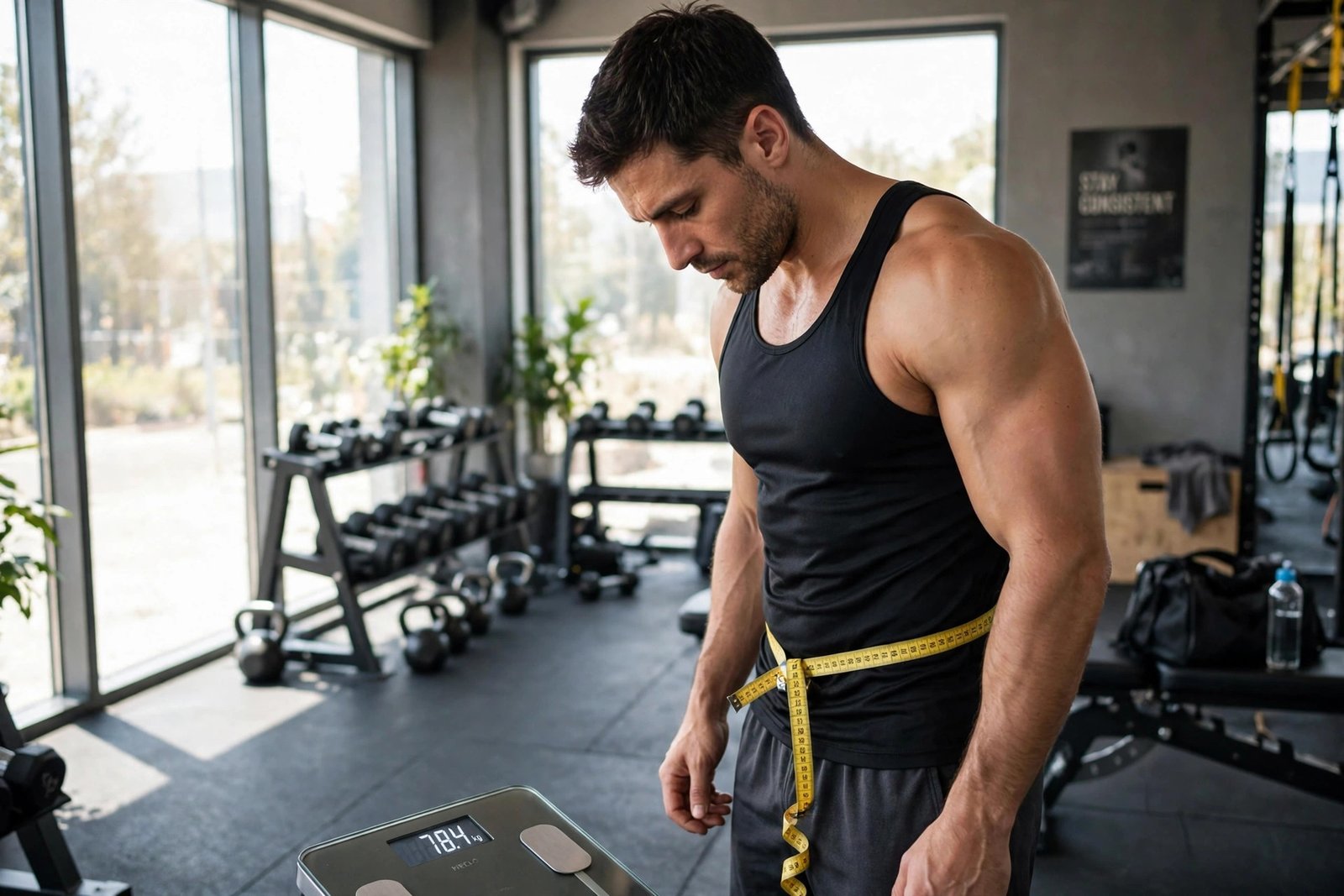
In short: Is BMI accurate for muscular people? No, not on its own. BMI only uses height and weight, so it cannot tell muscle from fat, and a lean lifter can score as overweight or even obese. A 180 cm man who weighs 95 kg of mostly muscle has a BMI of 29.3, one point short of obese, with about 13% body fat. Measure body fat percentage and waist-to-height ratio instead.
- BMI is weight in kilograms divided by height in metres squared. It has no input for muscle, so two people with the same height and weight get the same score, even if one is a lifter and the other is sedentary.
- The biggest direct test, Romero-Corral and colleagues in 2008, compared BMI with measured body fat in 13,601 adults. A BMI of 30 or higher found only 36% of the men and 49% of the women who were obese by body fat.
- Muscle is denser than fat, about 1.06 g per ml against about 0.9 g per ml, so a muscular body weighs more at the same size, and that extra weight pushes BMI up without adding any fat.
- Body fat percentage is the better number for a lifter. The American Council on Exercise puts the athlete range at 6-13% for men and 14-20% for women, and our body fat percentage calculator estimates it from a tape measure in under a minute.
- Waist-to-height ratio is the second number worth tracking. Keep your waist under half your height, a ratio below 0.5: a 2012 meta-analysis of 31 studies found it predicted cardiometabolic risk better than BMI.
Introduction
Walk into any gym and you will hear the same complaint. A lifter who trains four days a week, eats carefully, and can see their abs works out their BMI and gets told they are overweight. Sometimes the number says obese. The lifter knows the number is wrong, but it is printed on a medical form, so it feels official.
The lifter is right. BMI was published in 1832 by Adolphe Quetelet to describe populations, not patients. It takes two inputs, height and weight, and it has no way to know what the weight is made of. This post shows how wrong it is for muscular people, what the largest study found, and the two measurements that do the job BMI cannot.
What BMI Actually Measures
BMI is weight in kilograms divided by height in metres squared. That is the whole formula. There is no input for age, sex, muscle mass, bone density, or where the fat sits. The categories are fixed: under 18.5 underweight, 18.5 to 24.9 healthy, 25 to 29.9 overweight, and 30 or above obese.
For a sedentary adult in the middle of the range, BMI works well enough as a rough screen. It correlates with body fat at about r = 0.7 across the general population, which is why doctors and insurers still use it. The problem starts at the edges, and muscular people are one of the edges. The US Centers for Disease Control and Prevention calls BMI a screening tool, not a diagnosis, and the American Medical Association said in June 2023 that it should not be used alone. For a muscular person, the answer is no, and the numbers below show how badly it fails.
The Worked Example: One Lifter, Two Stories
Take a man who is 180 cm tall and weighs 95 kg. He trains with weights four days a week, his waist is 85 cm, and his neck is 42 cm. His BMI is 95 divided by 1.8 squared, which comes to 29.3: overweight on the chart, one point short of obese.
Now run the same man through the US Navy body fat formula, which uses waist, neck, and height. His waist minus neck is 43 cm, and his height is 180 cm. The calculation gives 12.89%, so about 13% body fat.
On the American Council on Exercise chart, 13% body fat puts a man at the top of the athlete range, which is 6-13%. BMI calls the same man almost obese. The two numbers disagree completely, because BMI looked at his weight and the Navy formula looked at his shape.
Our body fat percentage calculator runs this exact Navy formula, and our BMI calculator runs the BMI formula. Run both with your own numbers and compare them: if you lift, the gap between the two is the story of this post.
What the Biggest Study Found
The cleanest test of BMI against real body composition was published in 2008 by Romero-Corral and colleagues in the International Journal of Obesity. The team analysed 13,601 adults from the Third National Health and Nutrition Examination Survey, comparing BMI against body fat percentage measured by bioelectrical impedance, with obesity defined as over 25% body fat in men and over 35% in women.
The results are stark. Using a BMI of 30 or higher to identify obesity, the test found only 36% of the men and 49% of the women who were actually obese by body fat. In plain terms, BMI missed roughly half of the people carrying excess fat. Specificity was high, 95% in men and 99% in women, which means that when BMI did call someone obese, it was almost always right. The failure is in the other direction: a BMI under 30 does not mean you are clear.
Two findings matter most for lifters. First, in men, BMI correlated better with lean mass than with body fat percentage: a high BMI is often a high muscle reading, not a high fat reading. Second, in the intermediate range of 25 to 29.9, where most lifters land, BMI failed to discriminate between body fat percentage and lean mass in both sexes. That is exactly where our worked example sits at 29.3.
BMI-defined obesity was present in only 19.1% of men and 24.7% of women, while body fat defined obesity was present in 43.9% of men and 52.3% of women. BMI undercounts obesity in the general population by about half, and it overcounts it in muscular people. It is wrong in both directions, for opposite reasons.
Why Muscle Breaks the Formula
Muscle is denser than fat. A millilitre of muscle weighs about 1.06 g, while a millilitre of fat weighs about 0.9 g, a difference of roughly 18%. Two people with the same body volume can therefore differ by 18% in weight and BMI, with no extra fat at all.
Put numbers on it. A sedentary man at 180 cm and 80 kg has a BMI of 24.7, in the healthy range. Give him five years of serious lifting, and he might gain 15 kg of muscle while losing fat, arriving at 95 kg with a smaller waist. His BMI is now 29.3, overweight, borderline obese. His health improved and his BMI got worse, because BMI reads muscle gain as fat gain.
This is not a rare edge case. Rugby players, rowers, wrestlers, and anyone who lifts seriously will run into it. The formula was built from population averages, and a population average does not lift weights.
Body fat percentage does not have this problem, because it measures composition directly. Neither does waist-to-height ratio, because the waist tracks fat around the organs, and muscle does not sit on the waist.
Same BMI, Different Bodies
Every person in this table has a BMI between 29 and 32, which the chart reads as overweight or obese. Their bodies are nothing alike.
| Person | Height | Weight | BMI | What is really going on |
|---|---|---|---|---|
| Lifter, trains 4 days a week | 180 cm | 95 kg | 29.3 | About 13% body fat, athlete range, waist 85 cm |
| Office worker, no exercise | 180 cm | 95 kg | 29.3 | About 28% body fat, waist 102 cm, mostly fat |
| Sedentary adult, large waist | 178 cm | 100 kg | 31.6 | Obese by both BMI and body fat, waist over 110 cm |
The first two rows are the point of this post. Same height, same weight, same BMI. One is an athlete and the other carries excess fat, and BMI gives them the identical score. That is not a measurement. It is a guess that happens to use a formula.
Our BMI vs body fat percentage guide works through this comparison in more detail, with more worked examples and the healthy body fat ranges by age and sex.
What to Measure Instead
For a muscular person, two numbers do the job BMI cannot: body fat percentage and waist-to-height ratio.
Body fat percentage. This is the share of your weight that is fat. The American Council on Exercise publishes the most widely used categories, and the table below is their chart.
| Category | Men | Women |
|---|---|---|
| Essential fat | 2-5% | 10-13% |
| Athletes | 6-13% | 14-20% |
| Fitness | 14-17% | 21-24% |
| Average | 18-24% | 25-31% |
| Obese | 25% and above | 32% and above |
Essential fat is the minimum your body needs to function, not a target. Most lifters who look lean sit in the athlete or fitness range. If your body fat percentage is in the athlete or fitness range, your BMI does not matter, whatever it says. If it is in the obese range, your BMI is not the problem, your body fat is.
Waist-to-height ratio. Divide your waist circumference by your height, using the same units, and keep the result under 0.5, which means your waist is less than half your height. For our 180 cm lifter, that means a waist under 90 cm. His waist is 85 cm, so his ratio is 0.47. A 2012 meta-analysis by Ashwell and colleagues, pooling 31 studies in Obesity Reviews, found waist-to-height ratio predicted cardiometabolic risk better than BMI.
Waist-to-height ratio is the better health screen, because fat around the middle is most closely tied to diabetes and heart disease. Body fat percentage is the better progress tracker, because it moves when you gain muscle or lose fat. Track both, and BMI becomes a curiosity rather than a verdict.
How to Check Your Body Fat at Home
You do not need a lab. Four methods are available, in order of usefulness for a lifter.
The Navy tape method. Measure your waist at the navel and your neck just below the Adam’s apple, then enter the numbers with your height into our body fat percentage calculator. It uses the US Navy formula, the same one worked through above. It is accurate to within about 3 to 4 percentage points for most people, which is good enough to know which ACE category you sit in. Measure in the morning, before eating, with the tape snug but not tight, and measure the same way every time.
DEXA scan. Dual energy X-ray absorptiometry is the reference standard. It gives you fat mass, lean mass, and bone density, split by body region. It costs money and needs a clinic or a gym that offers it, but one scan a year gives you a ground truth to check the tape method against. Smart scales, which use bioelectrical impedance through your feet, are the least accurate option: use one only to track the trend over weeks, never to trust a single reading.
The Bottom Line
Is BMI accurate for muscular people? No. It was built for populations, it only sees height and weight, and muscle is denser than fat, so lifters score high without carrying excess fat. The largest direct test found that a BMI of 30 missed about half the people who were obese by body fat.
The fix is simple. Keep BMI as a rough screen, and make your real decisions from body fat percentage and waist-to-height ratio. Run your numbers through our BMI calculator and our body fat percentage calculator, and if the two disagree, trust the body fat number. If your BMI says overweight but your body fat is in the athlete range and your waist is under half your height, the BMI is wrong about you: show your doctor the other two numbers.
Frequently Asked Questions
Is BMI accurate for muscular people?
No, not on its own. BMI only uses height and weight, so it cannot tell muscle from fat. A lean 180 cm lifter at 95 kg scores a BMI of 29.3, borderline obese, with about 13% body fat. Body fat percentage and waist-to-height ratio are the better measures for anyone who lifts weights.
What BMI is considered obese for a bodybuilder?
The chart is the same for everyone: a BMI of 30 or above is labelled obese, and 25 to 29.9 is labelled overweight. The labels do not change for a bodybuilder, which is the problem. Many competitive bodybuilders score above 30 while carrying 10% body fat or less, so the label should be checked against a body fat measurement.
What should a muscular person use instead of BMI?
Body fat percentage first, and waist-to-height ratio second. Body fat percentage tells you what your weight is made of: the ACE athlete range is 6-13% for men and 14-20% for women. Waist-to-height ratio tells you where the fat sits: keep your waist under half your height.
Can you be overweight by BMI and still be healthy?
Yes, if the extra weight is muscle. A lifter with a BMI of 27 and 14% body fat is in a different health position from a sedentary person with the same BMI and 28% body fat. Health depends on body composition, waist size, blood pressure, blood sugar, and fitness, not on BMI alone.
Does BMI underestimate body fat in some people?
Yes. The Romero-Corral study of 13,601 adults found that a BMI of 30 or higher found only 36% of the men and 49% of the women who were obese by body fat. BMI misses about half of the people carrying excess fat, while it overstates fat in muscular people. It is wrong in both directions.
—
Sources
- Romero-Corral A, Somers VK, Sierra-Johnson J, et al. “Accuracy of body mass index in diagnosing obesity in the adult general population.” International Journal of Obesity. 2008;32(6):959-966. https://doi.org/10.1038/ijo.2008.11
- Ashwell M, Gunn P, Gibson S. “Waist-to-height ratio is a better screening tool than waist circumference and BMI for adult cardiometabolic risk factors: systematic review and meta-analysis.” Obesity Reviews. 2012;13(3):275-286. https://doi.org/10.1111/j.1467-789X.2011.00952.x
- American Council on Exercise. Body fat percentage categories: essential fat, athletes, fitness, average, obese. Widely cited ACE reference ranges.
- American Medical Association. Policy on body mass index as a measure, June 2023: BMI should not be used alone to assess health.
- Rubino F, et al. “Definition and diagnostic criteria of clinical obesity.” The Lancet Diabetes and Endocrinology. 2025;13(3):221-262.
- Weight Insider. BMI calculator and body fat percentage calculator. The worked examples in this post were computed with the same formulas these calculators use, and verified by recomputation.
Medical Disclaimer
This article is general information only. It is not medical advice, and it is not a substitute for advice from a qualified health professional. Body fat percentages from tape-measure formulas are estimates, not diagnoses. Talk to your doctor before starting a training or weight change programme, especially if you have a medical condition or take medication.