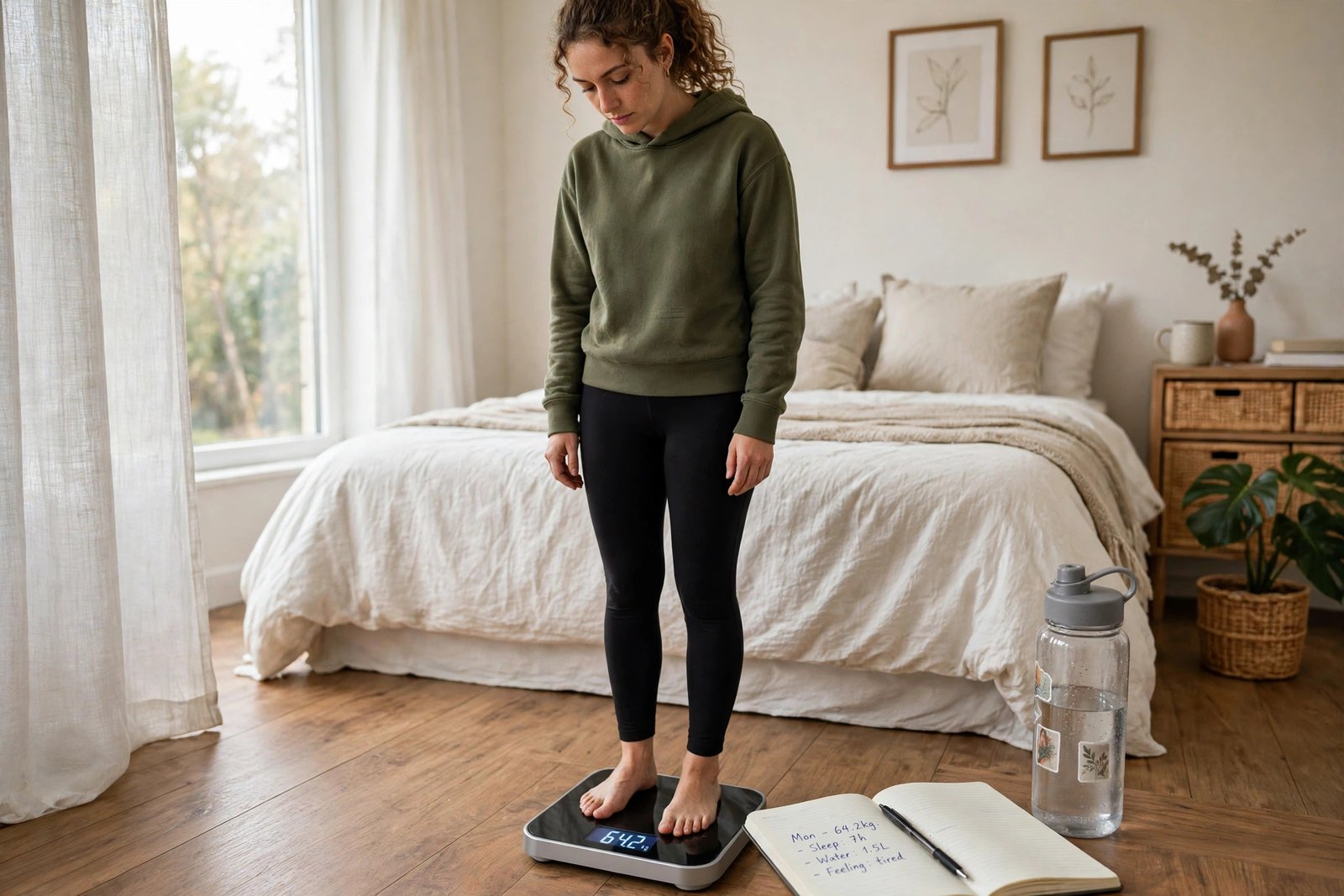
In short: Ozempic plateau how to break it comes down to four things: your smaller body burns fewer calories, so recalculate your TDEE; protect muscle with protein and strength training; check your tracking honestly; and talk to your prescriber before changing anything about your dose. A plateau is normal: in the STEP 5 trial, weight loss levelled off after about week 60.
- A plateau means no change on the scale or the tape measure for four weeks or more, while you are still following your plan. A week or two of no movement is normal noise.
- The main reason is maths, not failure. A 45 year old woman at 165 cm burns about 1,971 calories a day sedentary at 95 kg, and about 1,804 at 80 kg, so a target that worked at 95 kg can become maintenance at 80 kg.
- About 39% of the weight lost on semaglutide in the STEP 1 body composition substudy was lean mass, not fat. Protein at 1.2 to 1.6 g per kg a day, plus strength training two to three times a week, is the best defence: a trial that added exercise cut the lean share of weight loss roughly in half.
- Do not stop the drug suddenly to force a restart. In the STEP 1 extension, people who stopped semaglutide regained about two thirds of their lost weight within a year.
- Work through the four steps in this post in order, give each one two weeks, and measure your waist as well as your weight. If nothing moves after a month, take your numbers to your prescriber.
Introduction
The first months on Ozempic feel straightforward: the appetite quiets down, portions shrink without a fight, and the scale moves most weeks. Then it stops. Four weeks pass, then six, and the number does not move, though you are eating the same way and taking the same dose. It feels like the drug has stopped working.
It almost certainly has not. A plateau is what weight loss looks like when the maths catches up with you: your body is smaller, so it burns fewer calories, some of the weight you lost was muscle, and the habits that felt effortless at the start have drifted a little. None of that means you failed. It means the plan needs updating for the body you have now. This post explains why plateaus happen, what the trial evidence shows, and the four steps that break one.
Why Plateaus Happen on Ozempic
There are four reasons, and they usually arrive together.
Reason 1: a smaller body burns fewer calories. This is the biggest one. Every kilo you lose lowers the energy your body needs. A 45 year old woman at 165 cm who is sedentary burns about 1,971 calories a day at 95 kg, and about 1,804 at 80 kg: 167 fewer calories a day for the same life, or 215 if she is moderately active. A target that gave a 500 calorie deficit at 95 kg gives a much smaller one at 80 kg, or none at all.
Reason 2: metabolic adaptation. Beyond the size effect, the body defends its weight. When you eat less for months, you fidget less, your body temperature drops a fraction, and movement costs less energy. Researchers call this adaptive thermogenesis, usually worth 50 to 100 calories a day. It is not a broken metabolism.
Reason 3: muscle loss. In the STEP 1 body composition substudy, about 39% of the weight lost on semaglutide was lean mass, and about 61% was fat. Reviews pooling the GLP-1 trials put the fat-free mass share at 30 to 40%. Lean mass includes water, bone, and organ tissue as well as muscle, so the true muscle share is lower, but some of what you lost was tissue that burns calories.
Reason 4: tracking drift. Portions creep up: a tablespoon of oil becomes a generous pour, a snack that used to be a handful becomes two. Restaurant meals, takeaways, and weekends are the usual leak. It is worth 100 to 200 calories a day in most people. None of it is cheating: it is what happens when a behaviour becomes automatic.
What the Trial Evidence Shows
The STEP 1 trial is the best evidence we have. In 1,961 adults with overweight or obesity, semaglutide 2.4 mg once a week plus a lifestyle programme produced an average weight loss of 14.9% over 68 weeks, against 2.4% on placebo, and 50.5% of participants lost at least 15% of their body weight. But the curve did not fall forever. In STEP 5, weight loss levelled off after about week 60 and held at 15.2% below baseline at week 104. Most of the loss happens in the first year, then it slows and holds, so a plateau around 12 to 18 months is the expected pattern, not a sign that something has gone wrong.
One more finding matters. In the STEP 1 extension, 327 people were followed for a year after stopping semaglutide. On average they regained about two thirds of the weight they had lost, and their blood pressure, blood sugar, and cholesterol improvements drifted back. Stopping suddenly to shock the scale into moving is the worst response to a plateau.
Worked Example: Your Old Target Is Now Maintenance
Here is the maths for a 45 year old woman, 165 cm tall, using the same Harris-Benedict Revised equation our TDEE calculator uses. At 95 kg, her BMR is 1,642, her sedentary TDEE is 1,971, and her moderately active TDEE is 2,546. At 80 kg, her BMR is 1,504, her sedentary TDEE is 1,804, and her moderately active TDEE is 2,331: a fall of 167 calories a day sedentary, or 215 moderately active.
Suppose she started at 95 kg, sedentary, eating 1,471 calories a day, her TDEE minus 500, and lost steadily. Now, at 80 kg, her TDEE is 1,804, so the same 1,471 calories is only a 333 calorie deficit, and the loss slows, then stops. Her new loss target at 80 kg sedentary is 1,304 calories a day. The alternative is to move more: at moderately active, her new loss target is 1,831 calories a day, more food for the same rate of loss. Run your own numbers through our TDEE calculator and our calories calculator: if your current target is within 100 calories of your new TDEE, you have found your plateau.
Step 1: Recalculate Your TDEE at Your New Weight
This is the step most people skip, and the step that fixes most plateaus. Go to the TDEE calculator, enter your current weight, your height, your age, and your activity level, and take the new number. Then subtract 500 for your loss target, and do not go below 1,200 calories a day without talking to your doctor. Recalculate every time you lose about 5 kg, or once a month: a target is a number for the body you have today.
Be honest about activity: sedentary means a desk job and under about 5,000 steps a day, lightly active means light exercise one to three days a week, and moderately active means exercise three to five days a week. Most people overestimate by one level. When in doubt, pick the lower level.
Step 2: Audit Your Tracking Honestly
For two weeks, track everything you eat and drink, with a kitchen scale for the first week, to find the leak. The usual suspects are cooking oil, sauces, drinks with calories, snacks eaten standing up, and weekend meals. A tablespoon of olive oil is about 120 calories, and a generous pour is easily two: not small numbers when your deficit is only 300 calories.
Also check your protein. At 80 kg, the site’s protein intake calculator gives 96 to 128 g a day at 1.2 to 1.6 g per kg. Most people on a reduced appetite eat far less protein than they think, because protein is the most filling food and the first thing skipped when appetite is low. Low protein means more muscle loss and a lower burn, so if you are under 90 g a day at 80 kg, that is the first fix. If your tracking shows you are eating at or above your new TDEE, you have found the plateau.
Step 3: Protect Muscle With Protein and Strength Training
Muscle is the engine that burns calories, and it is the tissue most at risk on a GLP-1: the STEP 1 substudy found about 39% of weight lost was lean mass. That is a reason to train, not to stop treatment.
Strength training two to three times a week is the single most effective counter. In the S-LiTE trial, adding structured exercise to a GLP-1 cut the lean share of weight loss roughly in half. You do not need a complicated programme: squats, hinges, pushes, pulls, and carries, two to three sets of each, twice a week, with weights that feel hard by the last two repetitions. If you have never lifted, start with bodyweight or a resistance band.
Protein is the other half. Aim for 1.2 to 1.6 g per kg of body weight a day, which for an 80 kg person is 96 to 128 g. Spread it across the day, with 25 to 40 g at each meal. Eggs, Greek yoghurt, chicken, fish, lentils, and tofu all count. Our guide to keeping muscle on GLP-1 works through the targets and a starter strength plan in detail.
Step 4: Move More Without Eating More
Formal exercise is only part of daily burn. The rest is NEAT, non-exercise activity thermogenesis: walking, standing, fidgeting, housework, taking the stairs. When you eat less, NEAT drops without you noticing, and that can be worth 100 to 200 calories a day. Aim for 8,000 to 10,000 steps a day, adding 1,000 a week, and stand for part of your working day. Sleep matters too: in a 2022 randomised trial, adults who slept about 1.2 hours longer a night ate about 270 fewer calories a day, with no diet advice at all.
Step 5: What to Discuss With Your Prescriber
Some plateau questions belong to your prescriber, not to a blog post, because the answers depend on your medical history. Ask about your dose and timing, and whether you are on the right dose for your stage of treatment. Ask about adherence: missed or delayed doses are common and worth mentioning honestly. Ask about other medicines, including certain diabetes medicines, antidepressants, and steroids, which can slow weight loss. Ask about medical causes: an underactive thyroid, low iron, and sleep apnoea can all stall progress.
Do not change your dose yourself, do not split doses, and do not add another weight loss product on top. Semaglutide has a half-life of about one week, so dose changes take weeks to show their full effect. Bring your numbers: your weight log, waist measurements, food diary, and new TDEE. A prescriber with data can help you far faster than one with a shrug.
The 4-Week Reset Plan
Week 1: recalculate and track. Get your new TDEE, set your new target, and track everything with a kitchen scale. Find the leak.
Week 2: fix protein and add strength. Hit 1.2 to 1.6 g of protein per kg a day, and start two strength sessions a week. Measure your waist as well as your weight.
Week 3: add movement and sleep. Add 2,000 steps a day and get to bed 30 minutes earlier. Keep tracking.
Week 4: review and escalate. If the scale and the waist have moved, keep going with the new numbers. If nothing has moved after four honest weeks, take your log to your prescriber. Most plateaus break in week 2 or 3, when the recalculated target and the extra movement take effect. If yours does not, that is information, not failure.
Frequently Asked Questions
Ozempic plateau how to break it?
Recalculate your TDEE at your new weight: a 45 year old woman at 165 cm burns about 167 fewer calories a day sedentary at 80 kg than at 95 kg. Then protect muscle with 1.2 to 1.6 g of protein per kg a day and strength training twice a week, audit your tracking for portion creep, add steps and sleep, and talk to your prescriber if nothing moves after four honest weeks.
How long does an Ozempic plateau last?
Most plateaus last four to eight weeks and break once the calorie target is recalculated for the new weight. In the trials, weight loss levelled off after about week 60, so a plateau around 12 to 18 months is the expected pattern. A plateau longer than two months, with honest tracking and a recalculated target, is worth discussing with your prescriber.
Why did I stop losing weight on Ozempic after 6 months?
Because your body is smaller and burns fewer calories than when you started, and some of the weight you lost was muscle. A target that gave a 500 calorie deficit at your starting weight may give little or no deficit now. Recalculate your TDEE at your current weight, and check your protein and strength training.
Should I increase my Ozempic dose to break a plateau?
That is a decision for your prescriber, not for you and not for this post. Dose and timing depend on your medical history, your current dose, and how you have responded so far. Do not change your dose yourself. Take your weight log, waist measurements, and food diary to your prescriber.
Will I gain weight back if I stop Ozempic during a plateau?
Stopping is the worst response to a plateau. In the STEP 1 extension, people who stopped semaglutide regained about two thirds of their lost weight within a year. A plateau on treatment is fixable; regain off treatment is fast.
—
Sources
- Wilding JPH, et al. “Once-Weekly Semaglutide in Adults with Overweight or Obesity.” New England Journal of Medicine. 2021;384(11):989-1002. https://doi.org/10.1056/NEJMoa2032183
- Wilding JPH, et al. “Weight regain and cardiometabolic effects after withdrawal of semaglutide: the STEP 1 trial extension.” Diabetes, Obesity and Metabolism. 2022;24(8):1553-1564. https://doi.org/10.1111/dom.14725
- Garvey WT, et al. “Two-year effects of semaglutide in adults with overweight or obesity: the STEP 5 trial.” Nature Medicine. 2022.
- Lundgren JR, et al. “Healthy weight loss maintenance with exercise, liraglutide, or both combined.” New England Journal of Medicine. 2021;384(18):1719-1730.
- Tasali E, et al. “Effect of sleep extension on objectively assessed energy intake among adults with overweight in real-life settings.” JAMA Internal Medicine. 2022;182(4):365-374. https://doi.org/10.1001/jamainternmed.2021.8098
- Weight Insider. TDEE calculator, calories calculator, and protein intake calculator.
Medical Disclaimer
This article is general information only. It is not medical advice, and it is not a substitute for advice from a qualified health professional. It does not recommend starting, stopping, or changing the dose of any medicine, including semaglutide. Talk to your prescriber before making any change to your treatment, especially if you have a medical condition or take other medication. The trial results quoted here are group averages, and your own results may differ.