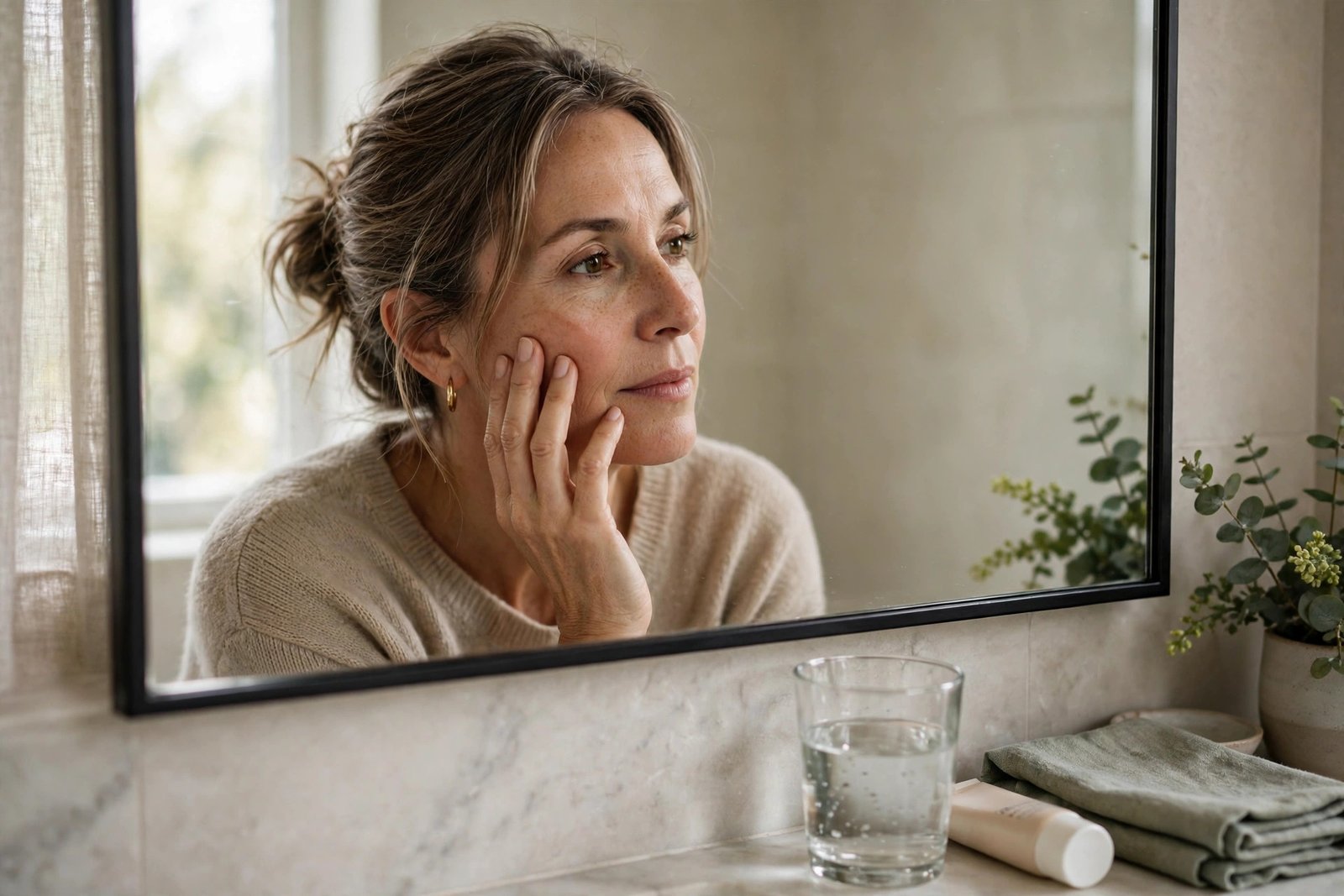
In short: How to get rid of Ozempic face starts with knowing what it is: facial volume loss from rapid weight loss, not a direct effect of the drug. The face loses fat from the cheeks, temples, and under the eyes, and the skin cannot shrink fast enough to keep up, so the face looks hollow and older. The best defence is to lose weight slowly, at 0.5 to 1 kg a week, with enough protein and strength training to protect muscle. Creams cannot restore lost volume, and any restoration is generally left until weight is stable.
- Ozempic face is not a medical diagnosis, and it is not caused by semaglutide acting on the skin. Any rapid weight loss can cause the same changes.
- It becomes visible after losing more than 5 to 10% of body weight quickly. In the STEP 1 trial, semaglutide produced an average loss of 14.9% at 68 weeks, and 50.5% of participants lost at least 15%, which is why the face changes are so common on this treatment.
- About 65% of people on GLP-1 medicines notice facial volume loss, according to Advanced Dermatology, and it is more pronounced with loss over 20 pounds or rapid loss in older people. A 2024 review reported temple hollowing in 68% and cheek flattening in over 50% of patients who lost more than 15% of body weight rapidly.
- Slow loss is the strongest prevention. The NHS and CDC both give 0.5 to 1 kg a week as the safe pace, because slower loss gives the skin time to adapt. Protein and strength training protect the muscle that supports the face.
- Creams cannot put volume back. They can improve hydration and texture, which helps the skin look better, but they cannot replace lost fat.
Introduction
You lose 15 kilos, your clothes fit, your blood sugar improves, and then someone asks if you are tired, or ill. You look in the mirror and see it: hollow cheeks, deeper lines around the mouth, shadows under the eyes, a jawline that sags a little. The weight loss worked, and your face looks older than it did before you started.
This is Ozempic face, and it is one of the most searched side effects of the new weight loss drugs. This post explains what it is, why it happens, who notices it most, and what actually limits it. It gives you the information to talk about it properly with your prescriber and your dermatologist.
What Ozempic Face Actually Is
Ozempic face is the visible loss of volume in the face after rapid weight loss on a GLP-1 medicine such as semaglutide, sold as Ozempic and Wegovy, or tirzepatide, sold as Mounjaro and Zepbound. The signs are consistent: hollowing of the cheeks and temples, more prominent under-eye circles, deeper nasolabial folds, the lines from nose to mouth, more visible fine lines and wrinkles, and sagging around the jawline. The overall effect is a gaunt or aged appearance, often out of proportion to the person’s age.
The important point is what it is not. It is not a direct effect of the drug on the skin. Dr. Alison Boucher, a dermatologist at Henry Ford Health, puts it plainly: there is no evidence that GLP-1 medications are directly changing the appearance of your face. Rather, anything that causes rapid weight loss can result in these changes.
Why the Face Changes: Fat Compartments and Skin
Facial fat is not one uniform layer. It sits in separate compartments, and a 2007 study by Rohrich and Pessa mapped 21 of them, later expanded to 23 by Cotofana and colleagues in 2019. The compartments that matter most here are the malar fat pad in the cheek, the temporal fat above the cheekbone, and the fat under the eyes. These pads give the face its fullness, and they are also among the first to shrink when the body loses fat.
When weight falls fast, these pads lose volume quickly, and the skin above them does not shrink at the same rate. Skin is elastic, but it has limits, and it needs time to remodel. Slow loss allows partial remodelling, so the skin gradually fits the new contour. Rapid loss outpaces that adaptation, leaving loose skin over a deflated pad, which reads as sagging and hollowing.
Two more factors make it worse. First, muscle loss: in the STEP 1 body composition substudy, about 39% of the weight lost on semaglutide was lean mass, which includes muscle, water, bone, and organ tissue. Second, age: after the mid-30s, collagen and elastin recover more slowly, so the same weight loss looks more pronounced in a 55 year old than in a 30 year old.
Who Notices It Most
Four factors predict more visible change: older age, a longer history of obesity, rapid weight loss, and low protein or poor hydration. The numbers behind that are striking. Advanced Dermatology reports that 65% of people on GLP-1 medicines notice facial volume loss, and the effect is more pronounced with loss over 20 pounds or rapid loss in older people. A 2024 review in the Journal of Plastic, Reconstructive and Aesthetic Surgery reported temple hollowing in 68% and cheek flattening in over 50% of patients who lost more than 15% of body weight rapidly.
The threshold matters too. Changes typically become visible after losing more than 5 to 10% of body weight quickly. A slower loss of the same total amount produces visibly less change, because the skin has time to adapt and the share of muscle lost is smaller.
Prevention 1: Slow the Loss Down
This is the single most effective step, and it is also the hardest to accept when the drug is working well. The NHS and CDC both give 0.5 to 1 kg a week as the safe pace of weight loss. That pace is not just about gallstones and muscle loss: it is the pace at which skin can keep up. A loss of 15 kg over 30 weeks looks very different from the same 15 kg over 12 weeks.
Talk to your prescriber about the pace, not just the dose. If you are losing more than 1 kg a week for several weeks running, that is worth raising, because it may mean your calorie intake is lower than it needs to be. Eating a little more, enough to bring the pace into the 0.5 to 1 kg band, protects your face, your muscle, and your energy.
Use our weight loss goal calculator to turn your target into a weekly pace, and check your daily burn with our TDEE calculator. Judge the pace over a month, not a week.
Prevention 2: Protein and Strength Training
Protein and strength training protect the tissue under the skin, and they are the two things appetite suppression works against. When appetite falls, protein is usually the first thing skipped, because it is the most filling food, and the result is faster muscle loss and slower skin repair.
Aim for 1.2 to 1.6 g of protein per kg of body weight a day. For an 80 kg person, that is 96 to 128 g. Use our protein intake calculator for your own number, and spread it across the day, with 25 to 40 g at each meal. Eggs, Greek yoghurt, chicken, fish, lentils, and tofu all count.
Strength training two to three times a week is the other half. It does not directly fill the cheeks, but it protects the muscle that supports the face and the body, and it reduces the share of weight loss that comes from lean tissue. In a trial that added structured exercise to a GLP-1, the lean share of weight loss fell by roughly half.
Prevention 3: Hydration, Sleep, and Sunscreen
These three sound minor next to protein and pace, and they are not. Skin that is well hydrated looks fuller and smoother than skin that is not, because water fills the tissue between the cells. The NHS Eatwell guidance is about 1.2 litres of fluid a day, 6 to 8 glasses, from water, lower-fat milk, and sugar-free drinks. On a GLP-1, thirst can fall along with appetite, so many people drink less without noticing: keep a bottle visible and drink on a schedule, not on thirst alone.
Sleep matters because the skin repairs itself overnight, and short sleep raises appetite the next day, which makes the pace harder to control. Aim for 7 to 9 hours, in a cool, dark room, with no screens for the last 30 minutes before bed.
Sunscreen is the long game. Ultraviolet light breaks down collagen, the protein that keeps skin firm, and the damage accumulates over years. A daily broad-spectrum sunscreen protects the skin you have while you lose weight, and it costs less than any cream.
What Does Not Work: Creams
This is the honest part, and it saves people money. No cream can restore lost facial volume, because a cream sits on the surface of the skin and the missing volume is fat underneath it. Moisturisers can improve hydration and texture, and retinoids can modestly improve fine lines over months, but neither replaces a deflated fat pad.
That does not mean skincare is useless. A simple routine, a gentle cleanser, a moisturiser, and daily sunscreen, keeps the skin in the best condition it can be in, and healthy skin shows volume loss less harshly. But if a product promises to fill hollow cheeks, it is promising something no cream can do. Spend the money on protein and sunscreen instead.
What the Options Are, Informationally
Published reviews describe a range of restoration options for people whose weight has stabilised and who still have visible volume loss. These are described here only as information, not as a recommendation, because the right choice depends on your face, your health, and your weight history, and only a clinician who has examined you can advise.
The options discussed in the literature include dermal fillers, which add volume to specific compartments, skin-tightening procedures, and collagen-stimulating treatments. The reviews agree on one practical point: restoration is generally deferred until weight has been stable for months, because continued weight loss after treatment can change the result, and treating before the face has settled risks overcorrection.
If the changes concern you, the right next step is a conversation with a board-certified dermatologist, not a purchase. Take your weight history with you: your starting weight, your current weight, your rate of loss, and how long your weight has been stable. A dermatologist with that history can tell you whether your face has settled and what the dominant problem is.
When to Talk to Your Doctor
Talk to your prescriber if you are losing more than 1 kg a week for several weeks, if your appetite has fallen so far that you are eating under 1,200 calories a day, or if you feel faint, very tired, or unwell. Talk to your doctor promptly if you notice rapid hair loss, very dry skin, or wounds that heal slowly, because these can signal that your intake is too low. None of these are reasons to stop your medicine on your own: stopping suddenly can bring rapid regain, and the decision belongs to you and your prescriber together.
Keep perspective: the face changes are real, but they are a side effect of a treatment that is also lowering blood sugar, blood pressure, and cardiovascular risk.
Frequently Asked Questions
How to get rid of Ozempic face?
There is no cream or quick fix that restores lost facial volume. The most effective approach is prevention: lose weight slowly at 0.5 to 1 kg a week, eat 1.2 to 1.6 g of protein per kg a day, do strength training twice a week, stay hydrated, and use sunscreen daily.
What is Ozempic face?
Ozempic face is facial volume loss from rapid weight loss, not a direct effect of the drug. The face loses fat from the cheeks, temples, and under the eyes, and the skin cannot shrink fast enough to keep up, so the face looks hollow and older. The term first appeared in late 2022, when dermatologist Dr. Paul Jarrod Frank used it in a New York Times interview.
Does Ozempic face go away on its own?
Once your weight stabilises, the changes to your face stabilise too, even if you keep taking the medicine. But the lost volume does not necessarily come back on its own. Slow loss, protein, and strength training while you are losing weight are the best protection, because they limit how much volume is lost in the first place.
Can creams fix Ozempic face?
No. Creams sit on the surface of the skin, and the missing volume is fat underneath it. Moisturisers can improve hydration and texture, and retinoids can modestly improve fine lines over months, but neither replaces a deflated fat pad. A simple routine of cleanser, moisturiser, and daily sunscreen keeps the skin in its best condition.
How can I prevent Ozempic face while losing weight?
Lose weight at 0.5 to 1 kg a week, eat 1.2 to 1.6 g of protein per kg a day, do strength training two to three times a week, drink about 1.2 litres of fluid a day, sleep 7 to 9 hours, and use sunscreen daily.
—
Sources
- Henry Ford Health. “Ozempic Face: Preventing Face Wrinkles After Weight Loss.” Dr. Alison Boucher: no evidence GLP-1 medicines directly change the face. https://www.henryford.com/blog/2026/09/ozempic-face
- Wilding JPH, et al. “Once-Weekly Semaglutide in Adults with Overweight or Obesity.” New England Journal of Medicine. 2021;384(11):989-1002. STEP 1: mean loss 14.9% at 68 weeks, 50.5% lost at least 15%. https://doi.org/10.1056/NEJMoa2032183
- Rohrich RJ, Pessa JE. “The fat compartments of the face: anatomy and clinical implications for cosmetic surgery.” Plastic and Reconstructive Surgery. 2007;119(7):2219-2227.
- Keaney TC, et al. Journal of Plastic, Reconstructive and Aesthetic Surgery, 2024: temple hollowing in 68% and malar flattening in over 50% of patients who lost more than 15% of body weight rapidly.
- Tasali E, et al. “Effect of sleep extension on objectively assessed energy intake among adults with overweight in real-life settings.” JAMA Internal Medicine. 2022;182(4):365-374. https://doi.org/10.1001/jamainternmed.2021.8098
- National Health Service. “Understanding calories” and Eatwell guidance: 0.5 to 1 kg a week as the safe pace of weight loss, and about 1.2 litres of fluid a day. https://www.nhs.uk/live-well/healthy-weight/managing-your-weight/understanding-calories/
- Weight Insider. Protein intake calculator, weight loss goal calculator, TDEE calculator, and calories calculator.
Medical Disclaimer
This article is general information only. It is not medical advice, and it is not a substitute for advice from a qualified health professional. It does not recommend starting, stopping, or changing the dose of any medicine, including semaglutide or tirzepatide, and it does not recommend any cosmetic treatment. Talk to your prescriber before making any change to your treatment, and talk to a board-certified dermatologist before considering any procedure. The trial results quoted here are group averages, and your own results may differ.