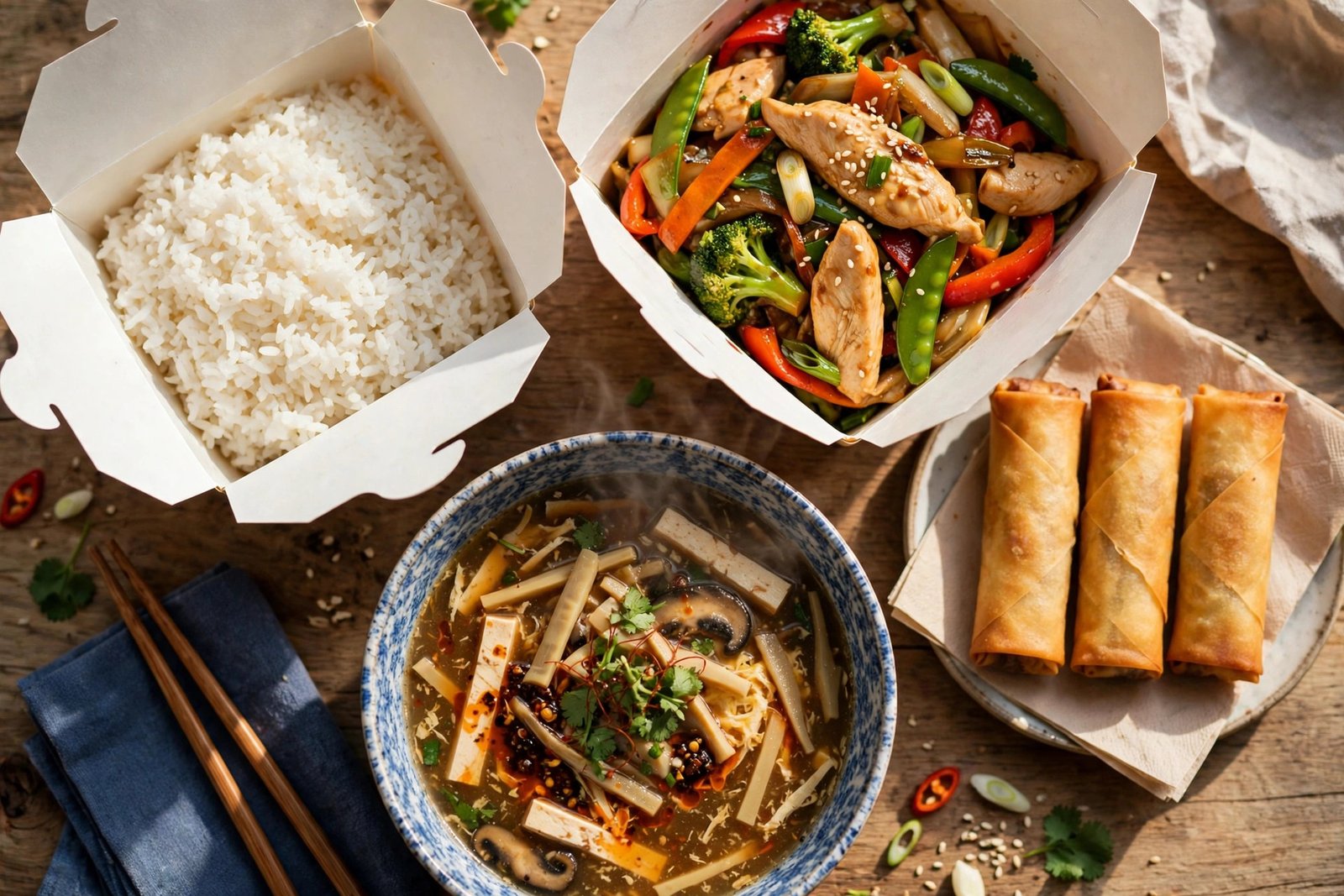
In short: Calories in Chinese takeaway add up fast, because the dishes are fried, sauced, and served in large portions. A typical order of sweet and sour chicken (679 calories), egg fried rice (558), and two spring rolls (290) totals 1,527 calories, which is most of a day’s food for many adults. The lowest-calorie order, hot and sour soup (90), broccoli beef (130), and steamed rice (420), totals 640. Swap fried rice for steamed rice and you save about 150 calories before you touch the main dish.
- The single biggest number on most menus is General Tso’s chicken: a full USDA order of 535 g carries 1,578 calories, while one cup of 146 g carries 431. The difference is the portion, not the recipe, so ask for a small container and share the rest.
- Rice is where most orders quietly double. Egg fried rice carries about 186 calories per 100 g against about 131 for boiled rice, so a 300 g portion of fried rice is 558 calories and the same weight of boiled rice is 393: a saving of 165 calories from one swap.
- Steamed and stir-fried dishes with vegetables are the lightest mains. Broccoli beef is about 130 calories a serving, string bean chicken breast about 170, and black pepper chicken about 250, against about 400 for sweet and sour chicken and 690 for Beijing beef.
- Soups are the best starter: hot and sour soup and egg flower soup are both about 90 calories a bowl. Spring rolls are the worst starter: two meat spring rolls are about 290 calories, and a chicken egg roll is about 200.
- Sauce is a hidden extra. A 1.8 oz portion of sweet and sour sauce is about 80 calories, and most of it is sugar. Ask for sauce on the side, and you decide how much of it you eat.
Introduction
Chinese takeaway is the Friday night default for millions of people, and it is also one of the hardest meals to judge. The menu lists no calories, the portions are generous, and a dish that sounds light can carry more calories than a burger. A typical main with rice lands between 900 and 1,250 calories, and a full order with starters and a sugary drink can pass 2,000, which is a whole day of food for many adults.
This post gives you the numbers dish by dish, from USDA food data and UK government food tables, so you can order with your eyes open. It shows the typical order worked out to the calorie, the lowest-calorie order you can ask for, and the swaps that save hundreds without making the meal joyless. Nothing here says never order takeaway. It says order the version that fits your day.
Why the Numbers Vary So Much
Three things decide how many calories a Chinese dish carries: how it is cooked, how much sauce it has, and how big the portion is. Frying adds oil, and oil is the most calorie-dense thing in a kitchen at about 120 calories a tablespoon. A battered, deep-fried dish absorbs far more oil than a stir-fried one, which is why General Tso’s chicken and sweet and sour pork sit at the top of the table and steamed fish and broccoli beef sit at the bottom.
Sauce is the second factor. Sweet and sour, hoisin, and oyster sauces are mostly sugar and salt, and a ladle of sauce can add 80 to 150 calories to a dish that would otherwise be light. Soy sauce is nearly calorie-free, but it is very salty, which is a different problem. The third factor is the portion. A takeaway container is often two or three servings by the label, not one, and the difference between a cup of General Tso’s at 431 calories and a full order at 1,578 is nothing but the amount on the plate.
That is also why two sources can disagree. The numbers below come from USDA FoodData Central and the UK government’s CoFID 2021 tables, plus published chain nutrition, and they agree closely where the dishes match. Treat every figure as a typical value for the stated portion, not a promise: your local restaurant’s recipe will differ a little, and its portions will differ a lot.
Calories in Chinese Takeaway: Dish by Dish
Here are the common dishes, with the portion each number belongs to. Mains first, then rice and noodles, then starters and soups.
| Dish | Portion | Calories |
|---|---|---|
| General Tso’s chicken | 1 order, 535 g | 1,578 |
| General Tso’s chicken | 1 cup, 146 g | 431 |
| Beijing beef | 5.6 oz serving | 690 |
| Sweet and sour chicken | 350 g | 679 |
| Sweet and sour pork | 5.6 oz serving | 400 |
| Kung Pao chicken | 5.8 oz serving | 280 |
| Black pepper chicken | 6.1 oz serving | 250 |
| String bean chicken breast | 5.6 oz serving | 170 |
| Broccoli beef | 5.4 oz serving | 130 |
| Chicken chow mein | 350 g | 514 |
| Chow mein | 8.3 oz serving | 400 |
| Egg fried rice | 300 g | 558 |
| Fried rice | 10 oz serving | 570 |
| Steamed rice | 8.7 oz serving | 420 |
| Boiled rice | 300 g | 393 |
| Meat spring rolls | 2 rolls, 120 g | 290 |
| Chicken egg roll | 1 roll | 200 |
| Veggie spring rolls | 2 rolls | 160 |
| Hot and sour soup | 1 bowl | 90 |
| Egg flower soup | 1 bowl | 90 |
| Mixed vegetables, side | 8.6 oz serving | 70 |
Three patterns jump out. First, the fried and battered dishes are in a different league: General Tso’s at 1,578 for a full order is more than three times the calories of broccoli beef at 130. Second, the rice matters as much as the main: fried rice at 570 is 150 calories more than steamed rice at 420 for a similar serving. Third, the light end of the menu is genuinely light: a bowl of soup at 90 calories and a side of mixed vegetables at 70 are real food, not garnish.
The Typical Order, Worked Out
Here is the order most people actually place: sweet and sour chicken, egg fried rice, and two spring rolls to share, with a sugary drink. The maths is 679 plus 558 plus 290, which is 1,527 calories before the drink. A 330 ml can of cola adds about 139 calories, taking the meal to about 1,666. That is more than two thirds of a 2,000-calorie day, and more than three quarters of a 1,800-calorie day, in a single meal.
The heavier version is worse. A full order of General Tso’s chicken at 1,578 plus a serving of fried rice at 570 is 2,148 calories, before starters or a drink. One filmed example, a takeaway container weighed item by item, totalled about 2,020 calories: fried rice at about 550, orange chicken at about 430, General Tso’s at about 420, Kung Pao chicken at about 400, and chicken balls at about 220. That is a full day of food in one box, and it is the box most people eat alone, in one sitting.
None of this means the meal is ruined. It means the meal is a whole day’s budget, and the rest of the day has to be light. If you know the number before you order, you can decide whether today is the day for it. Run the total through our calories calculator and see where it sits against your own daily target.
The Lowest Calorie Order
Here is the order to ask for when you want the takeaway without the damage: a bowl of hot and sour soup to start, broccoli beef as the main, and steamed rice on the side. The maths is 90 plus 130 plus 420, which is 640 calories, with a diet drink or water. That is less than half of the typical order, and it is still a full meal: soup, a proper main, and rice.
Two swaps make it lighter still. Replace the steamed rice with a side of mixed vegetables at 70 calories, and the total falls to 290. Replace the broccoli beef with string bean chicken breast at 170, and the total with steamed rice is 680. The pattern is simple: soup first, a steamed or stir-fried main with vegetables, and boiled or steamed rice instead of fried.
If you want noodles, chicken chow mein at 514 for 350 g is a reasonable main on its own, and it needs no rice beside it. That is the mistake most people make with noodles: ordering chow mein and fried rice together doubles the starch. Pick one, not both.
Swaps That Save Hundreds
Swap 1: steamed rice for fried rice. This is the biggest single saving, and the easiest. Fried rice at 570 against steamed rice at 420 saves 150 calories a serving on the Panda Express figures, and egg fried rice at 558 against boiled rice at 393 saves 165 on the UK figures. The rice still tastes of the dish, because the sauce and the main carry the flavour.
Swap 2: stir-fried for battered and deep-fried. Broccoli beef at 130 against Beijing beef at 690 saves 560 calories, and string bean chicken breast at 170 against sweet and sour chicken at 400 saves 230. The batter and the sugar sauce are where the calories live, not the meat.
Swap 3: sauce on the side. A portion of sweet and sour sauce is about 80 calories, and most of it is sugar. Ask for it on the side, dip instead of pour, and you will use a third of it. The same applies to hoisin and plum sauce.
Swap 4: soup for spring rolls. A bowl of hot and sour soup at 90 against two meat spring rolls at 290 saves 200 calories, and the soup fills you up more, because it is mostly water. Start with soup, and you will eat less of the main without trying.
Swap 5: water or diet drink for cola. A can of cola is about 139 calories of pure sugar, and it does nothing for fullness. Water is free, and a diet drink is near zero. This swap alone saves more than the rice swap.
Put the five together, and a 1,527-calorie order becomes a 640-calorie order, a saving of 887 calories, with the same restaurant, the same evening, and a meal that still feels like a takeaway. Check the split against your own day with our macro calculator and our TDEE calculator.
How to Order: The Script
Ordering well is easier if you decide before you call. Pick your main first, from the steamed and stir-fried end of the menu: broccoli beef, string bean chicken, black pepper chicken, or a vegetable and tofu dish. Then pick one starch, steamed rice or chow mein, not both. Then pick your starter: soup, not spring rolls. Then ask for sauce on the side.
The words to use are simple: “steamed rice instead of fried rice, please”, “sauce on the side, please”, and “small portion, please” if the restaurant offers one. Most restaurants will do all three without a fuss. If you are ordering for two, order one main and one rice between you, plus a soup each: sharing is the easiest portion control there is, and it halves the bill too.
One last habit: eat the soup and the vegetables first, then the main, then the rice. It sounds trivial, but filling up on the lightest food first means the heaviest food is eaten when you are already half full, and the box lasts two meals instead of one. Leftovers are not a failure. They are lunch tomorrow.
If your restaurant publishes nutrition online, check it before you order: chains such as Panda Express list every dish, and the numbers are usually close to the ones in this post. Independent restaurants rarely publish numbers, so use the table above as your guide and pick the closest match.
Frequently Asked Questions
Calories in Chinese takeaway: how many are in a typical meal?
A typical main with rice is about 900 to 1,250 calories. A common order of sweet and sour chicken (679), egg fried rice (558), and two spring rolls (290) totals 1,527 calories, and a can of cola adds about 139 more. A full order of General Tso’s chicken with fried rice is 2,148 calories.
What is the lowest calorie Chinese takeaway order?
Hot and sour soup (90), broccoli beef (130), and steamed rice (420), which totals 640 calories. Replace the steamed rice with a side of mixed vegetables (70) and the total falls to 290. Soup first, a steamed or stir-fried main, and boiled or steamed rice is the pattern.
How many calories are in General Tso’s chicken?
A full USDA order of 535 g carries 1,578 calories, while one cup of 146 g carries 431. The difference is the portion, not the recipe. Order a small container, share it, or eat half and keep the rest for tomorrow.
Is fried rice or steamed rice better for weight loss?
Steamed rice, by a clear margin. Fried rice carries about 186 calories per 100 g against about 131 for boiled rice, so a 300 g portion of fried rice is 558 calories and the same weight of boiled rice is 393: a saving of 165 calories from one swap.
Are spring rolls or soup a better starter?
Soup, by a long way. A bowl of hot and sour soup or egg flower soup is about 90 calories, while two meat spring rolls are about 290 and a chicken egg roll is about 200. Soup also fills you up more, because it is mostly water, so you eat less of the main.
—
Sources
- US Department of Agriculture, Agricultural Research Service. FoodData Central. Restaurant Chinese food entries, including General Tso’s chicken. https://fdc.nal.usda.gov/
- Public Health England. McCance and Widdowson’s Composition of Foods Integrated Dataset (CoFID) 2021. Takeaway dish values for chow mein, sweet and sour chicken, egg fried rice, boiled rice, and spring rolls.
- Panda Express. Published nutrition information: chow mein, fried rice, steamed rice, sweet and sour chicken and pork, Kung Pao chicken, black pepper chicken, broccoli beef, string bean chicken breast, egg rolls, spring rolls, and soups.
- Weight Insider. How many calories are in your favourite foods, with USDA-based values for rice, chicken, and fried rice. Also see our calories calculator and macro calculator.
Medical Disclaimer
This article is general information only. It is not medical advice, and it is not a substitute for advice from a qualified health professional. Calorie figures are typical values for the stated portions, from USDA and UK government food data and published chain nutrition, and your restaurant’s recipe and portions will differ. Talk to your doctor, or a registered dietitian, before starting a calorie deficit or a new eating plan, especially if you have a medical condition or take medication.