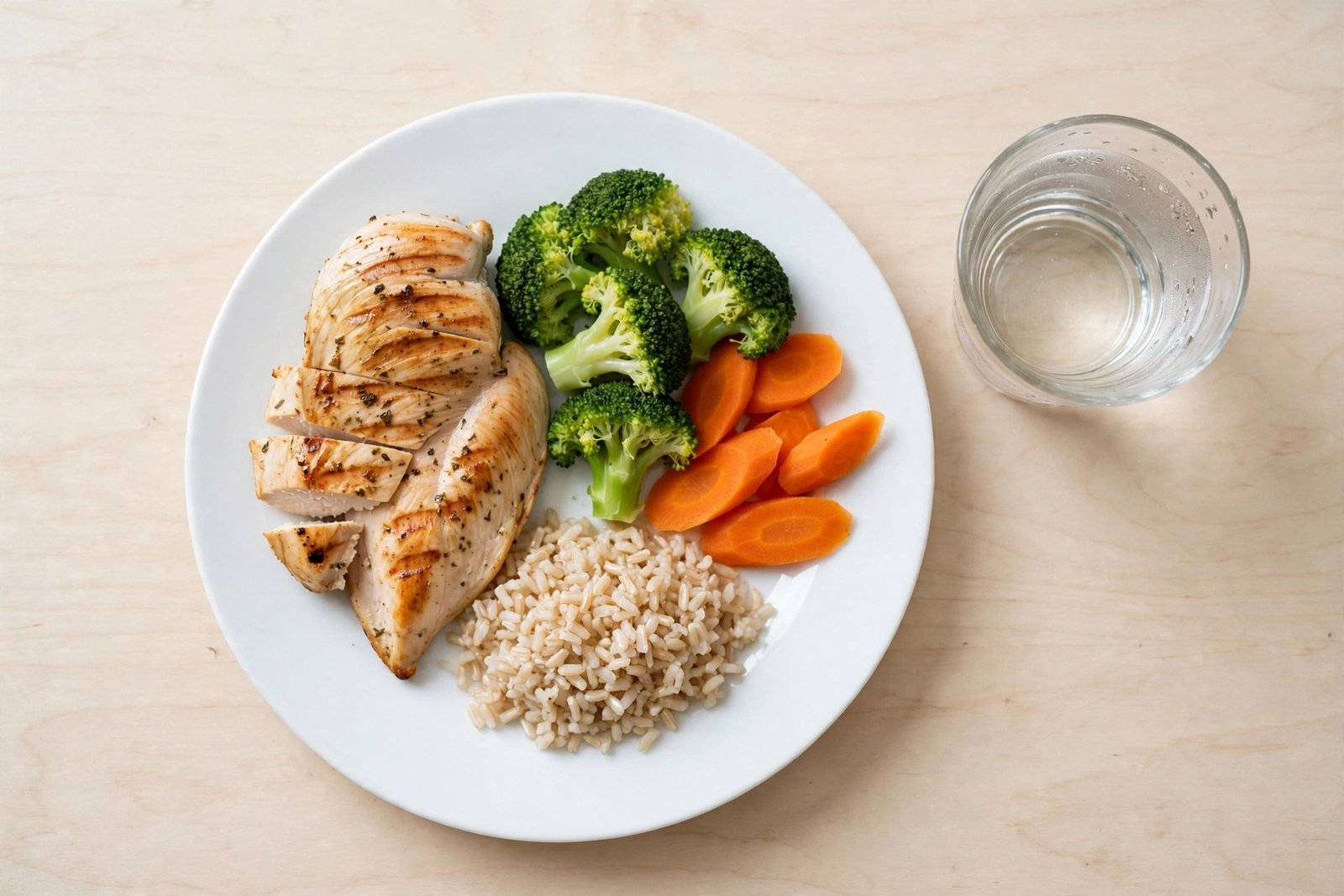
How to lose weight after gallbladder removal is a practical question, not a medical mystery. Without a gallbladder, bile trickles into your gut instead of arriving in a timed burst, so large fatty meals are harder to digest. The plan is simple: small, lower-fat meals while you recover, a deficit of about 500 kcal a day, enough protein, and walking from day one.
- About 13 in 100 people develop diarrhoea after gallbladder removal, a 2022 review of 21 studies found.
- In a three year study, average BMI rose by 1.8 kg/m2 after surgery, but regular exercisers gained less (1.4 against 2.1).
- Start with small, low-fat meals for one to two weeks, then add fat back to roughly a quarter to a third of calories.
- Aim for 1.2 to 1.6 g of protein per kg of body weight a day, spread across meals.
- A 500 kcal daily deficit is about 0.45 kg of fat a week, so 5 percent of body weight takes roughly 9 to 10 weeks.
How Fat Digestion Changes Without a Gallbladder
Before surgery, your gallbladder stored bile made by the liver and released it in a concentrated burst when you ate. Bile breaks large fat droplets into small ones so enzymes can digest them, and it carries vitamins A, D, E and K with them. After a cholecystectomy, the liver still makes bile, but there is no store and no burst: bile trickles continuously into the gut in a weaker form.
Your body can still digest fat, and most people adapt well, but a large fatty meal can overwhelm the trickle. Undigested fat passes further down the gut, where it can cause bloating, wind, urgency and loose stools. A 2022 review of 21 studies with 3,476 patients found that 13.3 percent developed diarrhoea after surgery. For why weight gain happens after surgery, see our guide to why you may experience weight gain after gallbladder removal.
The First Two Weeks: A Gentle Restart
The first two weeks are about healing, not dieting. Do not try to lose weight in this window. Your appetite may be low and you may feel tired, so follow your surgical team’s instructions first. NHS guidance says no special lifelong diet is needed after removal, though small meals may be easier for the first few days. Bradford Teaching Hospitals NHS advises avoiding fatty foods for the first week or so.
Eat four to six small meals instead of three large ones. Choose easy foods: oats or toast, rice or soup with soft vegetables, and grilled chicken or fish with potatoes and carrots. Bananas, applesauce and low-fat yoghurt are usually well tolerated. Drink water through the day. Keep fat low but not zero: a teaspoon of olive oil or a few nuts beats butter, cream and fried food. If you cannot keep fluids down, have severe pain, a fever, jaundice, or a red, swollen or leaking wound, seek urgent care.
Weeks 3 to 6: Rebuilding Your Plate
By week three, most people who had keyhole surgery feel much better, and a weight loss plan can properly begin. A practical fat target while digestion settles is roughly a quarter to a third of calories from fat. At 1,631 kcal a day, that is about 45 to 54 g of fat a day, or roughly 15 to 18 g per meal. Check your numbers with our calories calculator first.
Build each meal from three parts: a lean protein such as chicken, fish, eggs, tofu or lentils; a large portion of cooked vegetables; and a modest portion of oats, brown rice, potatoes or quinoa. Cook with a measured spoon of oil, and grill, bake, steam or air fry instead of deep frying. Oily fish, olive oil, nuts and seeds are easier on digestion than fat from fried food, pastry, processed meat and creamy sauces. Reintroduce dropped foods one at a time.
After Six Weeks: Your Long-Term Eating Pattern
After six weeks, the NHS message is clear: you do not need a special lifelong diet. A Cambridge University Hospitals leaflet says a low-fat diet is not routinely necessary, and recommends a healthy, varied diet in line with the Eatwell Guide. That means plenty of fruit and vegetables, wholegrains, a variety of protein, lower-fat dairy, and small amounts of unsaturated oils.
The habits from weeks three to six are the same ones that keep weight off for good. Keep meals modest, keep the fattiest foods as occasional treats, and keep protein and fibre high. Avoid the permanent very low-fat diet: it does not speed weight loss, and it makes it harder to absorb vitamins A, D, E and K. If you still eat almost no fat months after surgery, discuss it with your clinician.
Protein: The Anchor of the Plan
Protein is the most useful nutrient in this plan. First, it keeps you full far longer than the same calories from carbohydrate or fat, which matters in a deficit. Second, it protects muscle while you lose fat, so more of the weight you lose is fat rather than lean tissue. After surgery, when you may have lost some muscle during recovery, that protection matters even more.
Aim for 1.2 to 1.6 g of protein per kg of body weight a day. For a person at 84 kg, that is 101 to 134 g a day, or about 34 to 45 g at each of three meals. Check your own number with our protein intake calculator. Choose lean sources: chicken breast, turkey, white fish, eggs, low-fat Greek yoghurt, tofu, lentils and beans.
Managing Diarrhoea, Bloating and Urgency
Loose stools are the most common digestive complaint after gallbladder removal. The good news is that most cases improve in the first three months. Start with meal size and fat. Smaller, more frequent meals give the trickle of bile a manageable job, while one large fatty meal can overwhelm it. Cut back on fried food, fatty meat, cream sauces, pastries and full-fat dairy, especially in the first eight weeks.
Next, add soluble fibre, which absorbs water, binds some bile acids and firms up stools. Oats, bananas, rice, applesauce, cooked carrots and psyllium husk are the usual sources, added gradually to avoid gas and bloating. Caffeine, alcohol, very spicy food, and sugar alcohols in sugar-free gum can also loosen stools. If diarrhoea lasts more than a few weeks, keeps you housebound, or comes with blood or unplanned weight loss, see your clinician. The usual medical step is a bile acid binder such as cholestyramine. In an older review, 92 percent of patients responded, though from a small group of 25. Do not dose yourself with binders or enzymes bought online.
Fat-Soluble Vitamins: What to Watch
Because bile helps absorb vitamins A, D, E and K, deficiency after gallbladder removal is a natural worry. The evidence is reassuring. A 2025 study compared blood tests before and after cholecystectomy in 179 patients and found no clinically significant fall in vitamin D (19.76 against 19.13 ug/L) and no change in vitamin K related clotting tests. The authors concluded deficiencies are driven by pre-existing risk, not by the surgery itself. If you were already low in vitamin D, or have ongoing diarrhoea, ask your clinician to check your levels.
Exercise: When and How to Move Again
Walking starts on day one. MedlinePlus discharge guidance advises walking several times a day from the first day home, gradually increasing the distance. Walking helps healing, reduces the risk of blood clots, and burns calories gently. Heavier exercise waits: avoid strenuous activity and heavy lifting for at least a couple of weeks, with full recovery taking up to six weeks. A Royal Berkshire NHS leaflet advises against heavy lifting for four to six weeks.
A sensible return looks like this. Weeks one and two: short walks, building from ten minutes to thirty minutes a day. Weeks three and four: brisk walking, gentle cycling, and light activity. From week four to six, with your surgeon’s agreement, add strength training twice a week: squats, rows, push ups or light weights, two or three sets of 8 to 12 repetitions. In a three year study of 42 patients, average BMI rose by 1.8 kg/m2, but the 17 regular exercisers rose only 1.4, against 2.1.
The Worked Example
Meet Aisha, 45, 168 cm, 84 kg, lightly active, three months after keyhole gallbladder removal. Her numbers use the Harris-Benedict Revised equation our calculators use. Her basal metabolic rate is 1,550 kcal a day, and her maintenance level is 2,131 kcal a day. On a 500 kcal daily deficit, her target is 1,631 kcal a day. Check your own numbers with our basal metabolic rate and weight loss goal calculators.
Her protein target is 101 to 134 g a day, or about 34 to 45 g at each of three meals. Her BMI is 29.8. At her target calories, fat at roughly a quarter to a third of calories means about 45 to 54 g of fat a day. Her 5 to 10 percent target is 4.2 to 8.4 kg: 79.8 kg at 5 percent and 75.6 kg at 10 percent. At a 500 kcal deficit she loses about 0.45 kg a week, or about 5.5 kg in 12 weeks: 5 percent in 9 to 10 weeks, and 10 percent in 18 to 19 weeks.
A Realistic Timeline
Week one is recovery, not weight loss. Expect your weight to dip slightly from a smaller appetite and lighter meals, then return as you eat normally again. By one month, most people are eating a near-normal diet and walking daily. This is the right time to set a calorie target and track food honestly for two weeks. If your weight is stable, you have found your maintenance level.
By three months, digestion has usually settled. About 13 in 100 people still have diarrhoea then; if you are one of them, see your clinician. By six months, the average person has gained a little: an earlier study reported men gaining 4.6 percent and women 3.3 percent of pre-surgery weight. By twelve months, a 2025 study of 65 patients found weight gain in 29.0 percent of obese patients and 20.6 percent of non-obese patients. The long game is holding a modest deficit and staying active.
When the Scale Stalls
Stalls are normal, and after gallbladder removal there are extra reasons for them. Strength training adds water weight to muscles, so the scale can stay flat while your waist shrinks. Bloating after a fatty meal can add a kilogram overnight of water and gut contents, not fat. A smaller body burns fewer calories, so a deficit that worked at 84 kg works more slowly at 79 kg.
Before changing anything, track honestly for two weeks, including weekends and cooking oil. The usual hidden calories are oil poured freely into a pan, sauces, drinks with calories, and oversized weekend meals. A tablespoon of oil is about 120 kcal, and two unmeasured tablespoons a day is almost half your deficit. If the stall lasts more than six weeks, talk to your clinician about thyroid, blood sugar, medicines and sleep. Do not slash calories to 1,000 a day, and do not buy weight loss supplements or bile salts online.
Frequently Asked Questions
Can you lose weight after gallbladder removal?
Yes. Gallbladder removal does not prevent weight loss, and most people return to a normal, healthy diet within weeks. A deficit of about 500 kcal a day, enough protein, and regular activity give steady loss of about 0.45 kg a week.
What is the best diet after gallbladder removal for weight loss?
There is no single best diet, and the NHS says no special lifelong diet is needed after surgery. The best supported pattern is a normal, healthy diet with moderate fat at each meal, roughly a quarter to a third of calories from fat while digestion settles, plenty of protein and fibre, and small meals in the first weeks.
Why do I get diarrhoea after eating fatty food with no gallbladder?
Without a gallbladder, bile trickles continuously instead of arriving in a concentrated burst, so a large fatty meal can overwhelm digestion. Excess bile acids can also reach the colon and draw in water. A 2022 review found this affects about 13 in 100 people, and smaller, lower-fat meals plus soluble fibre usually help.
How long after gallbladder removal can I exercise?
Walking starts on day one, and most people are back to most normal activities within one to two weeks after keyhole surgery. Avoid strenuous activity and heavy lifting for at least a couple of weeks, and wait four to six weeks before heavy lifting.
Do I need to take digestive enzymes or bile salts after gallbladder removal?
Most people do not need them. The liver still makes bile, digestion usually adapts within weeks, and a 2025 study found no clinically significant fall in vitamin D or change in vitamin K related clotting tests after surgery. If you have ongoing diarrhoea, discuss options with your clinician.
Sources
- Farrugia et al. 2022, post-cholecystectomy diarrhoea review, BMJ Open: 21 studies, 3,476 patients, 13.3 percent developed diarrhoea.
- Postcholecystectomy diarrhoea rate and predictive factors, BMJ Open 2022: full text.
- Post cholecystectomy diarrhoea, systematic review 2012: 9.1 percent prevalence; bile acid malabsorption in 65.5 percent; 92 percent responded to cholestyramine.
- Ali, Cahill and Watson 2004, weight gain after laparoscopic cholecystectomy: 42 patients, mean BMI up 1.8 kg/m2 over three years.
- Clinicopathologic differences after elective laparoscopic cholecystectomy, 2025: 65 patients; weight gain in 29.0 percent of obese against 20.6 percent of non-obese at one year.
- Oxford University Hospitals NHS, about cholecystectomy booklet: diarrhoea and wind affect about 5 to 10 in 100 people.
- East Kent Hospitals NHS, dietary advice for gallbladder patients: a low-fat diet is not routinely necessary.
- Bradford Teaching Hospitals NHS, gallbladder surgery information: avoid fatty food for the first week or so.
- UF Health, gallbladder removal discharge guidance: start walking after surgery; no strenuous activity or heavy lifting for at least a couple of weeks.
- Royal Berkshire NHS, advice following laparoscopic cholecystectomy: avoid heavy lifting for four to six weeks.
- Vitamin D and vitamin K profiles after cholecystectomy, Medical Science Monitor 2025: no significant fall in vitamin D or change in clotting tests.
- Weight Insider: Why You May Experience Weight Gain After Gallbladder Removal, Calories Calculator, Protein Intake Calculator, Basal Metabolic Rate Calculator, Weight Loss Goal Calculator.
Medical Disclaimer
This article is for general information only and is not medical advice. Do not start, stop or change any medicine or supplement, or start a new diet or exercise programme, without talking to your clinician first, especially in the first weeks after cholecystectomy, or if you have diabetes, a thyroid condition, ongoing diarrhoea, or a history of an eating disorder.
Last updated: 26 November 2026