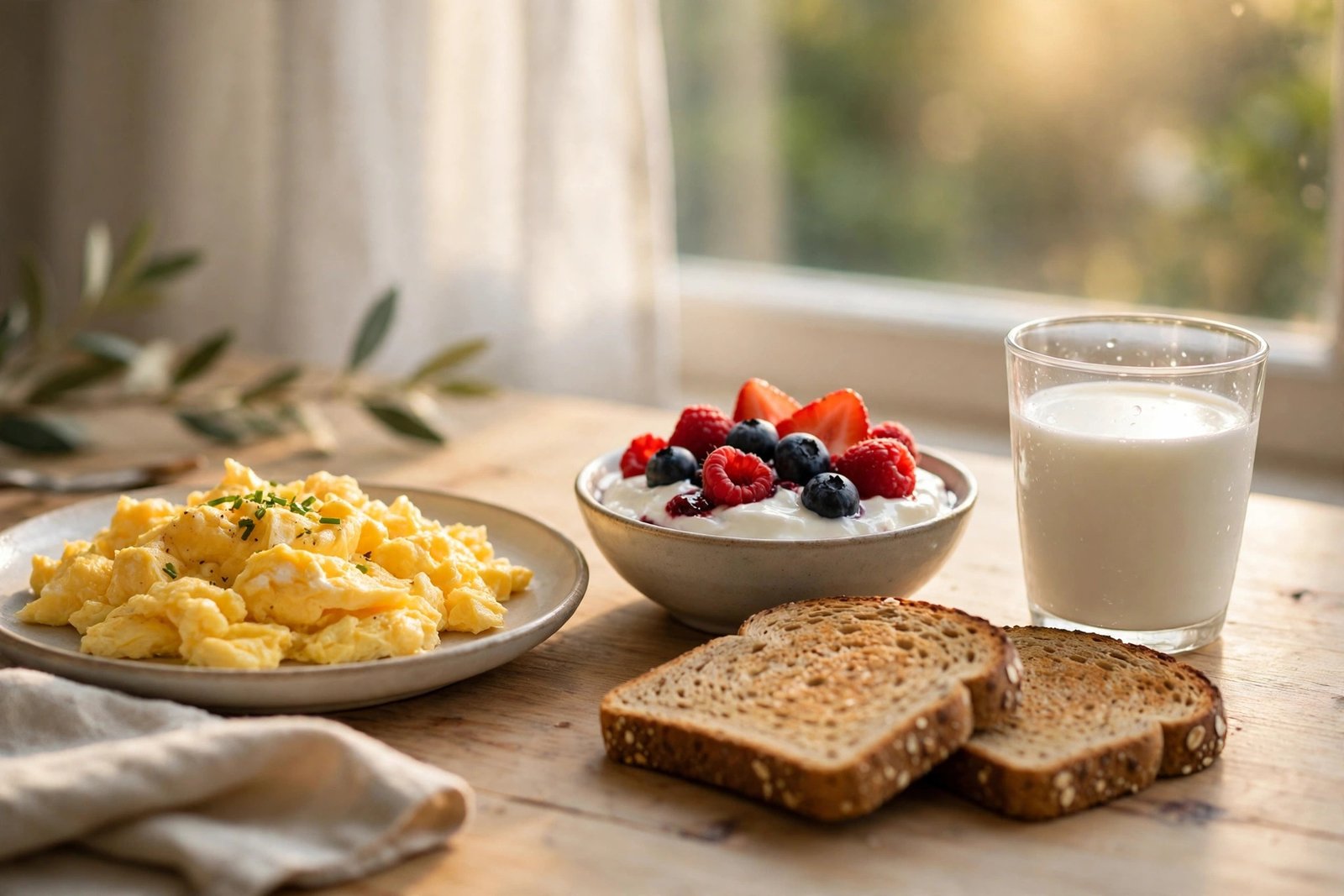
What should I eat for a high protein breakfast to lose weight? Aim for 25 to 30 g of protein in about 350 to 450 calories, built around eggs, Greek yogurt, or cottage cheese. Two scrambled eggs on wholemeal toast with a glass of milk gives about 29 g for about 390 calories.
- A high protein breakfast means 25 to 30 g of protein, roughly a third of a typical daily weight loss target.
- Eggs, Greek yogurt, cottage cheese, milk, and whey protein are the easiest sources: cheap, fast, and high in protein per calorie.
- In a 12 week trial, a 35 g protein breakfast prevented fat gain and cut daily intake by about 412 calories versus skipping.
- Protein is more filling than carbohydrate or fat, and your body spends 20 to 30 percent of protein calories processing it.
- The rule: pick the protein first, then add the toast, fruit, or oats around it.
Why Breakfast Is Where Protein Goes Missing
Most people do not eat too little protein at dinner: meat, fish, or lentils usually land it at 30 to 40 g without planning. Breakfast is the gap. Two slices of toast with jam and coffee give about 8 g of protein, and cereal with milk gives about 10 to 12 g.
The problem is the shape of the meal. Toast, cereal, jam, juice, and coffee are all carbohydrate or fat, with almost no protein. A breakfast built around bread will always be low in protein, because bread gives about 4 g a slice, while one built around eggs or yogurt starts at 12 to 17 g. That gap matters because protein is the hardest nutrient to catch up on later: if breakfast gives you 10 g of a 100 g daily target, lunch and dinner each have to carry 45 g, but if breakfast gives you 30 g, they each need only 35 g. This post stays on breakfast options and morning routine, not on splitting protein across the day.
Why a Protein Breakfast Keeps You Fuller
Protein is the most filling macronutrient, and the evidence is strongest at breakfast. In a 2013 trial, 20 overweight young women who usually skipped breakfast were given three mornings in turn: a 350 calorie breakfast with 35 g of protein, the same calories with 13 g, or no breakfast. The high protein breakfast gave greater fullness, lowered the hunger hormone ghrelin, raised the satiety hormone PYY, and cut evening snacking.
A 2015 trial tested whether that effect lasts. Fifty-seven overweight adolescents who usually skipped breakfast were randomised for 12 weeks to a 35 g protein breakfast, a 13 g protein breakfast, or continued skipping. The high protein group lost 0.4 kg of fat mass while the skippers gained 1.6 kg, and they ate about 412 fewer calories a day. The honest limit: high protein versus normal protein did not differ significantly, so the clear finding is that a protein breakfast beats skipping breakfast.
There is also a small metabolic bonus. Processing protein costs 20 to 30 percent of its calories, against 5 to 10 percent for carbohydrate and 0 to 3 percent for fat. A 30 g breakfast holds about 120 calories of protein, of which about 30 are spent on processing, against about 9 from carbohydrate, a difference of about 21 calories. The main event is fullness: a protein breakfast makes the hours until lunch easier, which means fewer snacks and smaller lunches. Our guide to how much protein to lose weight covers the daily target in full.
The Rule: Build Every Breakfast Around a Protein Source
The rule is one sentence: pick the protein first, then build the rest of the breakfast around it. Start with eggs, Greek yogurt, cottage cheese, milk, or whey protein, and only then add toast, oats, fruit, or coffee. Start with toast or cereal and the meal will land at 8 to 12 g no matter what you add.
The target is 25 to 30 g. That comes from the daily target: at 1.2 g per kg, a person at 85 kg needs about 102 g a day, or about 34 g per meal. Two eggs give about 13 g, a tub of Greek yogurt about 17 g, and a serving of cottage cheese about 14 g, so one of those plus milk or toast gets you most of the way there. Work out your own number with our protein intake calculator, and read our guide to how much protein per meal to lose weight. Boil four eggs on Sunday evening so two breakfasts are half made.
Seven High Protein Breakfasts, With Grams and Calories
Every breakfast below gives 25 to 35 g of protein in about 320 to 420 calories and takes 10 minutes or less, except the overnight oats, made the night before. Figures are USDA FoodData Central estimates.
| Breakfast | Protein | Calories |
|---|---|---|
| Scrambled eggs on toast with milk | about 29 g | about 390 kcal |
| Greek yogurt, oats and berries | about 27 g | about 400 kcal |
| Cottage cheese on toast with a boiled egg | about 28 g | about 320 kcal |
| Whey protein smoothie | about 35 g | about 370 kcal |
| Overnight oats with yogurt | about 28 g | about 420 kcal |
| Egg white omelette with toast | about 28 g | about 340 kcal |
| Greek yogurt smoothie bowl with almonds | about 32 g | about 410 kcal |
1. Scrambled Eggs on Toast With Milk: About 29 g, About 390 kcal
Scramble two eggs, about 13 g and 144 calories, and serve them on two slices of wholemeal toast, about 8 g and 162 calories, with a glass of skim milk, about 8 g and 85 calories. The total is about 29 g of protein for about 390 calories, in 10 minutes. Cook the eggs with a teaspoon of oil, not a tablespoon: the fat adds calories without adding protein. Use wholemeal toast: about 4 g of protein a slice against about 2 g in white.
2. Greek Yogurt, Oats and Berries: About 27 g, About 400 kcal
Put 170 g of plain nonfat Greek yogurt in a bowl, about 17 g and 100 calories, add 40 g of rolled oats, about 5 g and 150 calories, a handful of berries, about 1 g and 57 calories, and a tablespoon of peanut butter, about 4 g and 95 calories. The total is about 27 g of protein for about 400 calories, with no cooking. Greek yogurt is the best protein per calorie here: 17 g for 100 calories. Buy it plain: a flavoured pot adds 10 to 15 g of sugar and no protein.
3. Cottage Cheese on Toast With a Boiled Egg: About 28 g, About 320 kcal
Spread 113 g of low fat cottage cheese on two slices of wholemeal toast, about 14 g and 81 calories for the cheese plus about 8 g and 162 calories for the toast, and eat a boiled egg alongside, about 6 g and 72 calories. The total is about 28 g of protein for about 320 calories, the lightest on the list. Cottage cheese is the most underrated breakfast protein: 14 g for 81 calories, nearly as lean as Greek yogurt, and it spreads like butter. Boil the eggs the night before and this takes 5 minutes.
4. Whey Protein Smoothie: About 35 g, About 370 kcal
Blend one scoop of whey protein, about 25 g and about 120 calories, with a cup of skim milk, about 8 g and 85 calories, a banana, about 1 g and 105 calories, and a handful of berries, about 1 g and 57 calories. The total is about 35 g of protein for about 370 calories, the highest on the list. Two honest notes: the whey figure comes from the product label, because scoops vary by brand, so check yours. And a smoothie is less filling than the same food eaten with a fork, so if you are hungry an hour later, eat the banana instead of blending it.
5. Overnight Oats With Yogurt: About 28 g, About 420 kcal
The night before, mix 40 g of rolled oats, about 5 g and 150 calories, with 170 g of plain nonfat Greek yogurt, about 17 g and 100 calories, a tablespoon of peanut butter, about 4 g and 95 calories, and a tablespoon of chia seeds, about 2 g and 69 calories. Put it in the fridge and eat it cold in the morning. The total is about 28 g of protein for about 420 calories, and the morning takes 2 minutes. The oats soak up moisture from the yogurt and go soft without cooking. Measure the peanut butter: a free pour is easily double a tablespoon.
6. Egg White Omelette With Toast: About 28 g, About 340 kcal
Whisk two whole eggs, about 13 g and 144 calories, with two egg whites, about 7 g and 34 calories, and cook them as an omelette with mushrooms, spinach, or tomato. Serve with two slices of wholemeal toast, about 8 g and 162 calories. The total is about 28 g of protein for about 340 calories. Egg whites are almost pure protein: 3.6 g for 17 calories each. Two yolks plus two whites tastes like a three egg omelette with the calories of two.
7. Greek Yogurt Smoothie Bowl With Almonds: About 32 g, About 410 kcal
Blend 170 g of plain nonfat Greek yogurt, about 17 g and 100 calories, with a cup of skim milk, about 8 g and 85 calories, and berries, about 1 g and 57 calories, then pour it into a bowl and top it with 28 g of almonds, about 6 g and 164 calories. The total is about 32 g of protein for about 410 calories. The almonds add 6 g of protein and crunch, which is what makes a smoothie bowl feel like a meal rather than a drink. Keep the topping to one small handful: a second adds 164 calories without much protein.
The Worked Example: A 30 g Breakfast in Her Day
Take our worked example person: a woman aged 40, 165 cm, 85 kg, moderately active, with a maintenance of 2,436 calories a day and a weight loss target of 1,936. Her protein target is 85 kg times 1.2 g per kg, which is 102 g a day, or about 34 g per meal. Give her the scrambled eggs breakfast, about 29 g for about 390 calories.
That breakfast is 29.4 percent of her daily protein target, leaving 72 g for lunch and dinner, or 36 g each. A 10 g breakfast of toast and jam leaves 92 g for the rest of the day, or 46 g at each meal, which means a very large portion of meat twice a day. Swap a 10 g breakfast for a 30 g one every morning and you add 140 g of protein a week at the same calories. A 400 calorie breakfast is 20.7 percent of her 1,936 calorie target, and 120 of those 400 calories are protein, or 30 percent of the meal. Work out your own target with our calories calculator.
Five Mistakes That Keep Breakfasts Low in Protein
First, starting with the carbohydrate: if toast, cereal, or a croissant comes first, protein becomes an extra rather than the base. Second, counting peanut butter as a protein food: about 7 g in 2 tablespoons, but also 191 calories, under 4 g of protein per 100 calories. It is a fat that happens to contain protein, so use it as a topping, never as the main source.
Third, buying flavoured yogurt, which often matches plain yogurt on protein but adds 10 to 15 g of sugar. Fourth, drinking your breakfast: a smoothie can carry 35 g of protein and still leave you hungry by 10 in the morning, because liquid food does not fill you like solid food. Fifth, skipping breakfast to save calories: in the 2015 trial the skippers gained 1.6 kg of fat over 12 weeks while the high protein group lost 0.4 kg, and the skippers ate about 412 more calories a day. If mornings are rushed, make the overnight oats the night before. For the blood sugar side, read our guide to the best breakfast for blood sugar.
Frequently Asked Questions
What should I eat for a high protein breakfast to lose weight?
Aim for 25 to 30 g of protein in about 350 to 450 calories, built around eggs, Greek yogurt, cottage cheese, or whey protein. Two scrambled eggs on toast with milk gives about 29 g for about 390 calories.
How much protein should breakfast have for weight loss?
About 25 to 30 g, roughly a third of a daily target of 75 to 100 g. At 85 kg our example person needs 102 g a day, or about 34 g per meal, so a 30 g breakfast is close to her share.
Is it better to eat a high protein breakfast or skip breakfast?
A high protein breakfast is better than skipping. In a 12 week trial, a 35 g protein breakfast prevented fat gain and cut daily intake by about 412 calories versus skipping, while skippers gained 1.6 kg of fat.
What is the cheapest high protein breakfast?
Eggs: two give about 13 g of protein for about 144 calories, and adding two slices of wholemeal toast and a glass of milk takes the meal to about 29 g for about 390 calories.
Can I have a high protein breakfast without eggs?
Yes. Plain nonfat Greek yogurt with oats and berries gives about 27 g of protein for about 400 calories with no eggs at all, and a whey protein smoothie gives about 35 g.
Sources
- Beneficial effects of a higher protein breakfast on appetite and satiety signals: Leidy et al., American Journal of Clinical Nutrition 2013; 20 girls; 35 g breakfast gave greater fullness, lower ghrelin, higher PYY, and less evening snacking.
- A high protein breakfast prevents body fat gain in breakfast skipping adolescents: Leidy et al., Obesity 2015; 57 adolescents, 12 weeks; high protein breakfast prevented fat gain and cut daily intake by about 412 calories.
- Diet induced thermogenesis: Westerterp, Nutrition and Metabolism 2004; protein costs 20 to 30 percent of its calories to process, carbohydrate 5 to 10 percent, fat 0 to 3 percent.
- USDA FoodData Central: the source for the protein and calorie figures in this post.
- Weight Insider: Protein Intake Calculator, Calories Calculator, How Much Protein Per Meal to Lose Weight, How Much Protein to Lose Weight, Best Breakfast for Blood Sugar.
Medical Disclaimer
This article is for general information only and is not medical advice. If you have diabetes, kidney disease, an eating disorder, or another medical condition, talk to a health professional first.
Last updated: 25 November 2026