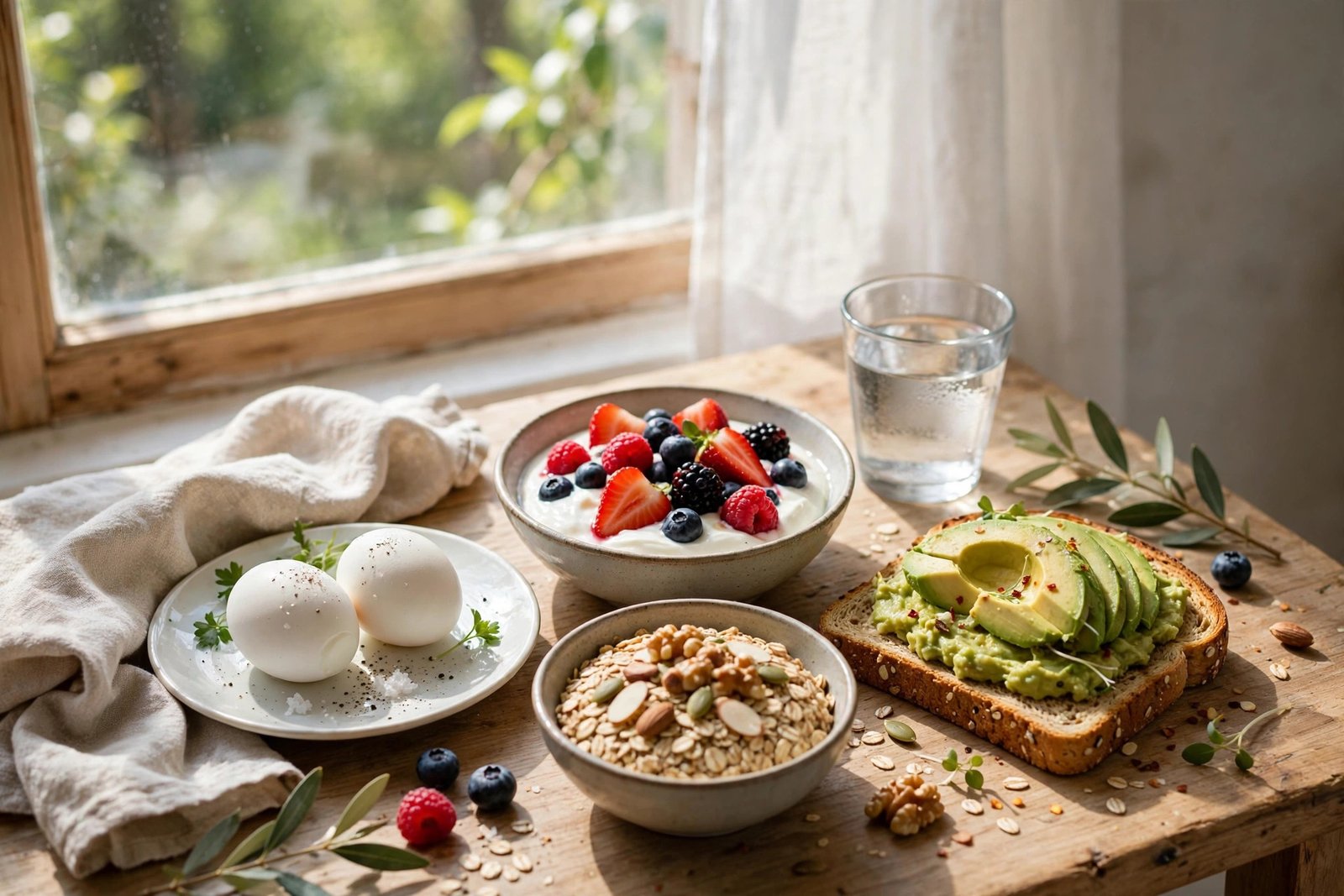
Best breakfast for blood sugar: a breakfast built on protein, fibre, and healthy fat, not on carbohydrates alone. Aim for about 20 g of protein, add fibre and a little fat, and your blood sugar rises slowly and stays steady until lunch. The seven combos below all follow that rule, with portions and glycaemic index numbers you can check.
- The rule is simple: protein plus fibre plus healthy fat slows digestion and blunts the blood sugar rise.
- Protein at breakfast works in trials. In a 12-week study of 56 adults with type 2 diabetes, a whey-protein breakfast cut post-meal glucose by 19% and HbA1c by 0.89% (Jakubowicz et al., 2017).
- Oats are not all equal. Steel-cut oats have a glycaemic index of 52, while instant oat porridge tests at 79. The same grain, very different blood sugar response.
- Skipping breakfast backfires for blood sugar. In a trial of 22 adults with type 2 diabetes, skipping breakfast raised lunch glucose by 36.8% and dinner glucose by 26.6% (Jakubowicz et al., 2015).
- Every combo below gives about 15 to 25 g of protein and uses low-glycaemic-index foods. Check any food on our glycemic index calculator.
Introduction
Breakfast sets the tone for your blood sugar all morning. Get it right and you feel full and steady until lunch. Get it wrong and you spike, crash, and crave something sweet by 10.30 am. The difference is rarely willpower. It is what is on the plate.
This post gives you the rule, the oatmeal mistake, and seven combos with portions and GI numbers.
The Rule: Protein Plus Fibre Plus Healthy Fat
Blood sugar rises fastest when a meal is mostly fast carbohydrate with nothing to slow it down. Protein, fibre, and fat all slow digestion, so glucose enters the blood gradually instead of all at once. That is the whole rule, and every good breakfast for blood sugar follows it.
Protein is the most important part. It slows stomach emptying, triggers fullness hormones, and reduces the glucose rise after eating. In the 2017 trial, three breakfasts had the same calories and differed only in makeup: a whey-protein breakfast with 42 g of protein, a mixed-protein breakfast with 42 g, and a high-carbohydrate breakfast with 17 g. After 12 weeks, the whey breakfast had cut post-meal glucose by 19% and the mixed-protein breakfast by 12% (Jakubowicz et al., Journal of Nutritional Biochemistry, 2017). HbA1c fell by 0.89% in the whey group against 0.36% in the high-carbohydrate group, and the whey group lost the most weight, 7.6 kg against 3.5 kg.
A smaller study found the same effect fast: 50 g of whey 30 minutes before a high-GI breakfast cut glucose over three hours by 28% (Jakubowicz et al., Diabetologia, 2014). You do not need a whey shake: eggs, yogurt, and cottage cheese do the same job.
Fibre is the second part. It slows digestion and helps glucose control: get it from oats, berries, nuts, seeds, or wholemeal bread, not from a supplement. Healthy fat is the third part: nuts, seeds, avocado, and olive oil slow the meal down further. Diabetes UK’s breakfast guidance points the same way: wholegrain toast, porridge or no-added-sugar cereals, unsweetened Greek yogurt with fruit and nuts, and eggs for protein.
A practical target is about 20 g of protein at breakfast, plus fibre and a little healthy fat. Most of the combos below land between 15 and 25 g. If you track calories, work out your daily target with our calories calculator first, then fit breakfast into it.
The Oatmeal Mistake
Oatmeal is the most misunderstood breakfast for blood sugar. It can be one of the best or one of the worst, and the difference is the type of oat and what you add to it.
Steel-cut oats have a glycaemic index of 52, rolled-oat porridge tests at 55, and instant oat porridge at 79. The difference is processing: instant oats are pre-cooked and cut fine, so your body breaks them down fast. A bowl of plain instant oats with honey is, for blood sugar, close to a bowl of sugary cereal.
The fix is easy. Use steel-cut or rolled oats, not instant, and never eat oats alone. Add a spoonful of nuts, a tablespoon of seeds, or a dollop of Greek yogurt. That turns a fast carbohydrate into a slow one.
Bread works the same way: whole wheat is 74 and white is 75, so what goes on the bread matters more than the bread.
Combo 1: Greek Yogurt, Berries, and Almonds
Put 170 g of plain non-fat Greek yogurt in a bowl, add 80 g of mixed berries, and scatter 15 g of almonds on top. That is about 20 g of protein: 17.3 g from the yogurt and about 3 g from the almonds. The yogurt alone is only 100 calories.
Berries are the fruit to choose. Strawberries have a glycaemic index of 25, while blueberries and raspberries test at 53. All three are low, at 55 or under. The almonds add healthy fat and crunch, with a glycaemic index of 15. Use plain yogurt, not flavoured: flavoured yogurts often contain 10 g or more of added sugar per pot.
Combo 2: Two Eggs, Avocado, and Wholemeal Toast
Boil or poach two large eggs, mash half an avocado, and serve both on one slice of wholemeal toast. Two eggs give 12.6 g of protein and 144 calories, and the avocado adds healthy fat and fibre that slow the meal down.
Eggs are almost carbohydrate-free, so they barely move blood sugar, and they keep you full. In a small study of 21 men, an egg breakfast led to about 112 fewer calories at lunch and about 400 fewer over 24 hours than an equal-calorie bagel breakfast (Ratliff et al., Nutrition Research, 2010). The study was small, so treat it as supporting evidence, not proof.
Combo 3: Steel-Cut Oats with Nuts and Seeds
Cook 40 g of dry steel-cut oats in water or milk, then stir in 15 g of chopped almonds and a tablespoon of chia seeds. Steel-cut oats have a glycaemic index of 52, against 79 for instant oats, so this is the same food with a very different blood sugar response.
The nuts and seeds are not decoration: they add protein, fat, and fibre, which slow the oats down further. Chia seeds add about 10 to 11 g of fibre per 28 g serving, with no sugars at all. Cook a batch on Sunday and reheat a portion each day: the oats keep for four days in the fridge.
Combo 4: Whey Smoothie with Berries
Blend one scoop of whey protein with 150 ml of milk and 80 g of berries. Check the label on your whey: most scoops give 20 to 25 g of protein. Add a tablespoon of peanut butter if you want it thicker and more filling.
This is the closest match to the trial breakfast that cut post-meal glucose by 19%. The whey breakfast in that study had 42 g of protein, so a single scoop is about half of that; the milk and berries bring the total up.
Combo 5: Cottage Cheese, Apple, and Peanut Butter
Put 150 g of low-fat cottage cheese on a plate with a sliced apple and a tablespoon of peanut butter for dipping. The cottage cheese gives about 18.6 g of protein, since low-fat cottage cheese has 12.4 g of protein per 100 g, and the peanut butter adds about 3.5 g more.
Cottage cheese is mostly casein, a slow-digesting protein that keeps you full for hours. The apple, with a glycaemic index of 39, adds fibre and crunch. One tablespoon of peanut butter is enough here: measure it, because a heaped spoon from the jar can easily be double.
Combo 6: Peanut Butter, Apple, and a Boiled Egg on Wholemeal Toast
Spread 2 tablespoons of peanut butter on one slice of wholemeal toast, add sliced apple, and eat a boiled egg on the side. The peanut butter gives 7.1 g of protein and the egg 6.3 g, for about 13 to 14 g in total, plus the fibre from the apple and the toast.
This is the combo for people who want something sweet-tasting without sugar. The apple gives sweetness and fibre, the peanut butter gives fat and protein, and the egg lifts the protein high enough to keep you full. Boil the egg the night before and it takes five minutes.
Combo 7: Chia Pudding with Greek Yogurt and Berries
Mix 28 g of chia seeds with 100 g of plain Greek yogurt and 80 g of berries, and leave it in the fridge overnight. The chia seeds absorb liquid and set into a pudding by morning. The seeds give about 4 to 5 g of protein and 10 to 11 g of fibre, and the yogurt adds about 10 g of protein, for about 14 to 15 g in total.
Chia pudding is the highest-fibre combo in this list. The seeds have no sugars at all, and their glycaemic index is very low. Make two or three pots on Sunday night and they will keep for three days.
What to Avoid at Breakfast
Four breakfasts spike blood sugar reliably. First, sugary cereal with milk: fast carbohydrate with almost no protein or fibre. Second, fruit juice and smoothies made from juice: a glass of orange juice has about as much sugar as a soft drink, and without the fibre of whole fruit it hits the blood fast. Diabetes UK advises limiting juice to 150 ml once a day.
Third, pastries, croissants, and muffins: refined flour, sugar, and fat with almost no protein or fibre. Fourth, plain instant oats with honey, the oatmeal mistake from earlier in this post. All four share the same pattern: fast carbohydrate, little protein, little fibre. If your breakfast matches that pattern, add protein and fibre rather than skipping breakfast.
Should You Skip Breakfast to Control Blood Sugar?
Skipping breakfast sounds logical: no breakfast, no blood sugar rise. The trials say the opposite. In a 2015 trial, 22 adults with type 2 diabetes ate the same 700-calorie lunch and dinner on two days, once after breakfast and once after fasting until noon. On the no-breakfast day, lunch glucose was 36.8% higher and dinner glucose 26.6% higher (Jakubowicz et al., Diabetes Care, 2015).
That was a small study in people with type 2 diabetes, so it does not prove the same effect in everyone. If you have diabetes, talk to your clinician or dietitian about your breakfast plan rather than copying a fasting routine from the internet.
Build Your Own Breakfast
Use the rule to build a breakfast from whatever you have. Pick one protein, such as eggs, Greek yogurt, cottage cheese, or whey. Add one fibre source, such as oats, berries, apple, nuts, or seeds, and a little healthy fat, such as nuts, seeds, avocado, or peanut butter. Keep added sugar out, and keep the fast carbohydrate portion smaller than the protein portion.
Check any food on our glycemic index calculator, work out your protein target with our protein intake calculator, and read our guide to foods that spike blood sugar. If your weight has stalled, our guide to how to break a weight loss plateau covers the next steps.
Frequently Asked Questions
What is the best breakfast for blood sugar?
A breakfast built on protein, fibre, and healthy fat: about 20 g of protein plus fibre and a little fat, with no added sugar. Examples are Greek yogurt with berries and nuts, eggs with avocado on wholemeal toast, or steel-cut oats with nuts and seeds.
Does oatmeal spike blood sugar?
It depends on the type. Steel-cut oats have a glycaemic index of 52 and rolled oats 55, both low, while instant oat porridge tests at 79. Plain instant oats with honey will spike blood sugar, but steel-cut oats with nuts and seeds will not.
Are eggs good for blood sugar?
Yes. Eggs are almost carbohydrate-free, so they barely move blood sugar, and they are high in protein, with 6.3 g per large egg. In a small study, an egg breakfast led to about 112 fewer calories at lunch than an equal-calorie bagel breakfast.
Should I skip breakfast to control blood sugar?
No. In a trial of 22 adults with type 2 diabetes, skipping breakfast raised lunch glucose by 36.8% and dinner glucose by 26.6%, even though lunch and dinner were identical. Eat a protein-rich breakfast instead, and talk to your clinician if you have diabetes.
What breakfast keeps you full until lunch?
One with about 20 g of protein, fibre, and healthy fat: for example, 170 g of Greek yogurt with berries and almonds, or cottage cheese with apple and peanut butter. A carbohydrate-only breakfast, such as toast with jam or sugary cereal, will leave you hungry within two hours.
—
Sources
- Atkinson FS, Foster-Powell K, Brand-Miller JC. Diabetes Care. 2008;31(12):2281-2283. International tables of glycaemic index: steel-cut oats 52, rolled oats 55, instant oats 79, whole wheat 74, white bread 75. https://pmc.ncbi.nlm.nih.gov/articles/PMC2584181/
- Jakubowicz D, Barnea M, Wainstein J, Froy O. Journal of Nutritional Biochemistry. 2017;49:1-7. Whey breakfast cut post-meal glucose by 19% and HbA1c by 0.89% over 12 weeks. https://pubmed.ncbi.nlm.nih.gov/28863364/
- Jakubowicz D, Froy O, Ahrén B, et al. Diabetologia. 2014;57(9):1807-1811. 50 g whey before a high-GI breakfast cut glucose over 180 minutes by 28% in 15 adults with type 2 diabetes. https://pubmed.ncbi.nlm.nih.gov/25005331/
- Jakubowicz D, Wainstein J, Ahren B, et al. Diabetes Care. 2015;38(10):1820-1826. Skipping breakfast raised lunch glucose by 36.8% and dinner glucose by 26.6%. https://www.ncbi.nlm.nih.gov/pubmed/26220945
- Ratliff J, Leite JO, de Ogburn R, Puglisi MJ, VanHeest J, Fernandez ML. Nutrition Research. 2010;30:96-103. Egg breakfast led to about 112 fewer calories at lunch than a bagel breakfast, in 21 men. https://medicalxpress.com/news/2010-04-eggs-breakfast-calorie-consumption-day.html
- WebMD. “Fruit and Diabetes.” Strawberries GI 25, blueberries and raspberries GI 53, apples GI 39. https://www.webmd.com/diabetes/fruit-diabetes
- Diabetes UK. “Healthy swaps: breakfast.” Wholegrain toast, porridge or no-added-sugar cereals, unsweetened Greek yogurt with fruit and nuts, eggs for protein, juice limited to 150 ml. https://www.diabetes.org.uk/living-with-diabetes/eating/healthy-swaps/healthy-swaps-breakfast
- USDA FoodData Central. Egg (FDC 171287): 72 kcal, 6.3 g protein. Greek yogurt, plain, nonfat (FDC 170894): 17.3 g protein per 170 g. Cottage cheese, lowfat, 1% (FDC 173417): 12.4 g protein per 100 g. Peanut butter (FDC 174266): 7.1 g protein per 2 tbsp. Chia seeds: 4 to 5 g protein, 10 to 11 g fibre per 28 g. https://www.proteinpalapp.com/articles/how-much-protein-in-cheese-yogurt-cottage-cheese
- Weight Insider. Glycemic index calculator, protein intake calculator, calories calculator, foods that spike blood sugar, and how to break a weight loss plateau.
Last updated: 18 November 2026
Medical Disclaimer
This article is general information only. It is not medical advice, and it is not a substitute for advice from a qualified health professional. If you have diabetes or another condition that affects your blood sugar, talk to your doctor or a registered dietitian before changing your diet. Do not change any diabetes medication based on this article.