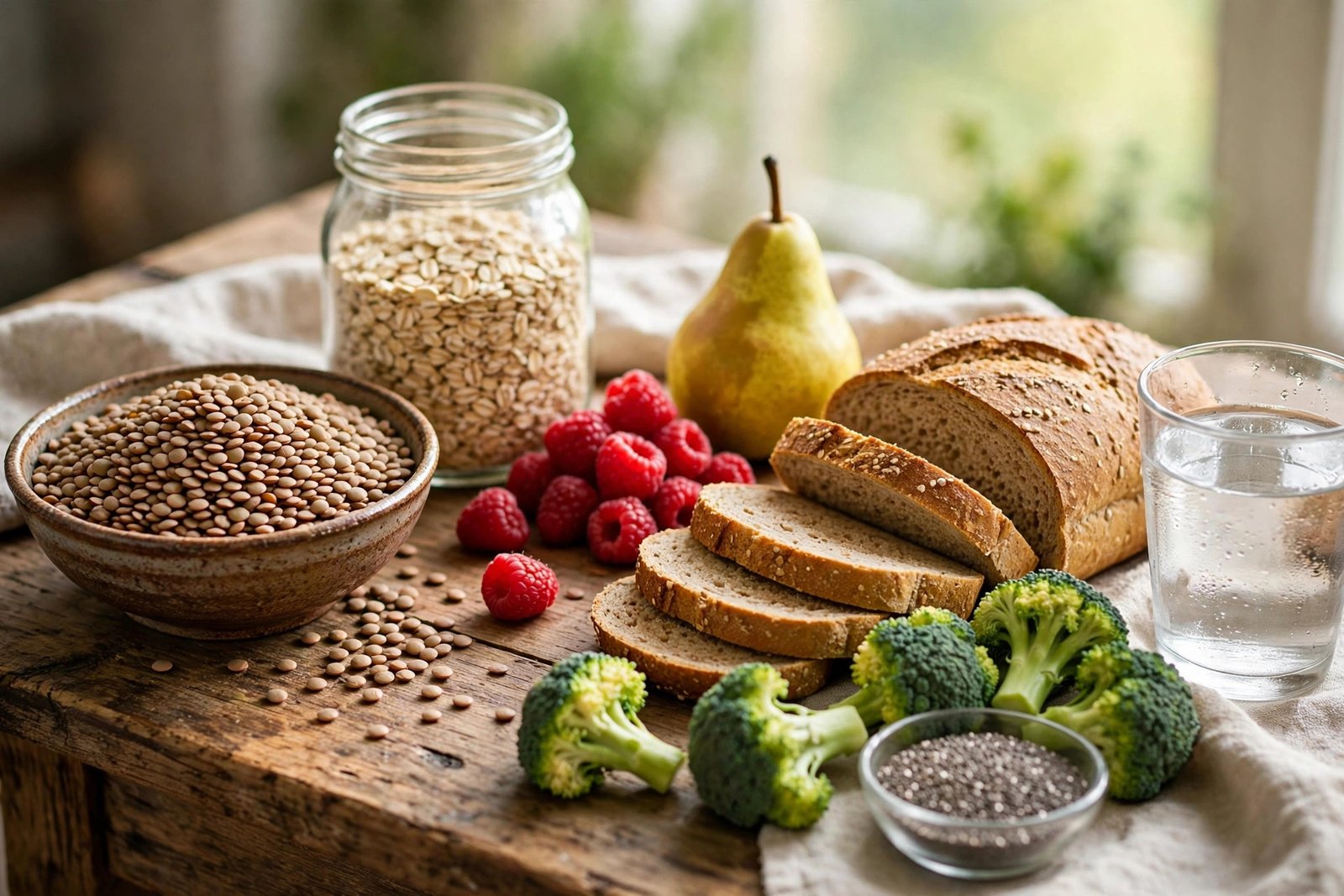
Fibermaxxing side effects are mild and short-lived: some bloating, wind, and a gurgly stomach for the first week or two, while your gut bacteria adjust to the extra fibre. The fix is to go slowly, adding about 5 grams of fibre a week, drink more water as you go, and keep portions of the gassiest foods small at first. Bloating that is severe, painful, or still there after a couple of weeks needs a doctor.
- Fibermaxxing means eating about 30 to 40 grams of fibre a day from real food. The UK recommendation is 30 grams a day for adults (Scientific Advisory Committee on Nutrition, 2015), and Mayo Clinic suggests 30 to 40 grams a day for most healthy adults (Kashyap, Mayo Clinic News Network, 2026). Most adults eat only 15 to 20 grams a day, so the jump is the problem.
- Bloating happens because gut bacteria ferment fibre and produce gas. A sudden jump from 15 grams to 35 grams gives them far more to ferment than they are used to.
- Add about 5 grams of fibre a week, and reach 30 grams in about three weeks from a starting point of 15 grams. Mayo Clinic suggests an even gentler ramp of about 3 grams a week for sensitive stomachs.
- Water is the second half of the plan. Mayo Clinic suggests aiming for 80 ounces, about 2.4 litres, of water a day while increasing fibre, and the NHS suggests 6 to 8 glasses of fluid a day. Fibre soaks up water, and without enough fluid it can make constipation worse.
- Beans, lentils, chickpeas, broccoli, cauliflower, onions, and garlic are the foods most likely to cause gas, along with fizzy drinks and sugar-free sweets. Start with small portions, rinse canned beans well, and eat slowly.
Introduction
Fibermaxxing started as a social media trend, but the idea behind it is sound: most of us eat about half the fibre we should, and eating more of it helps us feel full, steadies our blood sugar, and looks after our gut. The trouble starts when people try to max out their fibre overnight, jumping from 15 grams a day to 40 grams in a single day. That is when the bloating, wind, and cramps arrive, and when many people give up on fibre altogether.
This post is the missing instruction manual: why fibre causes bloating, the slow ramp that avoids it, how much water you need, which foods cause the most gas, and when bloating is a sign to see a doctor. If you have already read our guide to fibermaxxing for weight loss, this is the companion piece.
What Is Fibermaxxing?
Fibermaxxing is a social media word for maximising your fibre intake, usually with a target of about 30 grams a day from whole foods: beans, lentils, oats, whole grains, fruit, and vegetables. It works by adding food, not taking it away, so you snack less without trying so hard. Set your protein target with our protein intake calculator as well.
The target is not a guess. In the UK, the recommendation for adults is 30 grams a day, set by the Scientific Advisory Committee on Nutrition in 2015. In the US, the advice works out at about 25 grams a day for women and 38 grams for men aged 19 to 50. The National Institute of Diabetes and Digestive and Kidney Diseases gives a general adult range of 22 to 34 grams a day, and Mayo Clinic puts it at 30 to 40 grams a day for most healthy adults. A Lancet meta-analysis found the greatest risk reduction at 25 to 29 grams a day (Reynolds et al., The Lancet, 2019).
Most of us are a long way from that: the average adult in the UK and the US eats only about 15 to 20 grams a day, roughly half of what is recommended. Closing a 15 gram gap in one day is what causes the side effects this post is about.
Why Does Fibre Cause Bloating?
Fibre is the part of plant food your body cannot digest. It travels mostly intact to your large bowel, where trillions of bacteria ferment it. That fermentation feeds the gut bacteria and supports gut health, and it also produces gas.
Your gut bacteria are used to whatever you normally eat. Give them a sudden glut of fibre and they produce more gas than your bowel is used to dealing with, so you feel bloated, gurgly, and windy. The gut does adapt: the bacteria shift to match the new diet, and the gas usually settles within a couple of weeks. That is why the first two weeks are the worst, and why most people who push through them find the symptoms fade on their own.
Two other things make bloating worse: too little water, because fibre soaks up water to do its job, and without enough fluid it can make stools hard and slow; and eating fast and swallowing air, which adds gas on top of the gas your bacteria are already making. Both are fixable, and both are covered below.
The 5 Gram a Week Ramp
The single most effective way to avoid bloating is to add fibre slowly: about 5 grams a week, following our site’s fibermaxxing guide. From a starting point of 15 grams a day, you reach 30 grams in about three weeks, and 35 grams in about four weeks.
| Week | Daily fibre target | What to add |
|---|---|---|
| Starting point | About 15 g | Work out where you are now for 3 days, and set your daily target with our calories calculator |
| Week 1 | About 20 g | Fix breakfast: porridge or wholemeal toast |
| Week 2 | About 25 g | Add legumes twice: a few spoonfuls of beans or lentils in soup or salad |
| Week 3 | About 30 g | Upgrade snacks and sides: an apple with nuts, an extra vegetable at dinner |
| Week 4 | About 30 to 35 g | Take stock; add one more food only if still short |
If your stomach is sensitive, or you have IBS, go slower. Mayo Clinic suggests adding about 3 grams a week and holding each level for 7 to 10 days, and the National Institute of Diabetes and Digestive and Kidney Diseases advises people with IBS to add fibre by 2 to 3 grams a day. The exact pace matters less than the principle: one small change, lived with for several days, then the next.
If a step makes you uncomfortable, do not push on to the next one. Stay at the level you reached until the symptoms settle, then try again more slowly. The goal is 30 grams a day for life.
Water: The Second Half of the Plan
Fibre and water work together, and increasing one without the other is the most common mistake after going too fast. Fibre absorbs water, which keeps stools soft and easy to pass. Add fibre without drinking more and you can end up constipated, and the bloating gets worse rather than better.
Mayo Clinic suggests aiming for 80 ounces, about 2.4 litres, of water a day while increasing fibre. The NHS suggests 6 to 8 glasses of fluid a day. Both figures are guides, not prescriptions: how much fluid you need depends on your size, your health, your activity, and where you live, so ask a health care professional if you are unsure.
Drink a glass of water with each meal and sip through the day, and add an extra glass with each high-fibre food. Tea, coffee, lower-fat milk, and sugar-free drinks all count towards fluid, and so do soups. Spread it out through the day rather than making up for a dry morning in one go.
The Foods Most Likely to Cause Gas
Not all high-fibre foods are equal when it comes to gas. The worst offenders are the foods with the most fermentable fibre, the ones your gut bacteria love most. That does not mean you should avoid them: start with small portions and build up, because they are also the foods with the most fibre per serving.
| Food | Fibre per serving (approx.) | Gas risk | How to handle it |
|---|---|---|---|
| Lentils, cooked, 1 cup | About 15 g | High | Start with a few spoonfuls |
| Black beans, cooked, 1 cup | About 15 g | High | Rinse canned beans well |
| Kidney beans, cooked, 1 cup | About 13 g | High | Start small |
| Chickpeas, cooked, 1 cup | About 12 g | High | Try hummus first |
| Broccoli, cooked, 1 cup | About 5 g | Medium to high | Cook it well |
| Onions and garlic | Small amounts | Medium to high | Cook them, use less at first |
| Apple with skin, 1 medium | About 4 g | Medium | Eat it slowly |
| Oats, half a cup dry | About 4 g | Low to medium | A gentle place to start |
Fizzy drinks add gas directly to your stomach, and sugar-free sweets and chewing gum sweetened with sorbitol or xylitol can cause gas and bloating on their own. If you are fibermaxxing and still bloated, check these before blaming the beans.
Soluble fibre, the kind in oats, beans, and apples, dissolves in water and slows digestion down, which is good for fullness and blood sugar but can mean more gas at first. Insoluble fibre, the kind in bran and skins, adds bulk and speeds things along. You need both kinds, from a variety of foods. Eat slowly, chew well, and spread your fibre across the day instead of loading it into one meal: 10 grams at breakfast, 10 at lunch, and 10 at dinner is far easier on your gut than a single 30 gram bean feast at dinner. A gentle 10 to 15 minute walk after eating helps gas move through, too.
When Bloating Needs a Doctor
Mild bloating in the first week or two of eating more fibre is normal, and it usually settles as your gut adapts. Some bloating is not normal, and it should not be waited out: see a doctor promptly if your bloating is severe or painful, if it does not settle after a couple of weeks, or if it comes with ongoing diarrhoea, ongoing constipation, blood in your stool, or unexplained weight loss.
See a doctor sooner if bloating keeps you awake at night, if your stomach swells visibly and stays swollen, if you have a fever with your gut symptoms, or if you cannot pass wind or stools at all. The same applies if you have IBS, Crohn’s disease, ulcerative colitis, or diverticulitis: a sudden jump in fibre can make symptoms worse, so talk to your doctor or a dietitian before you start fibermaxxing.
After bowel surgery, or during a flare-up of a gut condition, doctors often recommend a low-fibre diet. Do not start fibermaxxing then unless your doctor says it is safe. Fibre is best obtained from food rather than supplements, and if you do use a supplement such as psyllium husk, start small, take it with a full glass of water, and check with your doctor or pharmacist first if you take regular medicines, because fibre can affect how some medicines are absorbed. And if tracking food or hitting a daily number tends to make you anxious, or you have a history of disordered eating, forget the number and focus on a varied diet instead.
Frequently Asked Questions
How long does fibermaxxing bloating last?
Usually one to two weeks. Bloating happens because gut bacteria ferment the extra fibre and produce gas, and it settles as the bacteria adjust. Adding about 5 grams a week, drinking enough water, and eating slowly all shorten it. If bloating has not settled after a couple of weeks, see a doctor.
How much fibre should I eat a day?
About 30 grams a day is a good target for most adults: it is the UK recommendation, and Mayo Clinic suggests 30 to 40 grams a day for most healthy adults. In the US the advice is about 25 grams a day for women and 38 grams for men aged 19 to 50. Most adults eat only 15 to 20 grams a day, so build up slowly.
What foods cause the most gas when fibermaxxing?
Beans, lentils, chickpeas, broccoli, cauliflower, onions, and garlic are the most likely to cause gas, because they contain the most fermentable fibre. Fizzy drinks and sugar-free sweets sweetened with sorbitol or xylitol can also cause gas. Start with small portions, rinse canned beans well, cook vegetables thoroughly, and build up over two to three weeks.
Does drinking water help with fibre bloating?
Yes. Fibre soaks up water to do its job, and without enough fluid it can make stools hard and constipation worse. Mayo Clinic suggests aiming for 80 ounces, about 2.4 litres, of water a day while increasing fibre, and the NHS suggests 6 to 8 glasses of fluid a day. Drink a glass of water with each meal and sip through the day.
When should I see a doctor about bloating?
See a doctor if bloating is severe or painful, does not settle after a couple of weeks, keeps you awake at night, or comes with ongoing diarrhoea, ongoing constipation, blood in your stool, unexplained weight loss, or a fever. Talk to your doctor before fibermaxxing if you have a gut condition or take regular medication.
—
Sources
- Scientific Advisory Committee on Nutrition. “Carbohydrates and Health.” 2015. Set the UK 30 g a day recommendation. https://assets.publishing.service.gov.uk/government/uploads/system/uploads/attachment_data/file/445503/SACN_Carbohydrates_and_Health.pdf
- NHS. “How to get more fibre into your diet.” Fibre should increase to 30 g a day; most adults eat about 20 g. https://www.nhs.uk/live-well/eat-well/digestive-health/how-to-get-more-fibre-into-your-diet/
- Kashyap P. “Mayo Clinic Q and A: Why is fiber good for your overall health?” Mayo Clinic News Network, 13 March 2026. Aim for 30 to 40 grams a day; increase by about 3 grams a week, hold each level for 7 to 10 days, and aim for 80 ounces of water a day. https://newsnetwork.mayoclinic.org/discussion/mayo-clinic-qa-why-is-fiber-good-for-your-overall-health/
- National Institute of Diabetes and Digestive and Kidney Diseases. “Eating, Diet, and Nutrition for Constipation.” 22 to 34 grams a day; add fibre a little at a time, and drink plenty of liquids. https://www.niddk.nih.gov/health-information/digestive-diseases/constipation/eating-diet-nutrition
- National Institute of Diabetes and Digestive and Kidney Diseases. “Eating, Diet, and Nutrition for Irritable Bowel Syndrome.” Adding fibre by 2 to 3 grams a day may help prevent gas and bloating. https://www.niddk.nih.gov/health-information/digestive-diseases/irritable-bowel-syndrome/eating-diet-nutrition
- Reynolds A, Mann J, Cummings J, Winter N, Mete E, Te Morenga L. “Carbohydrate quality and human health: a series of systematic reviews and meta-analyses.” The Lancet. 2019;393(10170):434-445. Greatest risk reduction at 25 to 29 grams a day. https://pubmed.ncbi.nlm.nih.gov/30638909/
- Weight Insider. Fibermaxxing for weight loss and calories calculator.
Last updated: 17 November 2026
Medical Disclaimer
This article is general information only. It is not medical advice, and it is not a substitute for advice from a qualified health professional. Talk to your doctor, or a registered dietitian, before changing your diet, especially if you have a digestive condition, take regular medication, are pregnant or breastfeeding, or have a history of disordered eating. If bloating is severe or painful, or does not settle, seek medical advice promptly.