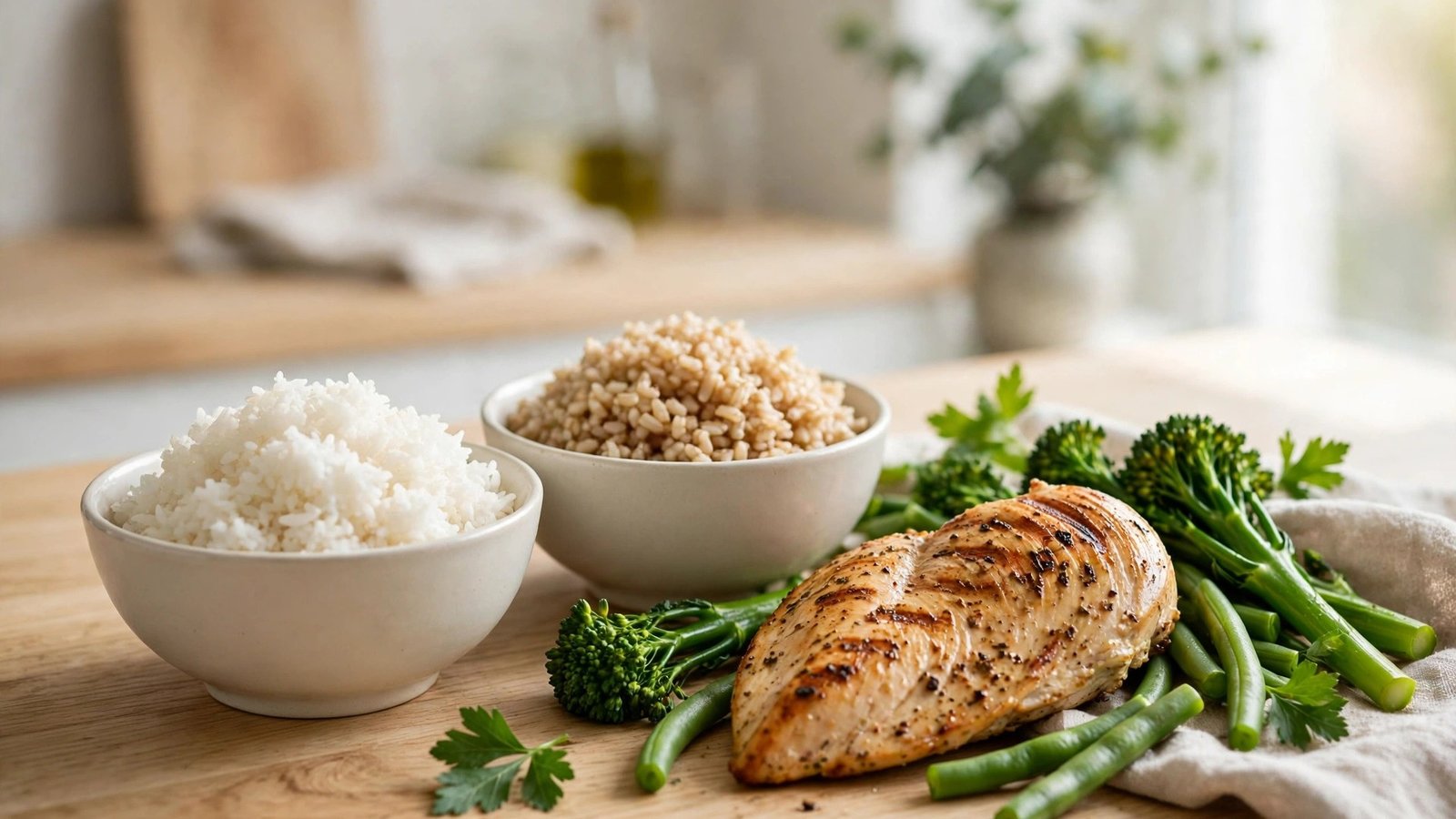
In short: Is rice good for weight loss? Yes, in the right portion and with the right foods next to it. Rice is not fattening on its own: cooked white rice is about 130 kcal per 100 g, and a 150 to 200 g portion is about 195 to 260 kcal. Brown rice has a lower glycaemic index, commonly quoted at 50 to 55 against white rice at 64 to 72, and more fibre, but the difference per portion is small. What matters most is the portion size, what you pair it with, and one trick: cooling cooked rice overnight adds resistant starch and lowers the blood sugar response.
- Rice fits a weight loss plan because it is low in fat and easy to portion. The problem is almost never the rice itself: it is the serving, which in restaurants and takeaways is often 300 to 400 g, about 390 to 520 kcal of white rice before anything else is on the plate.
- White rice has a glycaemic index commonly quoted at 64 to 72, and brown rice at 50 to 55, but tested values vary widely by variety: some brown rice tests as high as 86, jasmine white rice tests 79 to 109, and basmati tests about 57 to 58. Variety matters more than colour.
- A 150 to 200 g cooked portion is the sweet spot: about 195 to 260 kcal of white rice or about 165 to 220 kcal of brown rice, with room on the plate for protein and vegetables.
- Cooling cooked rice for 24 hours in the fridge and then reheating it more than doubles its resistant starch, from 0.64 to 1.65 g per 100 g in a 2015 trial, and lowers the blood sugar response. It does not make rice calorie free, and it must be cooled quickly and reheated only once.
- Pair rice with protein and vegetables, not with more starch: a palm-and-a-half of chicken or fish plus a plate that is half vegetables turns the same bowl of rice into a meal that keeps you full for hours.
Introduction
Rice is the most eaten food on earth, and one of the most argued about in weight loss. Some people cut it out completely the moment they start a diet. Others eat it at every meal and stay slim. Both groups are half right: rice is neither a fat loss food nor a fat gain food. Its effect depends almost entirely on how much of it you eat and what you eat with it.
This post compares white and brown rice with honest glycaemic index numbers, gives you the portion that works for weight loss, explains the cooling trick with the actual trial behind it, and shows you how to build a plate around rice that keeps you full. No food is banned here, and no food is magic either.
White Rice vs Brown Rice: What Is Actually Different
White rice and brown rice start as the same grain. Brown rice keeps its bran and germ, the outer layers that carry fibre, magnesium, and B vitamins, while white rice has those layers milled away, leaving mostly the starchy endosperm. That single difference explains almost everything that follows.
Per 100 g cooked, white rice is about 130 kcal with about 0.4 g of fibre, and brown rice is about 111 kcal with about 1.8 g of fibre, according to USDA FoodData Central. So brown rice is slightly lower in calories and noticeably higher in fibre, which helps fullness. But the difference per portion is small: a 200 g serving of white rice is about 260 kcal against about 220 kcal for brown. Swapping white for brown saves about 40 kcal, which is real, but the portion matters far more.
Brown rice also takes longer to cook, about 40 to 45 minutes against 15 to 20 for white, and it has a nuttier taste and a chewier texture. If you dislike brown rice, do not force it down: white rice in the right portion, paired well, works fine.
The Glycaemic Index Numbers, Honestly
The glycaemic index measures how quickly a food raises blood sugar, on a scale where pure glucose is 100: low is 55 or less, medium is 56 to 69, and high is 70 or more. The numbers most often quoted for rice are white rice at 64 to 72 and brown rice at 50 to 55, from the international GI tables of Atkinson and colleagues (2008) and the University of Sydney GI database.
Those numbers are real, but they are not the whole story. Tested brown rice actually spans 50 to 86 depending on the variety, with an international average near 65 to 68, which is medium, not low. Jasmine white rice tests 79 to 109, basmati about 57 to 58, which is lower than most brown rice, and parboiled rice, steamed in its husk before milling, tests about 38, which is genuinely low.
| Rice type | GI, tested range | Band |
|---|---|---|
| Parboiled white rice | About 38 | Low |
| Basmati white rice | About 57 to 58 | Medium |
| Brown rice, high amylose varieties | 50 to 66 | Low to medium |
| Long grain white rice | About 62 to 73 | Medium to high |
| Brown rice, general average | About 65 to 68 | Medium |
| Jasmine white rice | 79 to 109 | High |
The practical lesson is that variety matters more than colour. If blood sugar is your main concern, basmati or parboiled white rice beats an average brown rice, and jasmine is the worst choice of the common types. Choose basmati or parboiled when you can, and treat jasmine as an occasional food. You can check how a food’s GI fits your day with our glycemic index calculator.
The Portion That Works for Weight Loss
Here is where most rice eaters go wrong. A standard restaurant or takeaway serving is 300 to 400 g cooked, about 390 to 520 kcal of white rice before the curry, sauce, or stir fry is added. At home, a heaped serving from a large spoon can easily reach the same weight without looking large, because cooked rice is dense and it settles.
The portion that works for weight loss is 150 to 200 g cooked, about 195 to 260 kcal of white rice or about 165 to 220 kcal of brown rice. In everyday terms, that is about one cup cooked, a fist-sized mound, or roughly a third of a dinner plate. Weigh it for the first week: most people find the portion they thought was 150 g is usually 250 g or more, and that extra 100 g is about 130 kcal a day, or about 900 kcal a week, enough to stall a weight loss plan on its own.
Build the plate around the portion, not the other way round: half the plate vegetables or salad, a quarter protein, and a quarter rice. That plate is about 450 to 550 kcal with a proper serving of chicken, fish, lentils, or tofu, and it keeps you full for three to four hours. The same rice with no vegetables and a small piece of protein is the same calories but half the fullness.
The Cooling Trick: Resistant Starch
This is the most useful rice trick in the research, and also the most exaggerated online, so here is what the trial actually found. When cooked rice cools, some of its starch molecules reorganise into resistant starch, which resists digestion in the small intestine and behaves more like fibre. Food scientists call the process retrogradation.
In a 2015 randomised crossover trial by Sonia and colleagues, 15 healthy adults ate freshly cooked white rice and the same rice cooled for 24 hours at 4C and then reheated. Resistant starch rose from 0.64 to 1.65 g per 100 g, more than double, and the blood sugar response over two hours fell from 152 to 125 mmol min/L. A 2022 study in Nutrition and Diabetes found a similar pattern in 32 people with type 1 diabetes: peak blood sugar was about 10 mmol/L after cooled and reheated rice, against about 11 mmol/L after fresh rice.
That is a real effect, but keep it in proportion. The extra resistant starch is about 1 g per 100 g of rice, roughly 10 to 15 kcal less absorbed per portion, not a free pass to eat twice as much. Cooling does not turn rice into a low calorie food, and a lower blood sugar response in one meal is not proof of weight loss over months. What the trick does, modestly, is blunt the blood sugar rise and add a little fibre-like starch to a food that has almost none.
How to do it safely: cook the rice, cool it quickly, ideally within one hour, refrigerate it overnight, and reheat it once, thoroughly, the next day. Never leave cooked rice at room temperature overnight, and never reheat it more than once: rice can carry bacteria that grow quickly at warm temperatures. This is UK Food Standards Agency guidance. Cook a batch on Sunday and reheat portions through the week, one reheating each.
Pairing Rice With Protein
Rice on its own is mostly carbohydrate, and carbohydrate on its own digests fast and leaves you hungry. Protein slows that down, and it is the single best thing you can add to a rice meal. Aim for 1.2 to 1.6 g of protein per kg of body weight a day, the range our protein intake calculator uses. For a 70 kg person that is 84 to 112 g a day, or about 25 to 40 g at each meal.
On a plate, that is a palm and a half of grilled chicken, fish, or tofu, or a cup of lentils or beans, next to your 150 to 200 g of rice. Add vegetables for volume and fibre, a big salad, steamed broccoli, stir fried greens, or roasted vegetables, and a little healthy fat, a teaspoon of olive oil or a few nuts. This is the plate that works: rice for energy, protein for fullness and muscle, vegetables for volume, and a little fat for satisfaction.
Work out the whole day with our TDEE calculator and our calories calculator, and use our macro calculator to split your calories between protein, carbohydrate, and fat. Rice fits easily into any of those splits: it is just carbohydrate, a fuel, not a problem, when the portion is right.
Three Rice Meals That Work for Weight Loss
Here are three complete meals, each built on a 150 to 200 g portion of cooked rice.
Chicken and vegetable stir fry
150 g cooked basmati rice, about 195 kcal, 150 g grilled chicken breast, about 250 kcal, and a large pan of stir fried vegetables with a teaspoon of oil, about 120 kcal. Total about 565 kcal, with about 45 g of protein.
Lentil and brown rice bowl
180 g cooked brown rice, about 200 kcal, a cup of cooked lentils, about 230 kcal, and a big salad with cucumber, tomato, and lemon, about 60 kcal. Total about 490 kcal, with about 20 g of protein and about 12 g of fibre.
Egg fried rice, done properly
150 g cooked rice cooled overnight and reheated, about 195 kcal, two eggs, about 140 kcal, a cup of mixed vegetables, about 60 kcal, and a teaspoon of oil, about 40 kcal. Total about 435 kcal, with about 16 g of protein. Day-old rice fries better anyway, because it is drier, and you get the resistant starch as a bonus.
Frequently Asked Questions
Is rice good for weight loss?
Yes, in the right portion and paired with protein and vegetables. Cooked white rice is about 130 kcal per 100 g, and a 150 to 200 g portion is about 195 to 260 kcal. Rice is low in fat and easy to portion, and it fits a weight loss plan when the serving is measured.
Is brown rice better than white rice for weight loss?
Slightly, but not by much. Brown rice has more fibre, about 1.8 g per 100 g against 0.4 g, and a little fewer calories, about 111 kcal per 100 g against 130 kcal, so a 200 g portion saves about 40 kcal. The bigger difference is the glycaemic index, though tested values vary widely by variety, and basmati white rice tests lower than most brown rice.
How much rice should I eat to lose weight?
About 150 to 200 g cooked per meal, about one cup or a fist-sized mound. Weigh it for the first week, because most people serve themselves 250 g or more without realising it. Fill the rest of the plate with vegetables and protein.
Does cooling rice really reduce calories?
Cooling cooked rice for 24 hours in the fridge and reheating it more than doubles its resistant starch, from 0.64 to 1.65 g per 100 g in a 2015 trial, and lowers the blood sugar response. The calorie saving is small, roughly 10 to 15 kcal per portion: a useful trick, not a free pass to eat more rice.
What is the lowest GI rice?
Parboiled white rice tests about 38, which is genuinely low, and basmati tests about 57 to 58. Jasmine is the highest of the common types at 79 to 109, and brown rice varies widely, from 50 to 86 depending on variety, so the type matters more than the colour.
—
Sources
- Atkinson FS, et al. “International tables of glycemic index and glycemic load values: 2008.” Diabetes Care. 2008;31(12):2281-2283. https://doi.org/10.2337/dc08-1239
- University of Sydney GI Foundation. Glycemic Index Database and GI News, “Your GI shopping guide: rice,” December 2020. https://glycemicindex.com/
- USDA FoodData Central. Cooked white rice about 130 kcal per 100 g with about 0.4 g fibre; cooked brown rice about 111 kcal per 100 g with about 1.8 g fibre. https://fdc.nal.usda.gov/
- Sonia S, et al. 2015 randomised crossover trial, 15 healthy adults: resistant starch 0.64 to 1.65 g per 100 g after 24 hours at 4C and reheating, glucose response 152 to 125 mmol min/L. Reported in Glycemic-Index.org, “Resistant Starch and Blood Sugar: Cooling Carbs Explained.” https://www.glycemic-index.org/resistant-starch-and-blood-sugar.html
- UK Food Standards Agency. Rice safety guidance: cool quickly, ideally within one hour, keep refrigerated no more than one day, reheat once, steaming hot throughout. Reproduced at Health Well. https://healthwell.eani.org.uk/healthtopic/food-safety/rice
- Vively. “White rice vs brown rice: which is better for blood sugar?” Tested GI ranges by variety. https://www.vively.com.au/post/white-rice-vs-brown-rice-glucose
- Weight Insider. Glycemic index calculator, protein intake calculator, TDEE calculator, calories calculator, and macro calculator.
Medical Disclaimer
This article is general information only. It is not medical advice, and it is not a substitute for advice from a qualified health professional. The glycaemic index values quoted here are tested ranges that vary by variety, brand, and cooking method, and your own blood sugar response may differ. If you have diabetes or any condition affected by blood sugar, talk to your doctor or a registered dietitian about how rice fits your eating plan, and always follow food safety guidance when cooling and reheating rice.