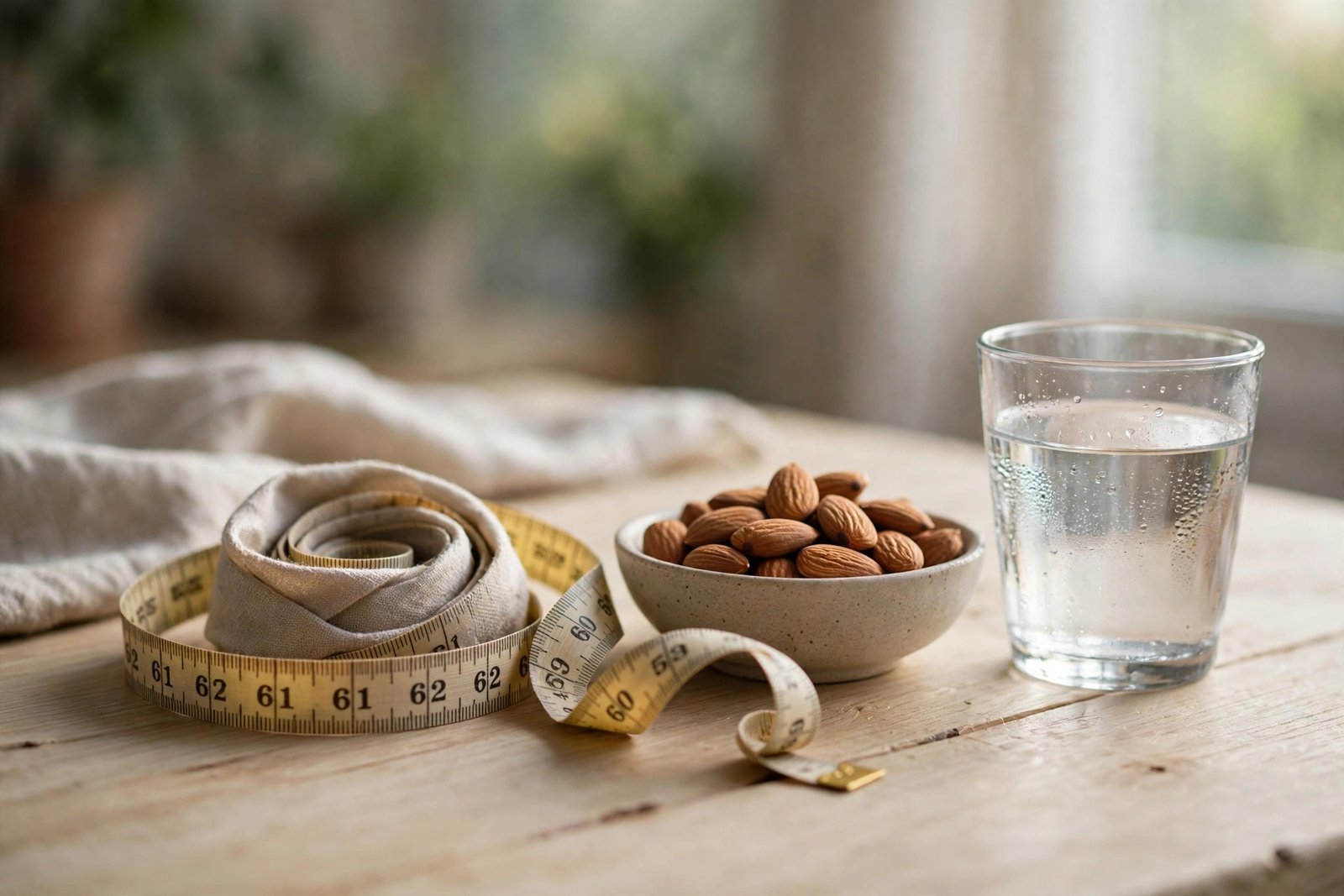
What is cortisol belly and how do I lose it? Cortisol belly is not a medical diagnosis: it is the popular name for belly fat that builds up during long stretches of stress. Cortisol does tilt fat storage towards the belly, but it is rarely the only cause, and no drink or supplement flushes it away. What works is the same set of levers that works for any belly fat: sleep first, then a modest calorie deficit, then 150 minutes of aerobic exercise a week, then strength training and enough protein. Expect the waist to move in 8 to 12 weeks.
- Cortisol follows a daily rhythm: it peaks within 30 to 45 minutes of waking and falls to its lowest point around midnight. Its half-life in blood is 60 to 90 minutes, and the liver clears it.
- Belly fat carries more cortisol receptors than fat on the hips or thighs, and an enzyme inside it can regenerate active cortisol locally.
- A waist above 88 cm in women and 102 cm in men marks higher risk; smaller than half your height is a good target.
- Aerobic exercise without any diet change reduced visceral fat by more than 30 square cm in women and more than 40 square cm in men after 12 weeks.
- In a 2022 trial of 80 adults, extending sleep by about 1.2 hours a night cut daily intake by about 270 calories (Tasali et al., 2022).
What Cortisol Belly Is, and What It Is Not
Cortisol belly is a phrase from social media, not a diagnosis. No doctor will write it in your chart. It describes the idea that chronic stress drives fat to gather around the middle, and it took off because many people notice their waistband tightening during the most stressful months of their lives. The phrase stuck because it contains a real mechanism, but the videos around it exaggerate it into a single villain with a single cure.
What is real: decades of research link long-term stress with more central fat, the kind stored deep in the abdomen around the liver and intestines, known as visceral fat. Studies that measure cortisol in hair find that people with higher long-term cortisol tend to carry larger waists. What is exaggerated: the size of that effect, and the idea that cortisol alone explains a growing waistline. For most people, stress is one contributor among several, working mostly through sleep, appetite, and activity. The rare hormone disorder that truly floods the body with cortisol, Cushing’s syndrome, needs a medical diagnosis.
What Cortisol Actually Does All Day
Cortisol is a steroid hormone made by the adrenal glands, two small organs on top of the kidneys. It is released on orders from the brain through the hypothalamic-pituitary-adrenal axis, or HPA axis. When the brain registers a threat, the chain fires and cortisol climbs within minutes, freeing up fuel: it prompts the liver to make new glucose, encourages fat and protein breakdown, dampens inflammation, and sharpens attention.
Most of what cortisol does is housekeeping, and it follows a daily rhythm whether you are stressed or not. Levels surge within 30 to 45 minutes of waking, then decline through the day to their lowest point around midnight. A single burst is cleared fast: its half-life in blood is 60 to 90 minutes. That fact kills the central claim of the detox drinks: there is nothing to flush. The problem is never one burst, but a rhythm that stays switched on because the stress never switches off.
The Three Ways Stress Reaches Your Waist
Stress adds belly fat through three routes, and only the first is purely hormonal. Each route has its own lever.
1. The Direct Route: Belly Fat Listens to Cortisol More Closely
Fat cells are not all the same. The fat deep in the abdomen, visceral fat, carries more cortisol receptors than fat under the skin of the hips or thighs. Belly fat also contains an enzyme that can regenerate active cortisol locally. A 2009 study of 24 men found that higher cortisol production tracked with more deep belly fat, but not with fat under the skin, and with lower insulin sensitivity. The effect is real but modest: cortisol nudges where fat goes, not how much fat there is. That is decided by calories.
2. The Appetite Route: Stress Changes What You Want to Eat
Cortisol increases hunger, and it nudges preference towards energy-dense foods. In stressed people, that shift can add hundreds of calories a day without any conscious decision. This is the route most people feel directly: a hard week, and the biscuits at work are much harder to resist. The calories are real, and they are the main way stress becomes fat: a hormone did not put the fat there, the extra food did.
3. The Behaviour Route: Stress Erodes Sleep and Movement
Chronic stress erodes sleep, and short sleep disrupts hunger and fullness hormones. People who sleep less than 6.5 hours a night eat more the next day, and a 2022 trial showed the reverse: 80 adults who extended their sleep by about 1.2 hours a night ate about 270 fewer calories a day (Tasali et al., 2022). Stress also crowds out movement: long days at a desk, skipped walks, no energy left for training. Our guide to sleep and weight gain covers the hormone chain, and our sleep cycle calculator can help you plan bedtimes that protect a full night.
The Myths, Busted
Before the levers, the myths, because they cost people money and months.
The cortisol cocktail, also sold as an adrenal cocktail, is a homemade juice drink of orange juice, coconut water, and salt, promoted as a hormone reset. There is no evidence it lowers cortisol or reduces belly fat. It is sugar water with salt, and the salt adds water retention. The liver clears cortisol in 60 to 90 minutes without any help.
Cortisol detox supplements promise to flush the hormone or balance the adrenals. There is no detox to perform: cortisol is a normal hormone, not a toxin, and the body clears it constantly. No supplement has been shown in a trial to reduce belly fat by lowering cortisol, and some contain stimulants that disturb sleep. A product that claims to melt belly fat by fixing cortisol is selling a story, not a result.
At-home saliva cortisol kits are sold as the way to find out if cortisol is your problem, but a single raised value means little: cortisol swings through the day, and a consistently high curve matters more than one reading. If you have symptoms that suggest a real hormone problem, a doctor orders proper testing. And the idea that one habit alone, a morning walk or a cold shower, melts cortisol belly is just as thin: single habits help only as part of the set.
How to Tell If Your Belly Is the Risky Kind
Not all belly fat is the same. The soft fat under the skin is less risky than the deep fat around your organs, visceral fat, which is linked to higher blood sugar, higher blood pressure, and heart disease. You cannot see visceral fat without a scan, but your waist circumference is a good stand-in, and it is the number to track, not the scale alone.
Measure your waist properly: stand relaxed, breathe out normally, and wrap a tape around the middle, halfway between your lowest rib and the top of your hip bone, keeping the tape level and snug. Do it in the morning, before eating. The commonly used risk thresholds are above 102 cm in men and above 88 cm in women; the World Health Organization puts the line lower, at above 94 cm for men and above 80 cm for women. A simpler target is to keep your waist smaller than half your height.
Track the waist every two weeks. It moves more slowly than the scale, which is a feature: it does not jump with salt, carbs, or a hard workout.
The Levers, in Order
Lever 1: Sleep, 7 to 9 Hours
Sleep comes first because it controls appetite. Short sleep raises the hunger hormone ghrelin, lowers the fullness hormone leptin, and raises next-day cravings. The Tasali trial is the cleanest proof: people who slept about 1.2 hours longer ate about 270 fewer calories a day. Aim for 7 to 9 hours, keep the same bedtime and wake time, and stop screens an hour before bed. Our stress level calculator gives a quick read on where your stress sits right now.
Lever 2: A Modest Calorie Deficit
Belly fat comes off with a calorie deficit, and the deficit does not need to be large. A deficit of 500 to 750 calories a day reduces visceral fat by roughly 10 to 30 percent over 12 weeks. A smaller deficit of 300 to 500 calories a day is easier to hold for months and protects muscle. Crash diets backfire: they raise stress and hunger, and strip muscle. Work out your numbers with our macro calculator.
Lever 3: Aerobic Exercise, 150 Minutes a Week
Aerobic exercise is the single best lever for visceral fat. A meta-analysis of 15 studies found that aerobic training without any diet change reduced visceral fat by more than 30 square cm in women and more than 40 square cm in men after 12 weeks. Brisk walking counts: 30 minutes, 5 days a week, at a pace where you can talk but not sing.
Lever 4: Strength Training and Enough Protein
Strength training protects the muscle that dieting would otherwise take with it. Two to three sessions a week of simple resistance work is enough. Pair it with enough protein: about 1.2 to 1.6 g per kg a day for most people losing weight. Our protein intake calculator works out your personal target. Abdominal exercises alone do not burn belly fat: in a 2011 study, 6 weeks of abdominal training 5 days a week lost no more abdominal fat than a control group.
Lever 5: Stress Habits That Lower the Load
The last lever is the stress itself. This is not about eliminating stress, which is impossible, but about giving the HPA axis regular chances to switch off. Daily daylight, a walk outside, and slow breathing all help the rhythm reset. Caffeine after midday and alcohol in the evening both disturb sleep, which feeds back into appetite the next day.
The Honest Timeline
In the first 2 weeks, sleep improves and appetite steadies. By 4 to 6 weeks, the waist usually starts to move, often 1 to 2 cm. By 8 to 12 weeks, the change is measurable: visceral fat falls after 12 weeks of aerobic exercise, and a 500 to 750 calorie deficit cuts it by roughly 10 to 30 percent over the same period. A waist reduction of 2 to 4 cm over a few months is a realistic result. Any product that promises a flat stomach in 7 days is selling water loss or a photo angle.
A Worked Example: The Numbers on a Real Person
Take the person our other guides use: a woman aged 40, 165 cm tall, 85 kg, moderately active. Her basal metabolic rate is 1,572 calories a day, her total daily energy expenditure is 2,436, and her weight loss target is about 1,936 a day, with protein at 102 g a day. Her waist target is smaller than half her height, 82.5 cm, and the higher-risk line for women is 88 cm. The plan: sleep 7 to 9 hours, eat about 1,936 calories a day, walk briskly 30 minutes a day, and do 2 strength sessions a week.
When to See a Doctor
Stubborn belly fat alone is rarely an emergency, but certain signs suggest a real hormone problem that needs a doctor: rapid weight gain of more than 5 kg in 6 weeks, purple stretch marks wider than 1 cm, a new fatty hump between the shoulders, new diabetes, or muscle weakness with easy bruising. Cushing’s syndrome is rare, and it is diagnosed with proper laboratory testing. If any of those signs apply to you, talk to a doctor promptly.
Frequently Asked Questions
What is cortisol belly and how do I lose it?
Cortisol belly is the popular name for belly fat linked to chronic stress. Cortisol tilts fat storage towards the belly, but it is rarely the only cause. Lose it with sleep of 7 to 9 hours, a modest calorie deficit, 150 minutes of aerobic exercise a week, strength training, and enough protein.
Can you really flush cortisol out of your body?
No. Cortisol has a half-life of 60 to 90 minutes in blood, and the liver clears it constantly. No drink, supplement, or detox speeds that up.
Does stress cause belly fat even if I eat well?
Stress can tilt fat towards the belly, but fat itself only accumulates with extra calories. If you eat well and stay in a modest deficit, stress alone does not create belly fat.
How long does it take to lose cortisol belly?
Expect the waist to start moving in 4 to 6 weeks and to fall by 2 to 4 cm over 8 to 12 weeks. Visceral fat responds earlier than the soft fat under the skin.
Do ab exercises get rid of cortisol belly?
No. In a 2011 study, 6 weeks of abdominal exercise 5 days a week did not reduce abdominal fat. Crunches build the muscle underneath, but the fat above it only leaves with a calorie deficit and aerobic exercise.
Sources
- Cortisol belly: what stress fat really is (and is not), Acibadem International: cortisol belly is not a medical diagnosis.
- Hydrocortisone blood level, ScienceDirect: plasma cortisol has a half-life of 60 to 90 minutes and is cleared mainly by the liver.
- Cortisol production, free cortisol, and 11beta-HSD-1 expression correlate with visceral fat in men, PubMed (PMID 19050176): 24 men; higher cortisol production correlated with intra-abdominal fat, not subcutaneous fat.
- The effect of exercise on visceral adipose tissue in overweight adults, PubMed (PMID 23409182, Vissers et al. 2013): aerobic training without diet reduced visceral fat by more than 30 square cm in women and more than 40 square cm in men after 12 weeks.
- Effect of sleep extension on objectively assessed energy intake, JAMA Internal Medicine 2022 (PMID 35129580, Tasali et al.): 80 adults; extending sleep by about 1.2 hours a night cut intake by about 270 calories.
- Ways to reduce visceral fat, Join HealthRX: waist above 102 cm in men and 88 cm in women per NHLBI.
- Weight Insider: Stress Level Calculator, Sleep Cycle Calculator, Protein Intake Calculator, Macro Calculator, Does Lack of Sleep Cause Weight Gain.
Medical Disclaimer
This article is for general information only and is not medical advice. If you notice rapid weight gain, purple stretch marks, a fatty hump between the shoulders, or new diabetes, talk to a doctor promptly.
Last updated: 23 November 2026