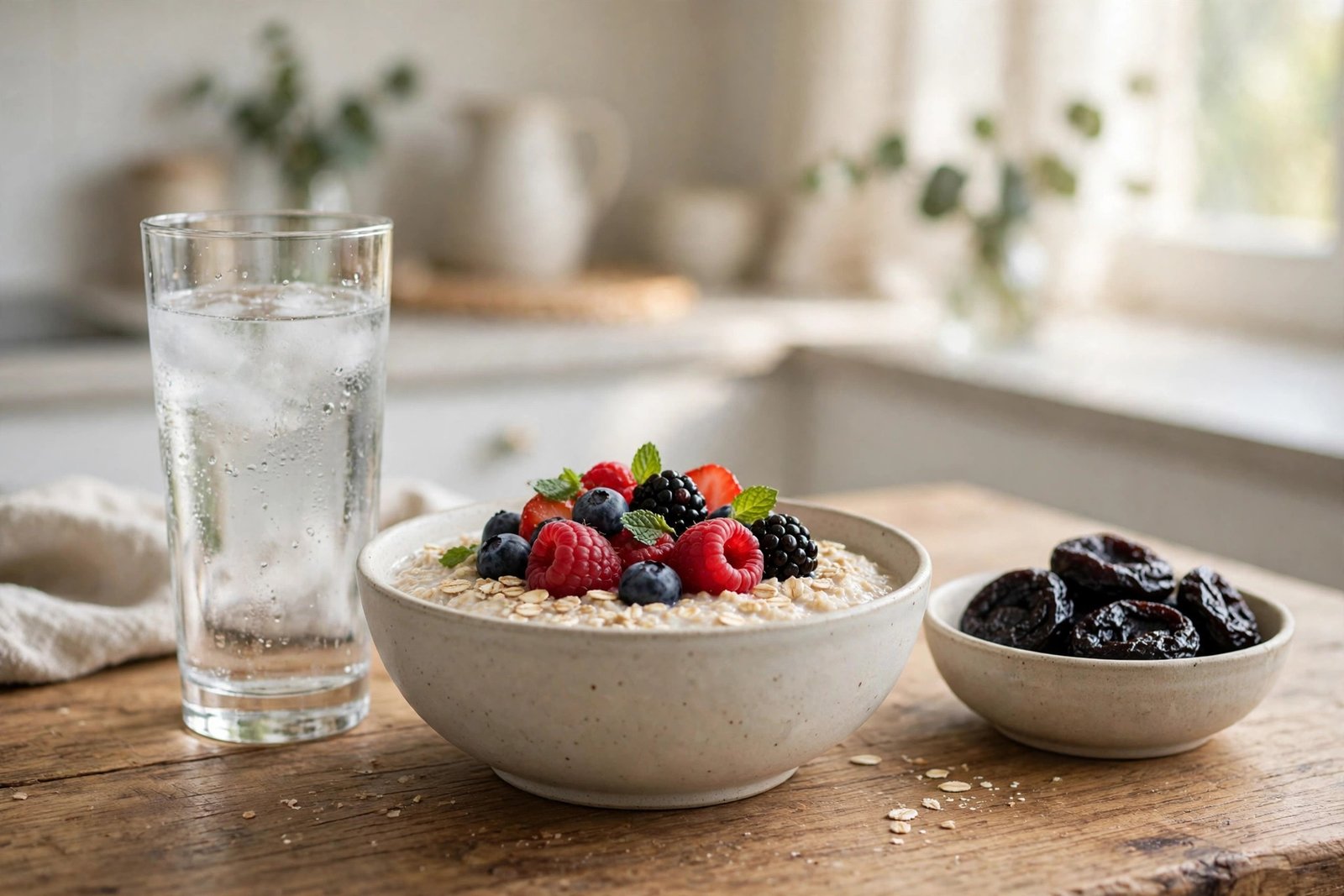
How do I stop constipation on Ozempic? Start with water, then add fibre slowly, move every day, and only then reach for a gentle laxative. Constipation affected 23.4% of people on semaglutide in the STEP 1 trial, so it is one of the most common side effects of this drug, and it usually responds to the basics done in the right order. This post is the step by step plan, with the numbers, a sample fibre day, and the red flags that mean calling a doctor.
- In STEP 1, constipation affected 23.4% of people on semaglutide 2.4 mg. In SURMOUNT-1, it affected 11.7% to 17.1% of people on tirzepatide, against 5.8% on placebo.
- The NHS advises 30 g of fibre a day for adults, increased gradually, with 6 to 8 cups of fluid a day.
- In a trial of 40 constipated people, prunes raised complete bowel movements from 1.7 a week to 3.5 a week, beating psyllium at 2.8 a week (Attaluri et al., 2011).
- The sample fibre day in this post adds up to about 30 g: oats and raspberries for breakfast, lentils at lunch, a pear as a snack, prunes in the afternoon, and vegetables with dinner.
- Call a doctor if you have not had a bowel movement for 3 to 4 days and feel unwell, or if constipation lasts longer than a week, or if you see blood or have severe pain or vomiting.
Why Ozempic Slows Your Bowel Down
Ozempic works partly by slowing down how fast food leaves your stomach, which is one reason you feel full for longer. That same slowing affects the rest of the gut: food moves through more slowly, more water is absorbed from it, and the stool that reaches the end is drier and harder to pass. Add a smaller appetite, which usually means less food, less fibre and less fluid, and you have three causes working together.
That is why constipation is so common on this drug rather than a rare reaction. In STEP 1, the main semaglutide trial, constipation affected 23.4% of people on the drug over 68 weeks (Wilding et al., 2021). In SURMOUNT-1, the main tirzepatide trial, it affected 16.8% of people on 5 mg, 17.1% on 10 mg and 11.7% on 15 mg, against 5.8% on placebo (Jastreboff et al., 2022). Roughly one person in four or five will deal with it, which means it is worth having a plan before it starts, not after a week of discomfort. Our guide to GLP-1 weight loss explained covers how the drug works in more detail.
The Steps, in Order
The order matters. People usually try fibre first, get bloated, and give up, when the missing piece was water. Or they take a laxative first, get cramps, and never fix the habits that caused the problem. Work through these steps in order, give each one a few days, and only move on when the step before it is in place.
Step 1: Water First
Drink more before you eat more fibre, because fibre without water makes constipation worse, not better. Fibre absorbs water as it moves through the gut, and if there is not enough water, it forms a dry, slow-moving mass instead of a soft stool. The NHS advises 6 to 8 cups of fluid a day, and that is a good starting target for most adults. If you were drinking far less than that before, build up over a few days rather than forcing it all in one afternoon. Keep a glass or bottle where you can see it, drink a glass with each meal, and check the colour of your urine: pale yellow means you are drinking enough, dark yellow means you need more. Our daily water intake calculator can work out a personal target from your weight and activity.
Step 2: Fibre, Added Slowly
Once the water is in place, raise your fibre towards 30 g a day, which is the NHS target for adults, but do it gradually. Add about 5 g a week, not 15 g in one day, because a sudden jump in fibre causes gas and bloating, and that is the reason most people quit. The best sources are foods you already know: oats, lentils, beans, pears, apples, raspberries, prunes, wholemeal bread, and vegetables. Our dietary fibre intake calculator can show how far your current diet is from 30 g and which foods would close the gap fastest. A sample day that reaches the target is set out below, with the maths shown.
Step 3: Move Every Day
A daily walk is the simplest laxative there is, and the NHS says a daily walk or run can help you pass stool more regularly. Movement stimulates the muscles of the gut, and sitting all day does the opposite. You do not need a gym session: a 20 to 30 minute walk after a meal is enough, and walking after eating works better than walking on an empty stomach, because eating itself triggers gut movement. If you have a desk job, stand up and walk around for a few minutes every hour, and take the stairs when you can. The effect is gentle and it builds over days, so give it a week before judging it.
Step 4: Prunes, the Food That Acts Like a Medicine
If water, fibre and movement are in place and you still need help, prunes are the best next step, and they have better trial evidence than most people expect. In a 2011 trial of 40 constipated people, dried plums at 50 g twice a day raised complete spontaneous bowel movements from 1.7 a week to 3.5 a week, against 2.8 a week for psyllium, a standard fibre supplement, and stool consistency improved more with prunes (Attaluri et al., 2011). The authors concluded that prunes should be considered first-line treatment for mild to moderate constipation. Prunes work two ways: they add fibre, about 7 g per 100 g, and they contain sorbitol, a natural sugar alcohol that draws water into the bowel. Start with 4 to 5 prunes a day and build up, because too many at once cause gas and loose stools.
Step 5: A Gentle Laxative, in the Right Order
If the steps above are in place and you are still constipated, a laxative is the next step, and the NHS approach is to start with the gentlest kind. Bulk-forming laxatives come first: they add fibre and water to the stool, and they take 2 to 3 days to work. If those do not help, osmotic laxatives such as macrogol or PEG draw water into the bowel and usually work within 1 to 3 days. Stimulant laxatives such as senna or bisacodyl work faster, in 6 to 12 hours, but they are for short-term use only, not for every day. No doses are given in this post: follow the packet, ask your pharmacist which kind suits you, and talk to your prescriber if you need a laxative for more than a few days. Laxatives are a bridge while the habits above take effect, not a replacement for them.
A Sample Day That Reaches 30 g of Fibre
A target of 30 g sounds like a lot until you see it on a plate. Here is a day built from ordinary foods, using the fibre values from our own fibre calculator and USDA figures for the fruit. The maths is shown so you can swap foods in and out and keep the total.
Breakfast: 40 g of oats made into porridge, with 100 g of raspberries on top. The oats give 4.0 g of fibre and the raspberries give about 6.5 g, so breakfast alone is 10.5 g. Lunch: a salad or soup with half a cup of lentils, which gives 7.8 g, taking the running total to 18.3 g. Snack: a pear, which gives 5.5 g, taking the total to 23.8 g. Afternoon: 50 g of prunes, about 5 prunes, which gives about 3.5 g, taking the total to 27.3 g. Dinner: vegetables with your main meal, worth about 3 g, taking the day to about 30.3 g. That is the target reached without any supplement, and every item on the list is a normal food you can buy anywhere.
Two notes on this day. First, the prunes count twice: they are part of the fibre total and they are also the Step 4 treatment, so this day is doing two jobs at once. Second, if you are new to this much fibre, do not start with the whole day at once: build up over 2 to 3 weeks, adding about 5 g a week, and keep the water up as you go. Our guide to what to eat on Ozempic has more high-fibre meal ideas that work with a small appetite, and our calories calculator can check that you are eating enough overall, because eating too little is itself a cause of constipation.
What Makes It Worse
A few habits make constipation worse even when you are doing the right things, and they are worth checking before you decide the plan is not working. The first is fibre without water, which is the most common mistake: adding bran or a fibre supplement while still drinking very little produces hard, dry stools and bloating. The second is eating too little. Take the person our other guides use: a woman aged 40, 165 cm, 85 kg, moderately active, with a weight loss target of about 1,936 calories a day. If she eats far below that target for weeks, there is simply less material for the bowel to move, and constipation follows. Very low calorie intake slows the gut on its own, so if you are barely eating, the fix is to eat a little more, not to take more laxatives.
The third is ignoring the urge. When you feel the need to go, go: delaying it lets the bowel absorb more water from the stool, making it harder and more painful to pass later, and over time it trains the bowel to stop signalling. The fourth is iron supplements, which are a common cause of constipation and are worth mentioning to your prescriber if you take them, because the dose or the form can sometimes be changed. The fifth is inactivity: a day spent sitting, with no walk at all, is enough to slow things down, even if the food and water are right.
Red Flags: When to Call the Doctor
Most constipation on Ozempic is uncomfortable but not dangerous, and it settles with the steps above. Some signs mean you should call a doctor rather than keep trying home measures. The NHS defines constipation as not having pooed at least 3 times in the last week, so if you have gone 3 to 4 days without a bowel movement and you feel unwell, bloated or in pain, get advice. Call sooner if the constipation lasts longer than a week despite water, fibre and movement, or if you have severe tummy pain, vomiting along with constipation, unexplained weight loss, blood from your bottom, or a feeling that you cannot empty your bowel properly. Those are the red flags listed by Patient.info, and they need a proper assessment, not a stronger laxative. Also tell your prescriber if constipation started suddenly after a dose increase, or if it is getting worse week by week rather than better.
Frequently Asked Questions
How do I stop constipation on Ozempic?
Start with water, 6 to 8 cups a day, then add fibre slowly towards 30 g a day, walk every day, and try prunes. If that is not enough, use a gentle laxative, starting with a bulk-forming one. Give each step a few days before moving on.
How common is constipation on Ozempic?
Very common. In STEP 1, constipation affected 23.4% of people on semaglutide 2.4 mg over 68 weeks. In SURMOUNT-1, it affected 11.7% to 17.1% of people on tirzepatide, against 5.8% on placebo.
Do prunes really help constipation?
Yes. In a 2011 trial of 40 constipated people, prunes at 50 g twice a day raised complete bowel movements from 1.7 a week to 3.5 a week, beating psyllium at 2.8 a week. The authors called prunes a first-line treatment for mild to moderate constipation.
Can I take a laxative every day on Ozempic?
Short-term use is fine, but daily laxatives are not a long-term plan. Bulk-forming laxatives take 2 to 3 days to work, osmotic laxatives 1 to 3 days, and stimulant laxatives 6 to 12 hours. If you need one for more than a few days, talk to your prescriber.
When should I call a doctor about constipation?
Call if you have not had a bowel movement for 3 to 4 days and feel unwell, if constipation lasts longer than a week, or if you have severe pain, vomiting, unexplained weight loss, blood from your bottom, or a feeling of incomplete emptying.
Sources
- STEP 1: semaglutide 2.4 mg weekly, New England Journal of Medicine 2021 (PMID 33567185): 1,961 adults; minus 14.9% vs minus 2.4% placebo at 68 weeks; constipation 23.4%.
- SURMOUNT-1: tirzepatide weekly, New England Journal of Medicine 2022;387:205-216 (PMID 35658024): 2,539 adults; minus 15.0%, 19.5%, 20.9% vs minus 3.1% placebo at 72 weeks; constipation 16.8%, 17.1%, 11.7%.
- How to get more fibre into your diet, NHS: 30 g of fibre a day for adults, increased gradually, with 6 to 8 cups of fluid a day.
- Constipation, NHS: not having pooed at least 3 times in the last week is a sign of constipation; a daily walk or run can help you pass stool more regularly; laxatives work within a few days and should only be used short term.
- Constipation, Patient.info: see a doctor if constipation lasts longer than a week, or with severe tummy pain, vomiting, weight loss, blood from the bottom, or a feeling of incomplete emptying.
- Dried plums vs psyllium for constipation, Alimentary Pharmacology and Therapeutics 2011;33(7):822-828 (PMID 21323688): 40 constipated subjects; complete bowel movements 1.7 a week at baseline, 3.5 a week with prunes vs 2.8 with psyllium; prunes first-line for mild to moderate constipation.
- Laxatives, NHS: bulk-forming laxatives first, then osmotic laxatives, then stimulant laxatives for short-term use; follow the packet and ask a pharmacist which kind suits you.
- Weight Insider: Dietary Fibre Intake Calculator, What to Eat on Ozempic, GLP-1 Weight Loss Explained, Calories Calculator, Daily Water Intake Calculator.
Medical Disclaimer
This article is for general information only and is not medical advice. It does not replace advice from your prescriber, pharmacist, or doctor. Do not start, stop, or change any medicine, supplement, or treatment because of something you read here. If you are worried about constipation, or about any symptom, talk to a qualified health professional.
Last updated: 22 November 2026