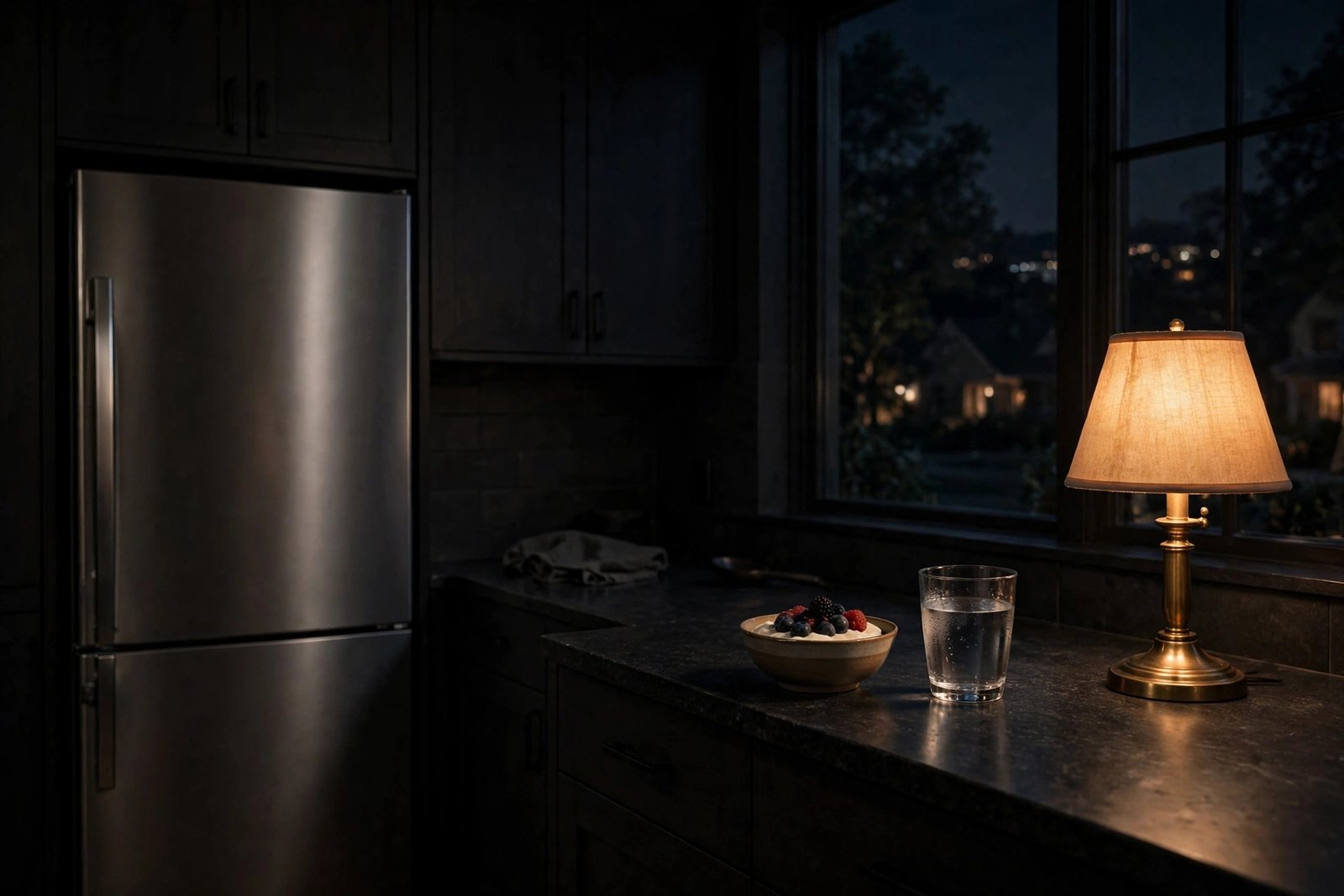
How to stop midnight snacking without willpower: find the trigger first, then change the setup around it. Most midnight snacking is not real hunger. It is tiredness, stress, boredom, or a habit that starts the moment you sit down in front of a screen. Fix the trigger, close the kitchen at a set time, and plan one evening snack, and the fridge stops calling.
- Run the trigger check before you eat anything: are you hungry, tired, stressed, or bored? Food only fixes the first.
- Sleep is the biggest lever. In a 2022 trial, adults who slept about 1.2 hours longer a night ate about 270 fewer calories a day, with no diet instructions at all (Tasali et al., JAMA Internal Medicine, 2022).
- Short sleep changes your hunger hormones. Two nights of 4 hours in bed cut the fullness hormone leptin by 18% and raised the hunger hormone ghrelin by 28% (Spiegel et al., Annals of Internal Medicine, 2004).
- Close the kitchen at a set time, brush your teeth, and make the kitchen boring after that hour: lights off and snacks out of sight.
- Plan one evening snack of about 100 to 200 calories, with protein in it. A 170 g pot of plain nonfat Greek yogurt with berries is about 150 calories and 17.3 g of protein (USDA FoodData Central).
Introduction
It is past midnight, the house is quiet, and you are standing in front of the fridge with the light on your face. You had dinner an hour ago. You are not even sure what you want. But here you are, eating cereal out of the box or finishing the biscuits. Then comes the guilt, and the same scene tomorrow night.
Midnight snacking stalls weight loss for a lot of people, and most of them blame willpower. It is not a willpower problem. At midnight you are tired, your hunger hormones are tilted towards eating, and the kitchen is three steps away. Changing the setup works better than scolding yourself.
The Trigger Check: Hungry, Tired, Stressed, or Bored
Before you change anything, spend three nights noticing. When the urge hits, stop for thirty seconds and ask which of four things it is.
Real hunger
Real hunger builds slowly, is felt in the stomach, and goes away when you eat. It usually means dinner was too small or too low in protein. Eat more at dinner, especially protein, and plan an evening snack instead.
Tiredness
Tiredness is the trigger most people miss, because it feels like hunger. Short of sleep, your body asks for quick energy, and your brain reads that as a craving for something sweet or starchy. You are hungry for sleep, not for food. The clue is timing: if snacking follows late nights or a short night the day before, tiredness is the trigger. The fix is bed, not a snack. Go to bed thirty minutes earlier for a week.
Stress
Stress snacking is fast, it is not about taste, and it often happens while you are doing something else. The food is a distraction. When the urge hits, do something else for ten minutes: a short walk or a shower. If the urge is still there after ten minutes, eat the planned snack sitting down, slowly, and then stop. Stress hunger fades when the moment passes. Real hunger does not.
Boredom
Boredom is the quietest trigger. The television is on, the phone is in your hand, and eating is something to do. Boredom snacking is almost always done in front of a screen, and it is almost always something crunchy. You are not hungry. You are understimulated, and the kitchen is the nearest entertainment. The fix is to make eating the boring option: eat only at the table, with no screen.
Three nights of notes will tell you which trigger is yours. Fix that one first.
The Sleep Link: What the Trials Actually Show
Sleep is the part of this post with the strongest evidence. Midnight snacking and short sleep feed each other: you stay up late, you get hungry, and you eat.
The 270 calorie trial
In 2022, researchers at the University of Chicago tested this (Tasali et al., JAMA Internal Medicine, 2022). They took 80 adults aged 21 to 40, with a body mass index between 25.0 and 29.9, who slept less than 6.5 hours a night. Half were given one sleep hygiene session and asked to extend their time in bed towards 8.5 hours. People ate whatever they wanted, with no diet or exercise instructions. After two weeks, the sleep extension group slept about 1.2 hours longer a night and ate about 270 fewer calories a day than the control group (95% confidence interval, minus 393 to minus 147), with no change in energy expenditure.
Why short sleep makes you hungry
Short sleep drives eating through hormones. In a 2004 trial, twelve healthy young men spent two nights with only 4 hours in bed, and two nights with 10 hours in bed, with food and activity held steady (Spiegel et al., Annals of Internal Medicine, 2004). After the short nights, the fullness hormone leptin was 18% lower, and the hunger hormone ghrelin was 28% higher. Hunger ratings rose 24%, appetite rose 23%, and appetite for calorie-dense foods high in carbohydrate rose 33% to 45%. The trial was small, only 12 young men over two nights, so it is a mechanism, not a promise.
How much sleep to aim for
The Centers for Disease Control and Prevention says adults aged 18 to 60 need 7 or more hours of sleep a night, and most adults do best on 7 to 9 hours. If you sleep six hours now, aim for 6 hours and 30 minutes this week. Work out your own bedtime with our sleep cycle calculator. For the full picture, read our guide on does lack of sleep cause weight gain.
The Kitchen-Closed Routine
The kitchen-closed routine is the heart of this method: small actions, done at the same time every night, that turn the kitchen into a closed room. The point is to add enough friction that a half-asleep snack stops being the easiest thing to do.
Pick a closing time and write it down: for most people, 9pm or 9.30pm works. At closing time, do these five things every night. First, clear the kitchen: wash up, put food away, and wipe the counters. Second, put trigger foods out of sight, in a high cupboard or an opaque box. What you see first is what you eat first. Third, turn the kitchen lights off. A dark kitchen feels closed. Fourth, brush your teeth. A minty mouth changes the taste of food and signals that eating is finished. Fifth, take a cup of herbal tea or a glass of water with you out of the kitchen. It helps you tell thirst from hunger.
The routine takes about ten minutes, and it becomes automatic if you do it at the same time every night for two weeks. If your weight loss has stalled as well as your evenings, our guide on how to break a weight loss plateau covers the two week reset that pairs with this one.
The Planned Evening Snack: Eat It on Purpose
This post tells you to eat in the evening: the planned snack is part of the method, not a failure of it. A small snack, chosen in advance and eaten sitting down, stops the midnight raid two ways: it takes the edge off real hunger, and it removes the deprivation that makes people binge later. Decide what it is at dinner time, not at midnight.
A good evening snack is about 100 to 200 calories, has protein in it, and is something you actually like. Here are three options, with counts from USDA FoodData Central.
| Evening snack | Portion | Calories | Protein |
|---|---|---|---|
| Plain nonfat Greek yogurt with raspberries | 170 g yogurt, 100 g berries | About 150 | About 18 g |
| Air-popped popcorn, plain | 3 cups | About 93 | About 3 g |
| A medium banana | One banana | About 105 | About 1 g |
The yogurt and berries is the strongest choice: a 170 g pot of plain nonfat Greek yogurt has 100 calories and 17.3 g of protein (USDA FDC 170894), and 100 g of raspberries adds about 52 calories, for about 150 in total. Popcorn is the best choice if you want volume: three cups of plain air-popped popcorn is only about 93 calories (USDA FDC 167959), because a cup weighs just 8 g. The catch is the toppings: butter, oil, and cheese flavouring are where the calories hide. The banana is the simplest option, at about 105 calories (USDA: 89 kcal per 100 g), but it is low in protein. Check how the snack fits your day with our calories calculator.
Dinner decides midnight too: too small, too early, or too low in protein, and no routine fixes the hunger that follows. For most adults losing weight, the protein guide is 1.2 to 1.6 g per kilogram a day (Leidy et al., 2015). An 85 kg person at the lower end needs about 102 g a day, or about 34 g per meal. Work out your own number with our protein intake calculator. If dinner is at 6pm and bed is at 11pm, a planned snack at 9pm is the sensible bridge.
When Midnight Eating Is Something More
Most midnight snacking is a habit, and the method in this post handles it. But a smaller number of people have a pattern that goes beyond habit: night eating syndrome, a recognised eating pattern listed in the DSM-5 under Other Specified Feeding or Eating Disorder.
The research criteria most often used, proposed by Allison and colleagues in 2010, describe eating at least 25% of your daily intake after the evening meal, or waking at night to eat at least twice a week. You are aware of the eating, which separates it from sleep-related eating. At least three of five further features are present: little morning appetite; a strong urge to eat at night; a belief that you must eat to fall asleep; trouble sleeping four or more nights a week; and low mood in the evening. The pattern causes real distress and has lasted at least 3 months.
If that description fits you, this post is not the right tool. Talk to your doctor about a referral to a clinician who works with eating patterns and sleep. Night eating syndrome is treatable, and the treatments work on sleep, mood, and eating together. The same applies if midnight eating comes with warning signs such as eating very large amounts very fast and feeling out of control, or using food to cope with low mood most days.
Frequently Asked Questions
How do I stop midnight snacking without willpower?
Change the setup, not yourself. Run the trigger check to find whether you are hungry, tired, stressed, or bored, close the kitchen at a set time each night, and plan one evening snack of about 100 to 200 calories. In a 2022 trial, adults who slept about 1.2 hours longer a night ate about 270 fewer calories a day with no diet instructions.
Is it better to eat a planned snack or nothing at all in the evening?
A planned snack is better for most people. A small snack of about 100 to 200 calories with protein in it, eaten sitting down, stops real hunger and removes the feeling of deprivation that leads to a midnight raid. A total ban works for a few days and then usually breaks badly on a stressful evening.
Does lack of sleep really cause midnight snacking?
Yes, and the mechanism is hormonal. In a 2004 trial, two nights of 4 hours in bed cut the fullness hormone leptin by 18% and raised the hunger hormone ghrelin by 28%, with hunger up 24% and appetite for calorie-dense, high-carbohydrate foods up 33% to 45%. In a 2022 trial, sleeping about 1.2 hours longer cut daily intake by about 270 calories. Adults aged 18 to 60 need 7 or more hours of sleep a night, according to the Centers for Disease Control and Prevention.
What is the best snack to eat before bed for weight loss?
Something with protein, about 100 to 200 calories, that you actually enjoy. A 170 g pot of plain nonfat Greek yogurt with 100 g of raspberries is about 150 calories with about 18 g of protein. Three cups of plain air-popped popcorn is about 93 calories. A medium banana is about 105 calories. All figures are from USDA FoodData Central. Avoid snacks that are mostly sugar or fat with no protein, because they do not keep you full.
When is midnight snacking a sign of night eating syndrome?
It may be night eating syndrome if you regularly eat at least 25% of your daily intake after the evening meal, or wake to eat at least twice a week, and the pattern has lasted at least 3 months, with features such as no morning appetite and low mood in the evening. That pattern causes real distress and needs a clinician, not a kitchen routine. If it sounds like you, talk to your doctor.
—
Sources
- Tasali E, Wroblewski K, Kahn E, Kilkus J, Schoeller DA. JAMA Internal Medicine. 2022;182(4):365-374. Sleep extension of about 1.2 hours a night cut intake by 270 kcal a day in 80 adults with overweight. https://pubmed.ncbi.nlm.nih.gov/35129580/
- Spiegel K, Tasali E, Penev P, Van Cauter E. Annals of Internal Medicine. 2004;141(11):846-850. Leptin fell 18% and ghrelin rose 28% after two nights of 4 hours in bed in 12 healthy young men. https://pubmed.ncbi.nlm.nih.gov/15583226/
- Allison KC, Lundgren JD, O’Reardon JP, et al. International Journal of Eating Disorders. 2010;43(3):241-247. Proposed diagnostic criteria for night eating syndrome. https://psycnet.apa.org/record/2010-06093-006
- Centers for Disease Control and Prevention. Adults aged 18 to 60 need 7 or more hours of sleep a night. https://www.cdc.gov/sleep/about/
- USDA FoodData Central. Yogurt, Greek, plain, nonfat (FDC 170894): 59 kcal per 100 g. Raspberries, raw: 52 kcal per 100 g. Popcorn, air-popped (FDC 167959): 31 kcal per cup. Banana: 89 kcal per 100 g. https://fdc.nal.usda.gov/
- Leidy HJ, Clifton PM, Astrup A, et al. American Journal of Clinical Nutrition. 2015;101(6):1320S-1329S. Higher-protein diets with 1.2 to 1.6 g of protein per kilogram a day for weight loss. https://pubmed.ncbi.nlm.nih.gov/25926512/
- Weight Insider. Sleep cycle calculator, does lack of sleep cause weight gain, calories calculator, protein intake calculator, and how to break a weight loss plateau.
Last updated: 20 November 2026
Medical Disclaimer
This article is general information only. It is not medical advice, and it is not a substitute for advice from a qualified health professional. Talk to your doctor before changing your eating habits, especially if you have a medical condition or a history of disordered eating. If your pattern of night eating matches the description in this article, or it is causing you distress, talk to your doctor. This article does not recommend any drug, supplement, or appetite suppressant.