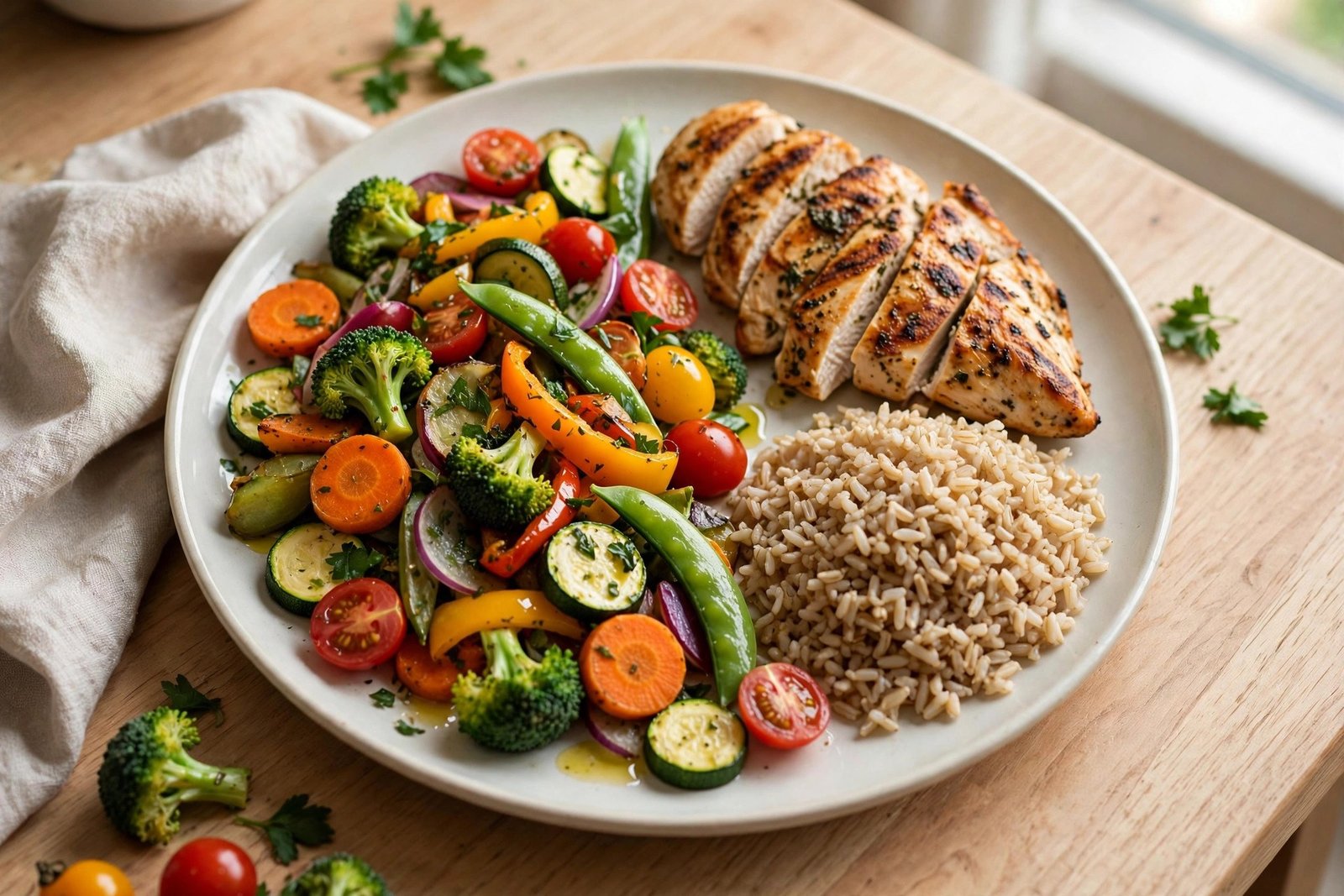
How to lose weight without counting calories? Build every meal on the plate method, put protein and fibre first, and swap the biggest calorie leaks for water and vegetables. Trials show each piece works: plates cut about 2 kg in three months, a high protein diet cut intake by about 440 calories a day with no counting, and one fibre change alone lost 2.1 kg in a year. You still need a calorie deficit, but the method changes, not the maths.
- In Hall 2019, 20 adults ate 508 kcal a day more on an ultra-processed diet, gained 0.9 kg in two weeks, and lost 0.9 kg on the unprocessed diet.
- In a 2021 meta-analysis of 5 studies, portion-control plates cut 2.02 kg in three months, with waist down 2.28 cm.
- In Weigle 2005, 19 people on a 30 percent protein diet with no calorie limit ate 441 kcal a day less and lost 4.9 kg in 12 weeks.
- In Ma 2015, 240 adults told only to eat at least 30 g of fibre a day lost 2.1 kg in 12 months, nearly matching a heart association diet at 2.7 kg.
- In Tasali 2022, 80 adults who slept 1.2 hours more a night ate 270 kcal a day less, with no diet instruction at all.
The Short Answer
Yes, you can lose weight without counting calories: counting is one way to create a calorie deficit, not the deficit itself. Weight loss happens when you take in less energy than you use, and that gap can come from structure instead of arithmetic: a plate that is half vegetables, a quarter protein and a quarter starch holds far fewer calories than one piled high with rice and fried food.
The target is a deficit of 500 kcal a day: 3,500 kcal a week, 0.45 kg of body fat a week, or 5.45 kg in 12 weeks. Every method below is judged against that number, and the honest catch is at the end: you need a way to know it is working, and a fallback for when it stops.
The Plate Method: Half Vegetables, a Quarter Protein, a Quarter Starch
The plate method is the backbone of this approach, from Harvard’s Healthy Eating Plate: half the plate vegetables and fruits, a quarter whole grains, a quarter protein, water as the drink. Nothing to weigh, nothing to log. Vegetables are bulky and low in calories, so they fill the stomach with very little energy, and the protein quarter keeps you full.
In 2007, Pedersen and colleagues in Calgary ran a six month trial in 130 adults with type 2 diabetes and a body mass index of 30 or more. The plate group got a calibrated plate and bowl, a booklet and one counselling session; plates were designed for an 800 kcal meal for men and 650 kcal for women. They lost significantly more weight, more reached 5 percent weight loss, and more cut their diabetes medicine. A 2021 meta-analysis of five plate studies pooled a loss of 2.02 kg over three months and 2.28 cm off the waist.
Three rules: use a normal sized plate, fill the vegetable half first, and keep the starch quarter to one serving, one cup of cooked rice, one slice of bread or one small potato. Potatoes and chips do not count as vegetables here, because they raise blood sugar quickly and carry far more calories than green vegetables.
Protein First: The Fullness Lever
Protein keeps you full longer than carbohydrate or fat. The best proof is Weigle 2005. Nineteen people ate a 15 percent protein diet for two weeks, then 30 percent protein for two weeks, then 12 weeks eating freely on 30 percent protein with no calorie limit. Spontaneous intake fell by 441 plus or minus 63 kcal a day, weight by 4.9 plus or minus 0.5 kg, and fat mass by 3.7 plus or minus 0.4 kg. Nobody counted anything.
The target used across this site is 1.2 to 1.6 g of protein per kilogram a day: 106 to 141 g a day for an 88 kg person. Spread it across meals: eggs or Greek yoghurt at breakfast, a palm sized portion of chicken, fish, beans or tofu at lunch and dinner. One caution: a fried chicken burger is protein rich and calorie rich at once, and people with kidney disease should not raise protein without medical advice.
Fibre: The One-Change Trial
In 2015, Ma and colleagues randomised 240 adults with metabolic syndrome to two diets. One group got the 13 part American Heart Association diet; the other got one instruction: eat at least 30 g of fibre a day. At 12 months the fibre group had lost 2.1 kg and the heart association group 2.7 kg, a difference that was not statistically significant, and both groups lowered blood pressure and improved insulin resistance.
Fibre slows eating, adds bulk and steadies blood sugar, and beans, lentils, oats, berries and vegetables are hard to overeat. The Institute of Medicine recommends 25 g a day for women and 38 g for men, while average intake is only about 15 g a day. Our post on fibermaxxing for weight loss sets out the foods in detail. Build to 30 g gradually over two or three weeks, with water: jumping from 15 g to 30 g in a day is the classic way to get bloating.
Why Food Choice Beats Willpower
Most diets fail because they ask willpower to fight the food environment. The cleanest proof is Hall 2019, at the National Institutes of Health. Twenty weight stable adults lived in a metabolic ward for 28 days, eating each diet for 14 days in random order. The diets were matched for calories, sugar, fat, sodium, fibre and macronutrients.
On the ultra-processed diet, people ate 508 plus or minus 106 kcal a day more, and ate faster. They gained 0.9 plus or minus 0.3 kg in two weeks on it and lost 0.9 plus or minus 0.3 kg on the unprocessed diet. Same nutrients on paper, a 500 kcal a day difference in practice: ultra-processed foods are soft, energy dense and quick to eat, so you take in a lot of calories before fullness catches up.
Use swaps, not willpower. A 12 oz can of cola carries about 140 kcal and 39 g of sugar, so swapping it for water removes 140 kcal without extra hunger. Eat whole fruit instead of drinking juice, choose grilled over fried, and keep crisps and biscuits out of the house.
The Worked Example
Meet Sarah, 42, 165 cm, 88 kg, lightly active. Her basal metabolic rate (Harris-Benedict Revised) is 1,591 kcal a day, and her maintenance is 2,187 kcal a day. A 500 kcal deficit gives a target of 1,687 kcal a day, protein of 106 to 141 g a day, and a body mass index of 32.3. Her 5 percent target is 4.4 kg, taking her to 83.6 kg. Check your own numbers with our calories calculator and weight loss goal calculator.
A 500 kcal daily deficit is 3,500 kcal a week, about 0.45 kg a week at 7,700 kcal per kilogram of body fat, or 5.45 kg in 12 weeks. Now the same deficit without an app: Sarah drinks two cans of cola a day and eats about two cups of cooked rice with dinner. She swaps both cola cans for sparkling water, saving 280 kcal a day, and halves dinner rice from two cups to one, saving 205 kcal a day, since one cup of cooked long grain white rice carries about 205 kcal. That is 485 kcal a day from two rules, with nothing weighed.
Over 12 weeks, 485 kcal a day is 40,740 kcal, about 5.29 kg of body fat, and 5 percent arrives in about 10 weeks. The plate method, protein and fibre protect the deficit: half a plate of vegetables keeps her full, protein at every meal stops snacking, and 30 g of fibre steadies appetite. If cola and rice are not her habits, she picks two different swaps. The principle never changes: find the biggest calorie leaks and replace them with lower calorie versions.
Sleep and Steps: The Quiet Deficit
Two levers sit outside the kitchen, and the first is sleep. In 2022, Tasali and colleagues randomised 80 adults aged 21 to 40 with overweight, all sleeping under 6.5 hours a night, to two weeks of sleep extension or a control group. The sleep group gained about 1.2 hours a night, and intake fell by about 270 kcal a day, with no diet instruction at all. The authors estimated up to about 12 kg of weight loss over three years if it was kept up. Our post on whether lack of sleep causes weight gain covers the mechanism.
The second is walking. A daily walk after meals uses energy, blunts the blood sugar rise, and breaks up sitting. Walking to the shops, taking the stairs, and a 20 to 30 minute walk after dinner add up to a meaningful daily burn without a gym. Our post on whether walking 10,000 steps helps you lose weight looks at the step target. Sleep and steps will not replace the food changes, but a tired, sedentary person finds every deficit harder.
Mindful Eating: Helpful, Not Magic
Mindful eating means paying attention while you eat: noticing hunger and fullness, eating slowly, and spotting hunger versus stress. It was tested in the SHINE trial, where Daubenmier and colleagues randomised 194 adults with obesity to a 5.5 month diet and exercise programme, with or without mindfulness training, in 2016. The mindfulness arm was 1.9 kg lighter at 12 months and 1.7 kg lighter at 18 months, but neither difference was significant.
A companion analysis found reduced reward-driven eating explained 47.1 percent of the effect at 12 months, and mindful eating was linked to fewer sweets and lower fasting glucose. The honest reading: mindfulness helps the behaviours around eating, not the scale on its own. Practise it, it costs nothing, but it supports the plate, the protein and the swaps, not replaces them.
How to Know It Is Working
Without counting, you need another feedback loop: the scale. Weigh yourself once a week, same day, same time, same clothes, and judge the trend over three or four weeks. Daily weight swings by a kilogram or more, so one high reading means nothing and a four week trend means everything.
Expect about 0.45 kg a week, and expect it to be uneven. If the trend is flat for four weeks, suspect portion creep: the rice quarter becomes a third, the cola returns on weekends, or a handful of nuts becomes three. Tighten one swap and give it two more weeks.
One warning: in 1992, Lichtman and colleagues used doubly labelled water and found 10 obese subjects reported roughly half of what they actually ate. Later studies put under-reporting at 20 to 50 percent in people with obesity. Your memory is unreliable even when you are honest, so if your weight is flat for a month, trust the scale over your memory.
When Counting Is the Honest Fallback
If your weight has not moved in four weeks despite the plate method, the swaps and the walking, two weeks of counting will find the leak: cooking oil, weekend drinks, forgotten snacks. Counting is a diagnostic tool: two weeks of it often teaches you enough to go back to not counting with better instincts. It is also right when the deficit you need is small, or a clinician has asked you to track intake. Use it to learn your portions, then return to the plate. The goal was never to avoid numbers forever, only to lose weight in a way you can keep doing.
Frequently Asked Questions
Can you lose weight without counting calories?
Yes. Trials show it works: portion-control plates cut about 2 kg in three months, a high protein diet cut intake by 441 kcal a day with no counting, and one fibre change alone lost 2.1 kg in a year. You still need a calorie deficit, but structure, protein, fibre and swaps can create it.
What is the plate method for weight loss?
Fill half your plate with vegetables and fruits, a quarter with protein foods like chicken, fish, beans or tofu, and a quarter with whole grains or starch. Use a normal sized plate, fill the vegetable half first, keep the starch quarter to one serving.
How much protein do I need to lose weight without counting calories?
Aim for 1.2 to 1.6 g of protein per kilogram a day, which is 106 to 141 g a day for an 88 kg person. Spread it across meals with eggs, yoghurt, chicken, fish, beans, lentils or tofu, and keep it lean rather than fried or covered in sauce.
How long does it take to lose weight without counting calories?
At a deficit of about 485 kcal a day, expect about 0.44 kg a week, or 5.3 kg in 12 weeks. A 5 percent weight loss takes about 10 weeks at that pace. Judge the trend over three or four weeks: daily weight swings by a kilogram or more.
What if I stop losing weight without counting calories?
First check for portion creep: the starch quarter growing, drinks returning, or small extras adding 100 to 200 kcal each. Tighten one swap and wait two weeks. If the scale is still flat after four weeks, count calories for two weeks to find the leak, then return to the plate.
Sources
- Hall et al. 2019, PubMed: 20 adults; 508 kcal a day more on ultra-processed food.
- Portion-control plates, meta-analysis 2021, ScienceDirect: 5 studies; minus 2.02 kg over 3 months.
- Portion control pilot, PMC: 65 adults; plate group down 2.4 percent at 3 months, usual care 0.5 percent.
- Weigle et al. 2005, PubMed: 19 subjects; intake minus 441 kcal a day, weight minus 4.9 kg.
- Ma et al. 2015, UMass Medical School: 240 adults; fibre group minus 2.1 kg, AHA diet minus 2.7 kg.
- Tasali et al. 2022, PMC: 80 adults; sleep up 1.2 hours, intake down 270 kcal a day.
- Mason et al. 2016, SHINE trial, PsycNet: 194 adults; reward-driven eating mediated 47.1 percent of the weight loss effect at 12 months.
- Lichtman et al. 1992, British Journal of Nutrition: 10 obese subjects reported roughly half of actual intake.
- Harvard Healthy Eating Plate: half vegetables and fruits, quarter whole grains, quarter protein.
- White rice, cooked, 1 cup, University of Rochester: 205.4 kcal, USDA values.
- Weight Insider: Calories Calculator, Weight Loss Goal Calculator, Fibermaxxing for Weight Loss, Sleep and Weight Gain, Walking and Weight Loss.
Medical Disclaimer
This article is for general information only and is not medical advice. If you have diabetes, kidney disease, heart disease or an eating disorder, or you take prescription medicine, talk to your clinician before changing your diet, protein intake or sleep routine.
Last updated: 27 November 2026