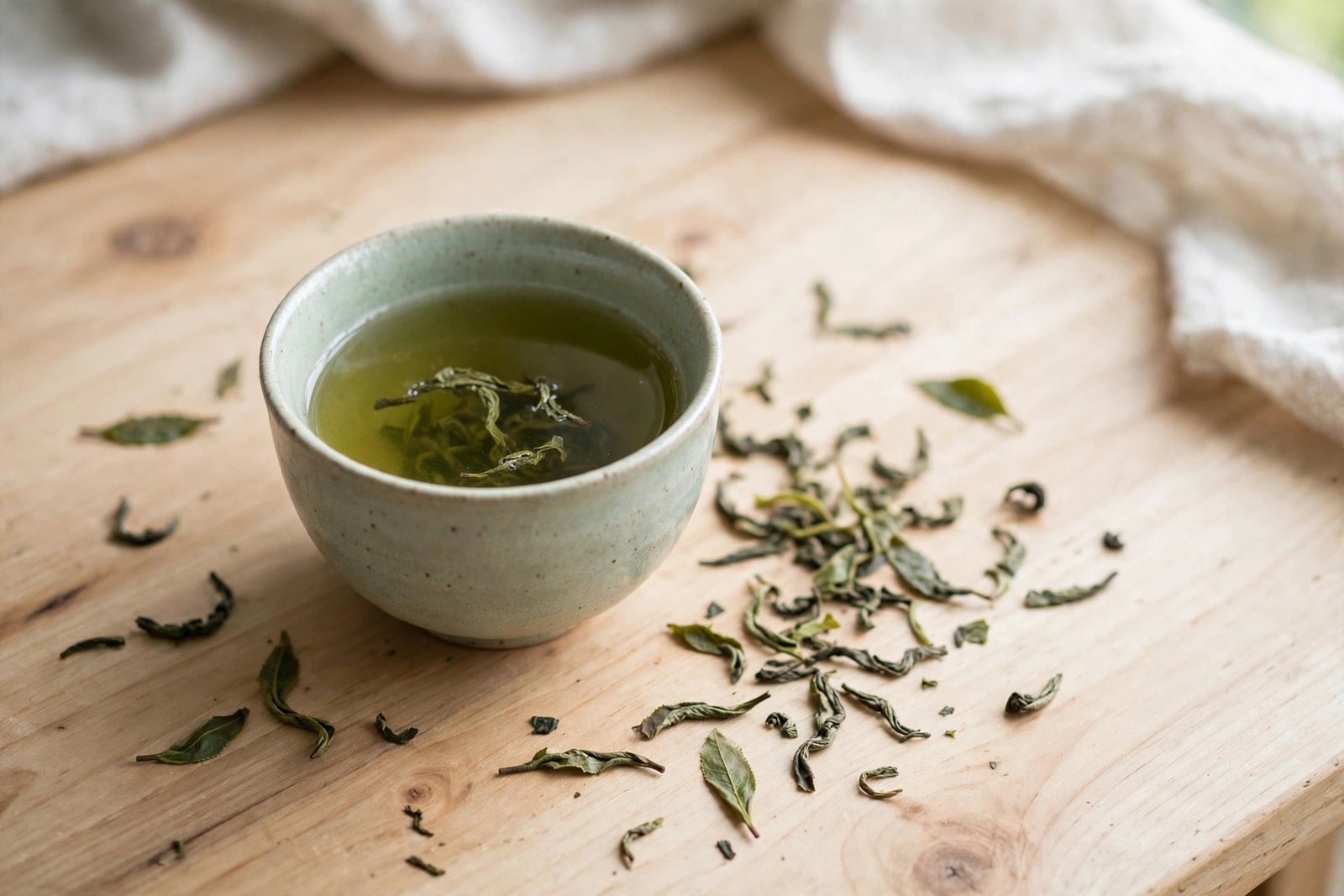
Does green tea help you lose weight? A little, and only as a small addition to a calorie deficit. Pooled trials put the extra loss at about 1 kg over 12 weeks, roughly a fifth of a 500 calorie deficit, and the best review outside Japan found almost nothing at all. Brewed tea is generally safe, but high dose extracts carry a real liver warning.
- Hursel 2009 pooled 11 studies: catechins cut weight by 1.31 kg, more in low caffeine drinkers.
- Cochrane 2012 found almost no effect outside Japan: 6 trials, 532 people, a difference of 0.04 kg.
- Nagao 2007 gave 583 mg of catechins a day to 240 Japanese adults for 12 weeks, but the maker ran the trial.
- Newer reviews agree: Zhang 2023 found 1.23 kg in women; Asbaghi 2024 found 0.64 kg in 59 studies.
- Safety is about dose: EFSA found liver enzyme rises at 800 mg of EGCG a day.
The Short Answer
Yes, but the honest size is about 1 kg over 12 weeks, and that is optimistic. Hursel 2009 found 1.31 kg, Phung 2010 found 1.38 kg against caffeine alone, Zhang 2023 found 1.23 kg in women, and Asbaghi 2024, the largest pooling with 59 studies, found 0.64 kg. The most careful review, Cochrane 2012, found essentially nothing outside Japan.
Compare that with a calorie deficit: 500 kcal a day below maintenance gives about 5.5 kg in the same 12 weeks, four to five times as much. Green tea is a garnish on a deficit, not a replacement for one, and no trial has shown it removes belly fat alone.
Almost every trial used concentrated extracts or catechin enriched drinks, not ordinary cups of tea. A cup has about 29 mg of caffeine and tens of milligrams of EGCG, while trials used hundreds of milligrams of catechins a day.
What Is in Green Tea That Could Matter
Green tea comes from the same plant as black tea, Camellia sinensis, but the leaves are steamed or pan fried without fermentation, which keeps their polyphenols intact. Most are catechins, and the one studied most is epigallocatechin gallate, EGCG, roughly half of them.
The proposed mechanism is a partnership: caffeine raises norepinephrine, which tells fat cells to release stored fat, and EGCG blocks an enzyme called COMT that breaks norepinephrine down, so the signal lasts longer.
Dulloo and colleagues tested this in 1999: ten healthy men in a respiration chamber took a green tea extract, matched caffeine, or a placebo with each meal. Each dose held 50 mg of caffeine and 90 mg of EGCG. Against placebo it raised 24 hour energy expenditure by 4 percent, about 328 kJ, and lowered the respiratory quotient from 0.88 to 0.85. Caffeine alone did nothing.
A 2011 pooling of six chamber studies found the same energy rise for both: mixtures raised 24 hour energy expenditure by 428 kJ, or 4.7 percent, and caffeine alone by 429 kJ, or 4.8 percent. Only the mixtures raised fat oxidation significantly, by 12.2 g or 16 percent, against 9.5 g for caffeine alone. The catechins may add a small fat burning edge, but the extra calories look like caffeine.
The Two Big Reviews Disagree
Hursel and colleagues pooled 11 studies in 2009: catechins cut body weight by 1.31 kg, with a 95 percent confidence interval from minus 2.05 to minus 0.57 kg, and helped people keep weight off after a diet. Low caffeine drinkers lost 1.60 kg against 0.27 kg for heavy drinkers, and Asian participants 1.51 kg against 0.82 kg for Caucasians, though neither gap reached significance.
Cochrane took a stricter approach in 2012, including only randomised trials of at least 12 weeks, and split them by country. Outside Japan, six trials with 532 people gave a mean difference of minus 0.04 kg. The eight Japanese trials, with 1,030 people, ranged from minus 0.2 to minus 3.5 kg, and the authors called the loss small and not clinically important.
Why the gap? Hursel included shorter trials and maintenance studies, while Cochrane demanded 12 weeks or more and separated the Japanese trials, where effects were consistently larger. Possible reasons include lower habitual caffeine intake, different diets, and the fact that many Japanese trials were run by the food companies that made the drinks. None of this is proven.
What the Newer Reviews Found
Phung and colleagues in 2010 pooled 15 randomised trials with 1,243 people: against caffeine alone, catechins with caffeine cut weight by 1.38 kg, BMI by 0.55 and waist by 1.93 cm. Against a caffeine free control the difference was only 0.44 kg, and catechins without caffeine showed no benefit, so caffeine does much of the work.
Zhang and colleagues in 2023 looked only at overweight and obese women: 15 articles, 16 trial arms. Green tea cut weight by 1.23 kg, BMI by 0.47 and waist by 3.46 cm. Effects were larger at doses of 1,000 mg a day or more. The waist figure comes from only seven trial arms.
The largest pooling so far is Asbaghi and colleagues in 2024: 59 studies, 3,802 people. Green tea extract cut body mass by 0.64 kg, with a confidence interval from minus 0.97 to minus 0.30 kg. BMI and body fat percentage fell too, but fat mass, leptin and ghrelin did not change. Gholami 2024 found the same for exercise: catechins plus exercise beat exercise alone by only a small margin.
The Best Single Trial: Nagao 2007
If one trial carries the green tea case, it is Nagao 2007: 240 Japanese adults with visceral fat type obesity, randomised to a drink with 583 mg of catechins a day or a low catechin control tea with 96 mg, double blind, for 12 weeks. The catechin group lost more body weight, body fat, waist size, and visceral and subcutaneous fat, and saw larger falls in blood pressure and LDL cholesterol.
Two limits matter. First, the control drink still contained 96 mg of catechins, so this was a high dose against a low dose, not green tea against nothing. Second, all three authors worked at Kao Corporation, the company that made the drink. A strong design with an interested funder is still worth reading, but it is not independent evidence.
A 2009 follow up in 43 people with type 2 diabetes found a larger fall in waist size, and a 2009 American trial with exercise found only a trend toward greater weight loss, both connected to Kao.
The Worked Example
Here is what the trial effect looks like next to a real deficit. Meet Sarah, 42, 165 cm, 82 kg, lightly active: basal metabolic rate 1,535 kcal a day, maintenance 2,111 kcal a day, so a 500 kcal deficit gives a target of 1,611 kcal a day. Her BMI is 30.1, protein 98 to 131 g a day. Check your own numbers with our calories calculator and weight loss goal calculator.
A 500 kcal daily deficit is about 0.45 kg a week at 7,700 kcal per kilogram of body fat, or about 5.45 kg in 12 weeks. Sarah’s 5 percent target is 4.1 kg, to 77.9 kg, passed in about nine weeks. The green tea figures: Hursel 1.31 kg is about 120 kcal a day, Phung 1.38 kg about 126, Asbaghi 0.64 kg about 59, and Cochrane outside Japan about 4.
So the optimistic green tea effect is roughly a quarter of a 500 kcal deficit: 1.31 kg against 5.45 kg, or 24 percent. The chamber studies agree: a 4.7 percent rise on Sarah’s 2,111 kcal maintenance is about 99 kcal a day, close to the 120 kcal a day Hursel implies.
What Happens When You Stop
Almost no trial followed people after the green tea stopped, so we do not know how long the effect lasts. Hursel 2009 found catechins helped people maintain weight after a diet. But Cochrane found only two maintenance studies, with 184 people, where the change ranged from a gain of 0.6 kg to a loss of 1.6 kg, too thin to support any claim.
The effect probably fades when you stop, since it works by raising energy expenditure while you take it, but nobody has run the trial that stops the tea and follows weight for six months.
How Much Green Tea the Trials Used
Nagao used 583 mg of catechins a day, Maki 625 mg, and Dulloo an extract with 270 mg of EGCG a day. Zhang found the larger effects at 1,000 mg of green tea a day or more. These are concentrated preparations, taken every day for 8 to 12 weeks.
A cup of brewed green tea is a different thing: about 29 mg of caffeine, based on USDA data, and tens of milligrams of EGCG, roughly 25 to 60 mg for a sencha style cup. Matcha has more, because you drink the whole leaf, but also more caffeine. EFSA estimated European tea drinkers get 90 to 300 mg of EGCG a day from infusions, and heavy drinkers up to about 866 mg.
This post does not recommend a dose. The trials that found about 1 kg of loss used far more catechins than a single cup provides, and the capsules that match those doses carry the liver warning below.
Safety: The Liver Warning
Brewed green tea is one of the most widely drunk beverages in the world, and the European Food Safety Authority concluded in 2018 that catechins from infusions are generally safe. The warning is about concentrated extracts, not a cup of tea.
EFSA found that 800 mg of EGCG a day or more, taken as a supplement, raised serum transaminases, the liver enzymes used to spot liver injury, in trials, and could not identify a safe dose. A 2020 United States Pharmacopeia review found case reports linking liver injury to EGCG intakes from 140 mg to about 1,000 mg a day. A 2022 review counted more than 200 published cases of liver failure linked to green tea over 30 years.
In the Minnesota Green Tea Trial, 1,075 postmenopausal women took 843 mg of EGCG a day, or a placebo, for 12 months, and ALT rose above 1.5 times normal in 36 of 513 on extract against 4 of 508 on placebo.
Taking an extract on an empty stomach raises EGCG absorption sharply, so the United States Pharmacopeia label says: do not take on an empty stomach, take with food, and do not use it if you have a liver problem. Caffeine also adds up across tea, coffee, energy drinks and pre-workout powders. EFSA considers up to 400 mg of caffeine a day safe for non-pregnant adults, and up to 200 mg a day for pregnant women.
Who should be cautious? Anyone with liver disease or raised liver enzymes, anyone who has reacted to a green tea product before, pregnant women because of the caffeine, and anyone who struggles with sleep or anxiety. Extracts can interact with medicines, so discuss one with your clinician first. Stop and seek care for abdominal pain, dark urine, or yellowing of the skin or eyes while taking one.
What Actually Moves the Scale
If the goal is weight loss, green tea is a footnote and the deficit is the story. Eat about 500 kcal a day below maintenance, get 1.2 to 1.6 g of protein per kg, fill half the plate with vegetables and fibre rich foods, including low glycemic index foods that keep you full longer, walk daily, and lift twice a week. That gives 5 percent in about nine weeks.
Drinking water before meals is worth more than a green tea capsule: it has its own trial evidence and costs nothing (our post on whether drinking water helps you lose weight covers the trials). And green tea will not choose where fat comes off, as our post on how to lose belly fat explains. A cup of green tea instead of a sugary drink is a good swap: a 330 mL soft drink carries about 140 kcal and the tea carries almost none.
Frequently Asked Questions
Does green tea help you lose weight?
A little. Pooled trials put the extra loss at about 1 to 1.5 kg over 12 weeks, roughly a quarter of a 500 calorie deficit, and Cochrane found almost no effect outside Japan. A helper on top of a deficit, not a fat burner.
How much green tea did the weight loss trials use?
Concentrated extracts or catechin enriched drinks, typically 583 to 625 mg of catechins a day, or 270 mg of EGCG a day, for 8 to 12 weeks. A cup of brewed tea has about 29 mg of caffeine and tens of milligrams of EGCG, far less. This post describes the trials; it does not recommend a dose.
Does green tea burn belly fat?
Only in that it reduced total body fat a little. In Nagao 2007 the high catechin group lost more visceral and subcutaneous fat than the low catechin group, but no food removes fat from one area only.
Is green tea extract safe for your liver?
Brewed tea is generally safe, but extracts carry a real warning: EFSA found liver enzyme rises at 800 mg of EGCG a day, case reports link liver injury to as little as 140 mg a day, and the United States Pharmacopeia advises taking extracts with food, never on an empty stomach.
Does green tea work better than coffee for weight loss?
Probably not by much. In chamber studies, mixtures and caffeine alone both raised 24 hour energy expenditure by about 4.7 percent, so the calorie burn looks like caffeine. Only the mixtures raised fat oxidation significantly.
Sources
- Hursel et al. 2009, PubMed: 11 studies; minus 1.31 kg.
- Jurgens et al. 2012, Cochrane: 14 trials; minus 0.04 kg outside Japan.
- Phung et al. 2010, PubMed: 15 RCTs; minus 1.38 kg.
- Nagao et al. 2007, PubMed: 240 adults; 583 mg against 96 mg a day.
- Dulloo et al. 1999, PubMed: 10 men; energy up 4 percent.
- Hursel et al. 2011, PubMed: 6 chamber studies; energy up 4.7 percent.
- EFSA 2018, green tea catechins: infusions safe; liver enzymes rise at 800 mg EGCG.
- Green tea extract and liver injury, review 2022, PMC: more than 200 cases of liver failure.
- Weight Insider: Glycemic Index Calculator, Calories Calculator, Weight Loss Goal Calculator, Does Drinking Water Help You Lose Weight?, How to Lose Belly Fat.
Medical Disclaimer
This article is for general information only, not medical advice. Green tea extracts can affect the liver and interact with medicines, and caffeine can affect sleep, anxiety and pregnancy. Do not start, stop or change any medicine or supplement, or start a new diet, without talking to your clinician first.
Last updated: 27 November 2026