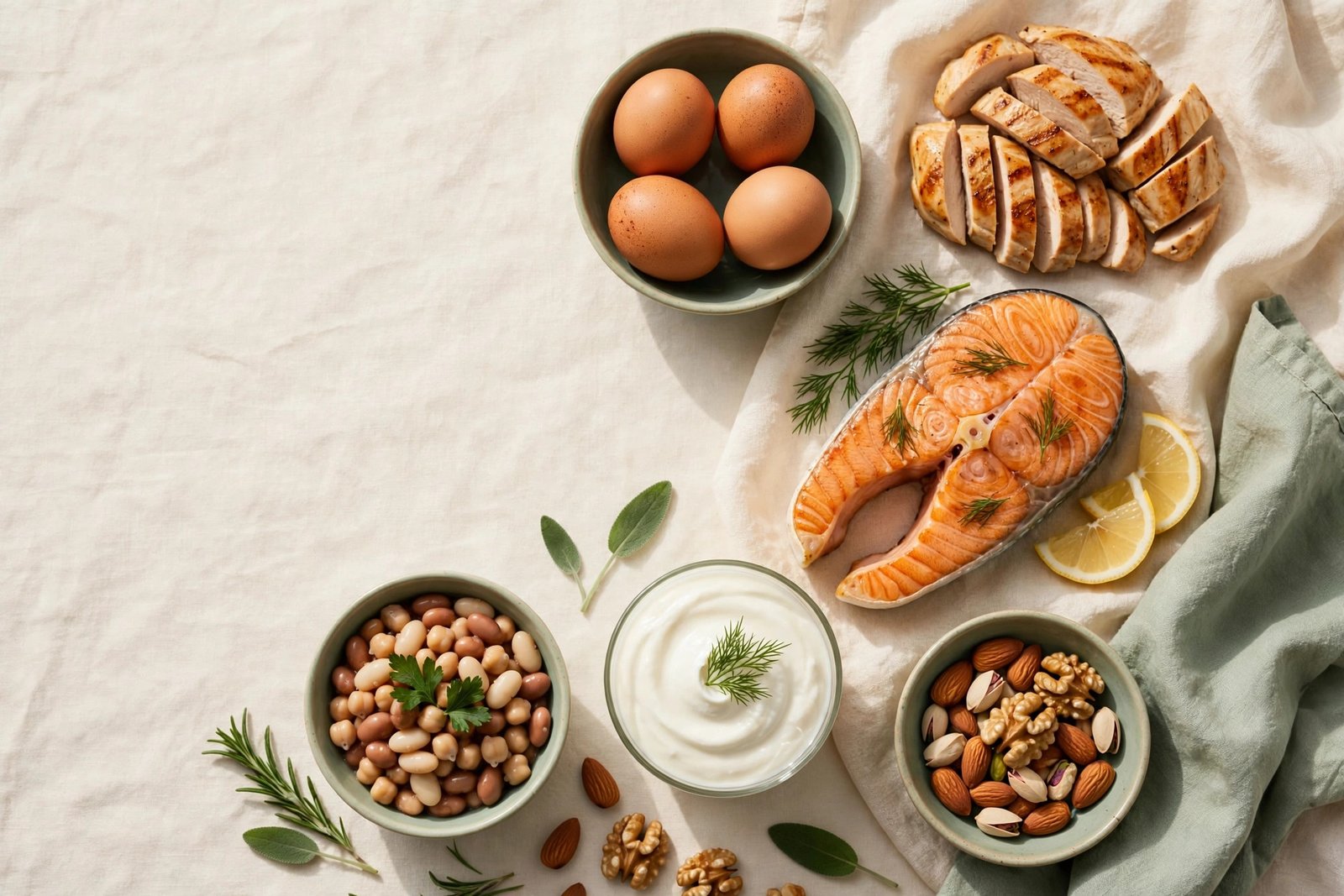
In short: if you train and want to lose fat without losing muscle, aim for 1.6 to 2.2 grams of protein per kilogram of body weight a day.
- The range comes from a 2018 meta-analysis of 49 studies with 1,863 people doing resistance training. Muscle gains levelled off at about 1.6 grams per kilogram a day, and the practical range runs to 2.2 grams to cover individual variation (Morton et al., British Journal of Sports Medicine, 2018).
- For a 70kg person, that is about 112 to 154 grams a day. For a 90kg person, it is about 144 to 198 grams a day. A good starting target is 130 to 140 grams at 70kg, or 160 to 180 grams at 90kg.
- Spread it across the day: about 25 to 40 grams at each of three or four meals, rather than almost nothing at breakfast and a mountain of it at dinner.
- Protein alone will not save your muscle. Pair it with strength training two or three times a week, or your body has no reason to hold on to muscle while you lose weight.
- A sample day in this post adds up to about 140 grams: eggs and yoghurt at breakfast, chicken and chickpeas at lunch, a whey or cottage cheese snack, and salmon or tofu with lentils at dinner.
Introduction
You step on the scale and the number has gone down. Good news, right? Not always. That number can’t tell you what you’ve actually lost. Was it fat? Or was some of it muscle?
That’s the part most people miss, and it’s where protein earns its keep. This guide explains how much protein to lose weight without losing muscle. Lose weight too fast, eat too little protein, and skip strength training, and a fair chunk of what you lose can be muscle. Protein alone won’t fix that. But get it right, add a little lifting, and you have a much better shot at losing mostly fat.
Why Protein Matters So Much in a Calorie Deficit
When you eat fewer calories than you burn, your body has to find that missing energy somewhere. You want it to come from stored fat, not muscle.
Protein helps in two simple ways. First, it gives your body the raw material to hold on to muscle, which is always being broken down and rebuilt. Eat too little in a deficit, and that balance tips the wrong way.
Second, protein keeps you full. Honestly, this might be the biggest win day to day. A meal with a decent portion of protein just sticks with you longer than the same calories from white bread or biscuits. And when you’re trying to eat a little less, feeling full is half the battle.
How Much Protein Do You Need Each Day?
Here’s the range most often supported by research on people who lift weights while eating fewer calories: 1.6 to 2.2 grams of protein per kilogram of body weight, per day. In those studies, higher protein helped people keep more lean tissue while they lost fat. In pounds, that’s roughly 0.7 to 1.0 grams per pound a day. Same range, different units. Use whichever feels easier.
That range is not a guess. It comes from a 2018 meta-analysis by Morton and colleagues, published in the British Journal of Sports Medicine, which pooled 49 studies with 1,863 people doing resistance training. Protein supplementation increased fat-free mass by an average of 0.30 kilograms and strength by an average of 2.49 kilograms on a one-repetition maximum, and the gains levelled off once total protein passed about 1.62 grams per kilogram a day. The 95 percent confidence interval around that breakpoint ran from 1.03 to 2.2 grams, which is why the practical range is quoted as 1.6 to 2.2 grams per kilogram a day. The International Society of Sports Nutrition’s position stand gives a compatible range of 1.4 to 2.0 grams per kilogram a day for most exercising people.
If you train hard or you’re in a bigger deficit, aim toward the higher end. If you’re lightly active or big targets feel impossible right now, the lower end is a fine place to start.
Don’t stress about hitting it to the gram. Nobody does that perfectly. What matters is landing close to your target most days, week after week.
These numbers are a guide, not a prescription for you personally. If you have a kidney condition or another medical condition, talk to your doctor before you push your protein up. For a quick estimate from your own numbers, try our protein intake calculator.
Worked Examples: 70kg and 90kg
The maths is easy. Multiply your weight in kilograms by 1.6 for the lower end, and by 2.2 for the higher end.
| Your weight | Lower end (1.6g per kg) | Higher end (2.2g per kg) | Good starting target |
|---|---|---|---|
| 70kg | 112g a day | 154g a day | 130 to 140g a day |
| 90kg | 144g a day | 198g a day | 160 to 180g a day |
Build up to your target over a week or two, rather than trying to hit it on day one.
Some people prefer lean body mass instead. That is your weight without body fat. Our lean body mass calculator can give you that estimate.
To see how protein fits alongside carbs and fat, try our macro calculator, and our BMR calculator for your daily calorie needs.
The Best Protein Sources for Weight Loss
The best protein source is the one you’ll actually eat, week after week, without getting bored or blowing your budget. The numbers below are approximate, from USDA FoodData Central values for cooked foods.
Animal sources:
- Chicken breast, cooked, 150g: about 45 to 48 grams
- Salmon fillet, cooked, 150g: about 30 to 34 grams
- Two large eggs: about 12 to 13 grams
- Plain Greek yoghurt, 200g: about 17 to 20 grams
- Cottage cheese, 200g: about 20 to 24 grams
- Whey protein powder, one scoop: about 20 to 25 grams
You don’t need whey powder to hit your target. It’s just handy on busy days, as a backup, not the main event.
Plant sources:
- Cooked lentils, 200g: about 16 to 18 grams
- Cooked chickpeas, 200g: about 14 to 16 grams
- Firm tofu, 150g: about 18 to 22 grams
- Cooked black beans, 200g: about 15 to 17 grams
- Shelled edamame, 150g: about 16 to 18 grams
Can you hit a high target on plants alone? Yes. It just takes a little more planning, so mix beans, lentils, tofu, whole grains, nuts, and seeds across the day.
How to Spread Protein Across the Day
Your daily total matters most, but spreading it out helps too. Aim for 25 to 40 grams at each of three or four meals, rather than almost nothing at breakfast and a mountain of it at dinner.
That per-meal figure has a research basis too. Schoenfeld and Aragon, in a 2018 review in the Journal of the International Society of Sports Nutrition, suggested about 0.4 grams of protein per kilogram at each of at least four meals to reach a daily total of 1.6 grams per kilogram. For a 70kg person, that works out to about 28 grams per meal, four times a day, which sits neatly inside the 25 to 40 gram range used in this post.
The easiest way to do it is to build each meal around protein first, then add the rest. Eggs or Greek yoghurt at breakfast. Chicken or lentils at lunch. Fish or tofu at dinner. Then add veg, some rice or potatoes or bread, and a little healthy fat.
A Sample Day With About 140 Grams of Protein
This is a sample day for someone aiming for around 140 grams, near the middle of the range for a 70kg person who trains. Tweak the portions to fit your calories and tastes.
| Meal | What to eat | Protein |
|---|---|---|
| Breakfast | Two eggs on wholemeal toast, plus Greek yoghurt with berries | About 30g |
| Lunch | Salad bowl with 150g of cooked chicken, chickpeas, and a wholemeal roll | About 40g |
| Snack | A scoop of whey protein with milk, or cottage cheese with a sliced peach | About 25g |
| Dinner | Salmon with 200g of cooked lentils and steamed veg, or tofu stir fry with rice and edamame | About 45g |
That adds up to about 140 grams for the day.
Protein Plus Strength Training: The Pair That Protects Muscle
Here’s the honest truth. Protein alone won’t save your muscle. Your body needs a reason to keep it, and strength training is that reason. Lifting tells your body that muscle is still needed, and protein gives it the material to hold on to it.
You don’t need a fancy gym routine. Two to three sessions a week is plenty to start.
Each session can cover the big movements: a squat or leg press, a push like a chest press, a pull like a row, and a hinge like a deadlift or hip thrust. Add a core exercise if you fancy it, and you’re done.
What matters most is doing a little more over time. That is called progression. One more rep. A slightly heavier weight. One extra set.
New to lifting? Start light and get the form right first. If you have an injury or a medical condition, check with a health professional before you start.
What If You Eat Too Little, or Too Much?
Too little protein
Too little protein in a deficit shows up fast. You feel hungry all the time, your strength drops, and recovery takes longer. The fix is simple. Find the meal that’s missing protein, normally breakfast, and add something to it. Add 20 to 30 grams a day, and see how you feel in a week or two.
Too much protein
Too much is less common, but it can happen. For most healthy adults, the 1.6 to 2.2 range isn’t considered excessive. Problems are more likely if your protein is very high for a long time, or if it crowds out everything else.
The main caution is kidney health. If you have kidney disease, reduced kidney function, liver disease, gout, or another condition that affects how your body handles protein, a high protein diet may not be right for you. Don’t just follow a high target in that case. Talk to your doctor or a registered dietitian first.
How to Start This Week
You don’t need to overhaul your whole life on Monday. Here’s a gentler way in.
- Work out your target. Multiply your weight by 1.6 and by 2.2, or use our protein intake calculator.
- Track what you eat for three days. You’ll quickly see which meal is the weak one. For most people, it’s breakfast.
- Fix that one meal first, and make sure lunch and dinner each have a protein source too.
- Get two strength sessions in this week if you’re not already training.
Then check in after two or three weeks. Is your weight trending down slowly, and is your strength holding up? If yes, keep going. If your weight isn’t moving, check your total calories first. Our TDEE calculator gives you the daily burn to work from.
Start near the middle of the range, spread it across your meals, lift two or three times a week, and adjust based on what you see.
Frequently Asked Questions
How much protein do I need to lose weight without losing muscle?
Most people who are losing weight and training do well with 1.6 to 2.2 grams of protein per kilogram of body weight per day. For a 70kg person, that is about 112 to 154 grams a day. For a 90kg person, it is about 144 to 198 grams a day. Pair that intake with strength training two or three times a week for the best chance of keeping muscle.
Is 100 grams of protein a day enough for weight loss?
It depends on your weight. At around 60kg, 100 grams is near the top of the range, so it may be enough. At 90kg, it is below the range, so it may not protect muscle well in a deficit. Work out your own range, and use 100 grams only if it fits that range.
Can I lose weight on a high protein diet without exercise?
You can lose weight in a calorie deficit without exercise, but you are more likely to lose muscle along with fat if you do not train. Protein helps, but strength training gives your body a reason to keep muscle. Even two short sessions a week can make a real difference.
What is the best time to eat protein for weight loss?
Total daily protein matters more than exact timing. Spreading protein across your meals, with 25 to 40 grams at each meal, is a practical approach. A meal with protein after training is sensible if it fits your routine, but there is no narrow window you must hit.
Is too much protein bad for your kidneys?
For most healthy adults, a protein intake in the 1.6 to 2.2 grams per kilogram range is commonly used and is not considered excessive. If you have kidney disease, reduced kidney function, or another condition that affects how your body handles protein, a high protein diet may not be suitable. Talk to your doctor before raising your protein intake in that case.
—
Sources
- Morton RW, Murphy KT, McKellar SR, et al. “A systematic review, meta-analysis and meta-regression of the effect of protein supplementation on resistance training-induced gains in muscle mass and strength in healthy adults.” British Journal of Sports Medicine. 2018;52:376-384. In 49 studies with 1,863 people, protein gains levelled off above about 1.62 grams per kilogram a day. https://doi.org/10.1136/bjsports-2017-097608
- Schoenfeld BJ, Aragon AA. “How much protein can the body use in a single meal for muscle-building? Implications for daily protein distribution.” Journal of the International Society of Sports Nutrition. 2018;15:10. Suggests about 0.4 grams of protein per kilogram at each of at least four meals to reach 1.6 grams per kilogram a day. https://doi.org/10.1186/s12970-018-0215-1
- Jager R, et al. “International Society of Sports Nutrition position stand: protein and exercise.” Journal of the International Society of Sports Nutrition. 2017;14:20. Recommends 1.4 to 2.0 grams of protein per kilogram a day for most exercising people to build and maintain muscle mass.
- USDA FoodData Central. Protein values for cooked chicken breast, salmon, eggs, Greek yoghurt, cottage cheese, lentils, chickpeas, tofu, black beans and edamame. https://fdc.nal.usda.gov/
Medical Disclaimer
This article is general information only. It is not medical advice, and it is not a substitute for advice from a qualified health professional. Talk to your doctor, or a registered dietitian, before changing your diet or exercise routine, especially if you have a medical condition, are taking medication, are pregnant or breastfeeding, or have a history of disordered eating.