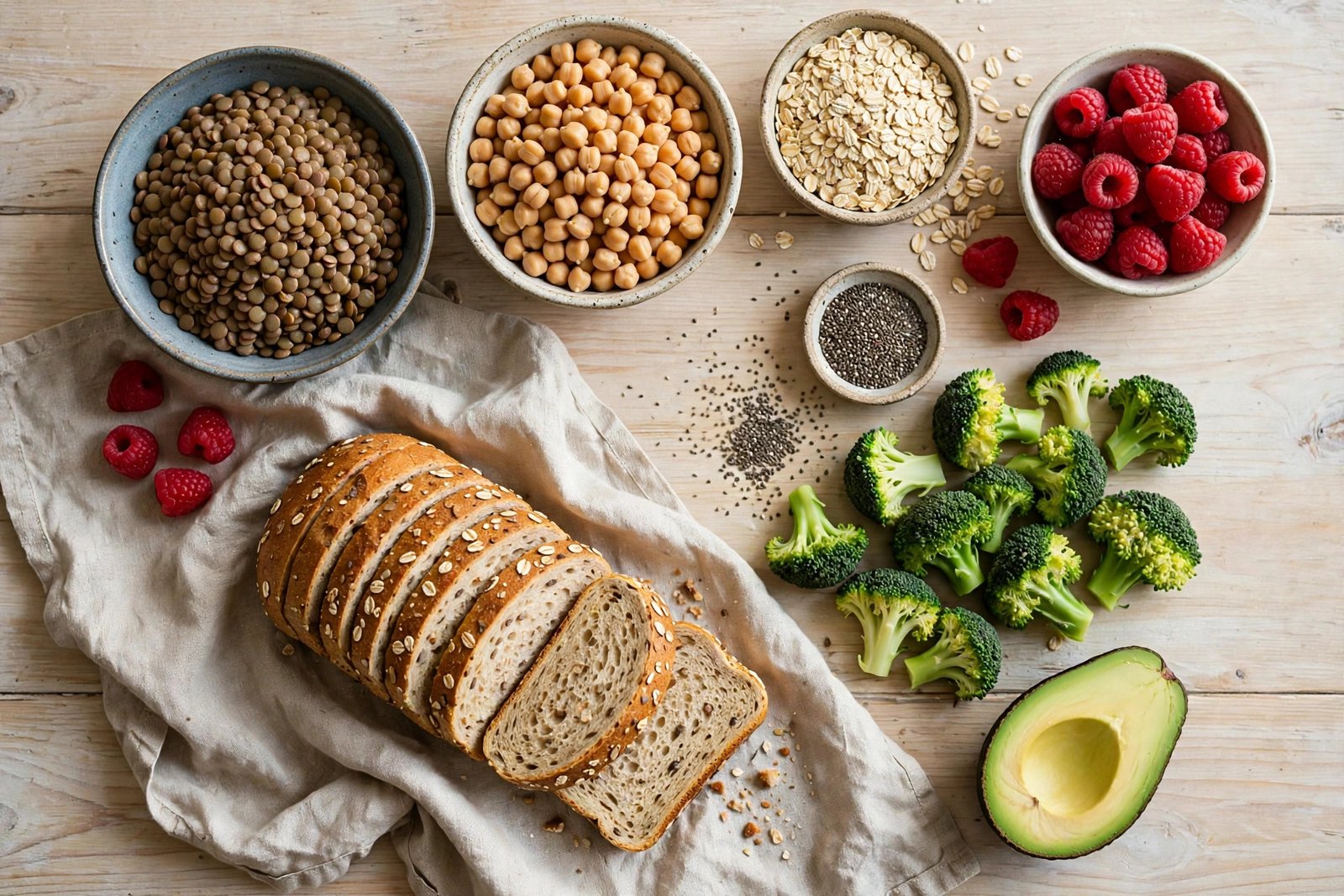
Fibermaxxing meal plan 30g fiber: a 7-day plan that lands at 35 to 39 grams of fibre a day on about 1,790 to 1,880 calories, with the fibre counted at every meal.
- Thirty grams a day is the UK recommendation for adults (SACN, 2015). In the US it is about 25 grams a day for women and 38 for men, so 30 lands neatly in the middle.
- Each day gives 35 to 39 grams of fibre and about 1,790 to 1,880 calories, so it fits a weight loss target of roughly 1,900 calories a day.
- Beans and lentils do the heavy lifting: half a cup of cooked lentils gives about 8 grams of fibre for about 115 calories.
- Do not jump from 15 grams to 30 overnight. Add about 5 grams a day each week, reach 30 in about three weeks, and drink more water.
- The largest review of the evidence, in The Lancet in 2019, found the greatest benefit at 25 to 29 grams a day, and its trials showed lower body weight.
Introduction
Most fibermaxxing meal plans tell you to eat 30 grams of fibre a day and leave you to guess the rest. They do not say how many calories the day adds up to, so you can hit the fibre target and still eat too much. That is the gap this plan closes.
Every day below lists four meals with the fibre and the calories attached. Day totals sit between 35 and 39 grams of fibre and about 1,790 to 1,880 calories.
Our guide to fibermaxxing for weight loss explains the idea itself; this post is the practical follow-on: seven days of meals, counted out.
Why 30 Grams of Fibre a Day?
In the UK, the Scientific Advisory Committee on Nutrition set 30 grams a day as the recommendation for adults in 2015, and the NHS still uses it today. In the US, the National Academies set an Adequate Intake of 14 grams of fibre for every 1,000 calories eaten, about 25 grams a day for women and 38 for men. Thirty grams sits between the two.
Most of us are far short: the NHS says most adults eat about 20 grams a day, roughly two thirds of the target. Three swaps close the gap: porridge with berries instead of sugary cereal, lentil soup instead of a white bread sandwich, and an apple instead of crisps.
The evidence is strong. A Lancet series in 2019 pooled 185 prospective studies covering 135 million person-years and 58 clinical trials with 4,635 adults (Reynolds et al., 2019). The highest fibre intakes, against the lowest, carried a 15 to 30 percent lower risk of death from all causes and from cardiovascular disease, with lower rates of heart disease, stroke, diabetes, and bowel cancer. The benefit was greatest at 25 to 29 grams a day, and the trials showed higher intakes lowered body weight by an average of 0.37 kg, blood pressure, and cholesterol.
That 0.37 kg is small, and it is not a promise that fibre alone will move your weight. It shows fibre helps when it replaces lower-fibre food.
How This Plan Works: Calories First, Fibre Second
Fibre without a calorie target can still fail: 35 grams of fibre at 2,500 calories will not lose weight for most people, because the deficit does the work and fibre only makes it easier to hold. So this plan sets the calories first and fits the fibre inside them.
Each day is built around about 1,850 calories, which suits a moderately active adult burning around 2,300 to 2,400 calories a day. If your burn is lower, eat smaller portions of the oil, cheese, nuts, and peanut butter. Work out your own number with our calories calculator first, then adjust the plan to fit it.
Worked example: 85 kg, moderately active, losing weight
Take a woman aged 40, 165 cm tall, 85 kg, moderately active, using the Harris-Benedict Revised formula our BMR and TDEE calculators use.
Step 1, BMR:
447.593 + (9.247 x 85) + (3.098 x 165) – (4.330 x 40)
= 447.593 + 785.995 + 511.17 – 173.2
= 1,572 calories a day
Step 2, TDEE. She is moderately active, so multiply by 1.55:
1,572 x 1.55 = 2,436 calories a day
Step 3, the weight loss target, 500 calories below maintenance:
2,436 – 500 = 1,936 calories a day
The plan days run at about 1,790 to 1,880 calories, 56 to 146 calories below her 1,936 target. A deficit of about 300 to 500 calories a day usually gives a slow loss of about 0.25 to 0.5 kilograms a week.
Protein sits alongside the fibre here: eggs and yogurt at breakfast, chicken or fish at lunch and dinner, and lentils, chickpeas, or tofu on the plant-based days. Our protein guide sets the range at 1.2 to 1.6 grams per kilogram a day, which for an 85 kg person is 102 to 136 grams a day. Split your calories with our macro calculator.
The 7-Day Fibermaxxing Meal Plan
Each day has four meals. Figures are approximate, added up from USDA FoodData Central values and rounded to the nearest gram and 10 calories. Cooked weights are used for beans, lentils, and grains. Repeat any day you like, or run the seven days in order.
Day 1: Monday
| Meal | What to eat | Fibre | Calories |
|---|---|---|---|
| Breakfast | Porridge, 40g dry oats, half a cup of raspberries, 1 tbsp chia seeds, 200ml milk, 2 boiled eggs | 12g | 480 |
| Lunch | Wholemeal sandwich, 2 slices bread, 100g chicken, half an avocado, salad, 30g cheddar | 11g | 640 |
| Dinner | 150g salmon, half a cup of quinoa, 1 cup broccoli, 1 tbsp olive oil | 8g | 590 |
| Snack | 1 medium pear | 6g | 100 |
| Total | 37g | 1,810 |
Day 2: Tuesday
| Meal | What to eat | Fibre | Calories |
|---|---|---|---|
| Breakfast | 170g Greek yogurt, half a cup of raspberries, 1 tbsp chia seeds, 1 slice toast, 2 boiled eggs, 200ml milk | 10g | 510 |
| Lunch | Lentil soup, half a cup of lentils, 1 slice bread, 1 carrot, 30g cheddar, 1 tbsp olive oil | 11g | 480 |
| Dinner | 150g chicken, 1 sweet potato, half a cup of broccoli, 1 tbsp olive oil, 30g cheddar | 6g | 620 |
| Snack | 1 medium apple, 3 cups popcorn | 8g | 190 |
| Total | 35g | 1,800 |
Day 3: Wednesday
| Meal | What to eat | Fibre | Calories |
|---|---|---|---|
| Breakfast | Porridge, 40g dry oats, 1 sliced banana, 200ml milk, 2 boiled eggs | 7g | 490 |
| Lunch | Half a cup of chickpeas, 60g hummus, 1 slice bread, 1 tbsp olive oil | 11g | 500 |
| Dinner | Half a cup of black beans, 100g chicken, half a cup of quinoa, half a cup of broccoli, 1 tsp olive oil, 30g cheddar | 13g | 580 |
| Snack | 1 medium orange, 28g almonds | 7g | 230 |
| Total | 38g | 1,800 |
Day 4: Thursday
| Meal | What to eat | Fibre | Calories |
|---|---|---|---|
| Breakfast | 170g Greek yogurt, 1 cup strawberries, 1 tbsp chia seeds, 1 slice toast, 2 tbsp peanut butter, 1 boiled egg | 11g | 550 |
| Lunch | 1 cup whole-wheat spaghetti, 100g chicken, half a cup of broccoli, 1 tbsp olive oil | 9g | 490 |
| Dinner | 150g salmon, half a cup of edamame, 1 sweet potato, 1 tbsp olive oil | 8g | 650 |
| Snack | 1 medium pear, 3 cups popcorn | 9g | 190 |
| Total | 37g | 1,880 |
Day 5: Friday
| Meal | What to eat | Fibre | Calories |
|---|---|---|---|
| Breakfast | Porridge, 40g dry oats, half a cup of raspberries, 1 tbsp flaxseed, 200ml milk, 2 boiled eggs | 10g | 460 |
| Lunch | Half a cup of pinto beans, 2 slices bread, 30g cheddar, 1 tbsp olive oil | 12g | 560 |
| Dinner | 150g tofu, half a cup of quinoa, half a cup of broccoli, 1 tbsp olive oil, 30g cheddar | 9g | 590 |
| Snack | 1 medium apple, 28g almonds | 8g | 260 |
| Total | 39g | 1,870 |
Day 6: Saturday
| Meal | What to eat | Fibre | Calories |
|---|---|---|---|
| Breakfast | 2 slices toast, 2 tbsp peanut butter, 1 banana, 170g Greek yogurt, 200ml milk | 9g | 660 |
| Lunch | Lentil soup, half a cup of lentils, 1 slice wholemeal bread, 1 carrot, salad, 30g cheddar, 1 tbsp olive oil | 11g | 480 |
| Dinner | 150g chicken, half a cup of quinoa, 1 cup broccoli, 1 tbsp olive oil | 8g | 530 |
| Snack | 1 medium orange, 3 cups popcorn | 7g | 160 |
| Total | 35g | 1,830 |
Day 7: Sunday
| Meal | What to eat | Fibre | Calories |
|---|---|---|---|
| Breakfast | Porridge, 40g dry oats, 1 diced apple, 200ml milk, 2 boiled eggs | 8g | 480 |
| Lunch | Half a cup of chickpeas, 1 slice bread, 1 tbsp olive oil, 30g cheddar | 8g | 470 |
| Dinner | 150g salmon, half a cup of black beans, 1 sweet potato, 1 tbsp olive oil | 11g | 650 |
| Snack | 1 medium pear, 28g almonds | 9g | 270 |
| Total | 36g | 1,870 |
The Ramp-Up: How to Reach 30 Grams Without Bloating
If you eat about 15 grams of fibre a day now, do not start this plan at full speed tomorrow. A sudden jump is the most common reason people quit fibermaxxing in the first week: gut bacteria ferment the extra fibre and produce gas. Add about 5 grams a day each week instead, so 15 grams becomes about 20 in week one, about 25 in week two, and about 30 in week three. Follow the plan in stages: breakfasts only in week one, then lunches, then dinners and snacks. Check your intake with our dietary fibre intake calculator each week.
Water matters as much as the fibre itself: without enough fluid, fibre can make constipation worse instead of better. The NHS advises about 6 to 8 cups of fluid a day, so drink a glass of water with each meal, eat slowly, and rinse canned beans before eating them. Mild bloating in the first week or two is common and usually settles. See a doctor if bloating is severe or painful, does not settle after a couple of weeks, or comes with diarrhoea, constipation, blood in your stool, or unexplained weight loss. If you have a gut condition such as IBS or Crohn’s disease, or you take regular medication, talk to your doctor or a dietitian before starting.
Shopping List for the Week
One shop covers most of the plan: lentils, chickpeas, black beans, and pinto beans; oats; chia seeds and flaxseed; wholemeal bread; quinoa and whole-wheat spaghetti; berries, apples, pears, bananas, and oranges; broccoli, sweet potatoes, carrots, and salad; almonds and popcorn; peanut butter and hummus; eggs, yogurt, milk, and cheddar; chicken, salmon, and tofu; and olive oil. Cook a pot of lentils and chickpeas on Sunday.
Common Mistakes With a Fibermaxxing Meal Plan
Jumping straight to 30 grams
The plan is built for 35 to 39 grams a day, but that is the destination, not the starting point. Start from where you are and add about 5 grams a day each week. The people who quit usually doubled their fibre overnight.
Counting fibre and ignoring calories
Some of the best fibre foods are also the most calorie-dense: an ounce of almonds gives 3.5 grams of fibre for 164 calories, and two tablespoons of peanut butter give 1.6 grams for about 190. Keep to the portions listed.
Forgetting to drink more water
Fibre without fluid is the fastest route to constipation, so every extra 5 grams of fibre deserves an extra glass of water. Keep a glass on the table at each meal, and count tea and coffee too.
Buying fibre bars and powders instead of food
A bar that claims 10 grams of fibre can carry as much sugar as a biscuit, and a scoop of powder does nothing for fullness. Real food works better: a cup of raspberries gives 8 grams of fibre for 64 calories, and half a cup of lentils gives about 8 grams for about 115, with protein included.
Frequently Asked Questions
Can I follow this fibermaxxing meal plan if I am vegetarian?
Yes. Swap the chicken and salmon for tofu, lentils, or chickpeas. One dinner is already plant-based, and the lentil and chickpea lunches need no meat at all. Check your protein target against the 1.2 to 1.6 grams per kilogram a day range.
What should I do if this plan makes me bloated?
Slow down rather than quitting. Drop back to plan breakfasts only and add about 5 grams a day each week. Drink a glass of water with each meal and eat slowly. See a doctor if bloating is severe or painful, or does not settle after a couple of weeks.
Can I repeat the same day every day instead of following all seven?
Yes, if that is what keeps you going. Pick the day you enjoy most and repeat it, but change the fruit and vegetable each day for a wider mix of nutrients. Repeating one day is fine for fibre and calories but narrower for everything else.
Is 30 grams of fibre a day safe?
For most healthy adults, yes. Thirty grams a day is the UK recommendation, and the largest review found the greatest benefit at 25 to 29 grams a day. Talk to your doctor first if you have a gut condition, take regular medication, or are pregnant or breastfeeding.
Will this meal plan make me lose weight?
It can help, but it does not guarantee it. The plan runs at about 1,790 to 1,880 calories a day, a deficit of roughly 300 to 500 calories for a moderately active adult. Fibre makes the deficit easier to hold.
—
Sources
- Scientific Advisory Committee on Nutrition. “Carbohydrates and Health.” 2015. The UK report behind the 30 grams a day target. https://assets.publishing.service.gov.uk/government/uploads/system/uploads/attachment_data/file/445503/SACN_Carbohydrates_and_Health.pdf
- Reynolds A, Mann J, Cummings J, Winter N, Mete E, Te Morenga L. The Lancet. 2019;393(10170):434-445. 185 studies, 135 million person-years, 58 trials: greatest benefit at 25 to 29 grams a day. https://pubmed.ncbi.nlm.nih.gov/30638909/
- NHS. “How to get more fibre into your diet.” Fibre should rise to 30 grams a day; most adults eat about 20 grams a day. https://www.nhs.uk/live-well/eat-well/digestive-health/how-to-get-more-fibre-into-your-diet/
- Worcestershire Acute Hospitals NHS Trust. “High Fibre Diet.” 30 grams a day for adults; increase fibre gradually; 6 to 8 cups of fluid a day. https://www.worcsacute.nhs.uk/leaflets/high-fibre-diet/
- U.S. Department of Agriculture, Agricultural Research Service. FoodData Central. All fibre and calorie figures in the plan come from this database. https://fdc.nal.usda.gov/
- Dietary Guidelines for Americans: Food Sources of Fiber. Standard portions; Adequate Intake 14 grams of fibre for every 1,000 calories. https://www.dietaryguidelines.gov/sites/default/files/2024-08/Food-Sources-Fiber-Standard-508C.pdf
- Roza AM, Shizgal HM. American Journal of Clinical Nutrition. 1984;40(1):168-182. The Harris-Benedict equations re-evaluated. https://pubmed.ncbi.nlm.nih.gov/6741850/
- Leidy HJ, Clifton PM, Astrup A, et al. American Journal of Clinical Nutrition. 2015;101(6):1320S-1329S. Higher-protein diets of 1.2 to 1.6 g/kg a day improve appetite, weight, and cardiometabolic risk. https://pubmed.ncbi.nlm.nih.gov/25926512/
- Weight Insider. Macro calculator, dietary fibre intake calculator, calories calculator, fibermaxxing guide, and protein guide.
Last updated: 20 November 2026
Medical Disclaimer
This article is general information only. It is not medical advice, and it is not a substitute for advice from a qualified health professional. Talk to your doctor, or a registered dietitian, before changing your diet, especially if you have a digestive condition, take regular medication, are pregnant or breastfeeding, or have a history of disordered eating.