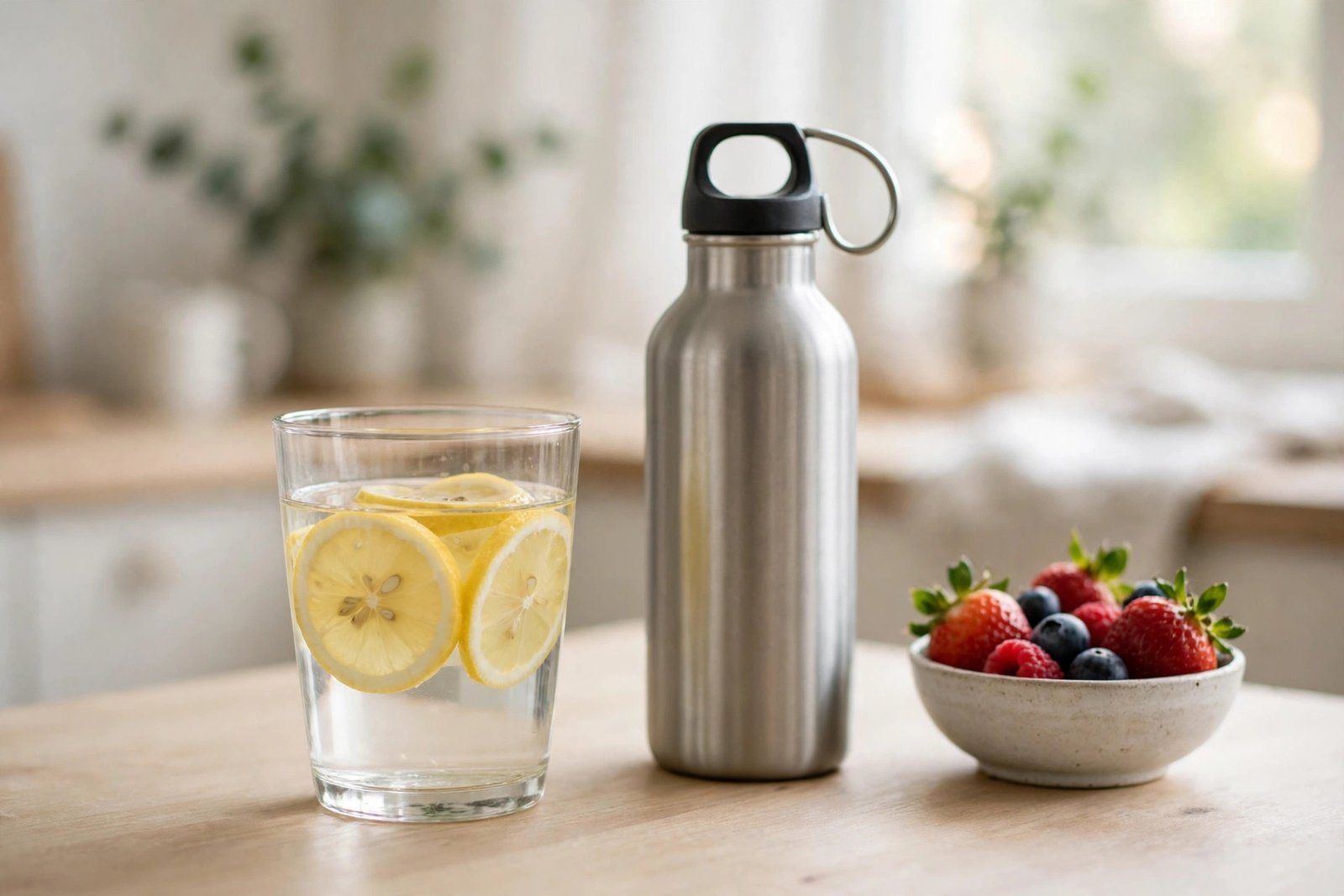
Does drinking water help you lose weight? A little, and only in specific ways. Two small trials found 500 ml of water before meals added about 1 to 2 kg of extra loss over 12 weeks, swapping sugary drinks for water saves hundreds of calories a day, and water itself burns almost no calories. Water is a helper, not a fat burner.
- Two 12 week trials found 500 ml of water before each main meal added about 1 to 2 kg of extra loss on top of a diet.
- Water before a meal works by taking the edge off appetite, not by burning calories: the 30 percent metabolism claim did not hold up when other labs retested it.
- The biggest win is the swap: replacing two 330 ml sugary drinks a day with water saves 278 calories a day, about 0.25 kg of fat a week.
- Water alone does not melt fat. Without a calorie deficit, extra water changes nothing except a short rise from the water itself.
- EFSA adequate intake is about 2.0 litres of total water a day for women and 2.5 litres for men, including the water in food.
The Three Water Strategies in One Table
Water shows up in weight loss advice in three roles, and they are not equal. Pre-meal water is a timing trick that may help you eat a little less. Swapping drinks is a calorie cut that works every time. Thermogenesis, the idea that water burns calories by warming up in your stomach, is real but tiny.
| Strategy | What you do | Evidence | Size of the effect |
|---|---|---|---|
| Pre-meal water | 500 ml, 30 minutes before each main meal | two small randomised trials | about 1 to 2 kg extra over 12 weeks |
| Swapping drinks | water instead of sugary drinks | simple calorie maths | 139 kcal saved per 330 ml can |
| Thermogenesis | drink cold water to burn calories | one small 2003 study, not replicated | about 24 kcal per 500 ml at best |
Drinking more water on its own has no trial behind it as a weight loss method. If the water does not change what you eat or drink, it does not change your weight.
The Davy Trial: 500 ml Before Meals
The best known trial comes from Virginia Tech, published in 2010. Researchers put 48 adults aged 55 to 75, with a body mass index between 25 and 40, on a low calorie diet for 12 weeks, a small and short trial in older adults. Half drank 500 ml of water, about two glasses, before each of their three main meals. The other half just followed the diet.
After 12 weeks, the water group had lost about 2 kg more than the diet only group, and their rate of weight loss was 44 percent greater. Read that figure carefully: 44 percent greater than the other group, not 44 percent of body weight. If the diet only group lost about 4.5 kg, the water group lost about 6.5 kg. Both groups lost weight. The water added a modest extra.
The trial also tested the mechanism. At the start, a 500 ml preload cut how much people ate at a test meal by 43 calories. By week 12, that effect had faded and was no longer statistically significant. The likely explanation is simple: a stomach with half a litre of water in it has less room and less appetite, at least for a while.
The Parretti Trial: The Same Idea, A Smaller Result
Five years later, a team at the University of Birmingham tested the same idea in ordinary GP practices in England, with 84 adults who had obesity. One group drank 500 ml of water 30 minutes before each main meal for 12 weeks. The control group was asked to imagine their stomach was full before meals, which separates the water from thinking about fullness.
The water group lost 1.3 kg more than the control group over 12 weeks. After adjusting for age, sex, ethnicity and deprivation, the difference was 1.2 kg and was no longer statistically significant, which means the result could be chance. The authors called the evidence preliminary.
Two details are more interesting than the headline. First, 27 percent of the water group lost at least 5 percent of their body weight, against 5 percent of the control group. Second, people who preloaded before all three meals every day lost 4.3 kg, while those who preloaded once or not at all lost 0.8 kg. That gap is not a randomised comparison, but the trick only works if you actually do it, three times a day.
Water and Your Metabolic Rate: The 30 Percent Claim
You will see a claim that drinking water raises your metabolic rate by 30 percent. It comes from a real study, and it is also misleading. In 2003, Boschmann and colleagues gave 500 ml of water to 14 healthy, normal weight adults and measured their energy expenditure. Metabolic rate rose by 30 percent, peaking 30 to 40 minutes after drinking, and the total extra burn was about 100 kJ, roughly 24 calories.
When another group retested the idea in 2015, with 27 young adults and a sham drink control, room temperature water produced no measurable rise at all. Very cold water produced about a 4.5 percent rise over an hour. The 30 percent figure has not held up.
Even if you take the original figure at face value, it is small. Warming 500 ml of water from 22 C to body temperature costs about 7.5 calories. The rest was put down to a nervous system response, and that is the part the retest could not reproduce.
The Swap That Actually Moves the Scale
Here is where water genuinely earns its place: not by adding something, but by replacing something. A 330 ml can of cola has 139 calories and 35 g of sugar, with no nutrients at all. Water has zero. Every time you choose water instead of a sugary drink, you bank the whole 139 calories, and you only need to make the swap once.
Sugary drinks are unusually bad at filling you up. A 2010 systematic review found that a sugar sweetened drink before a meal raised total energy intake for that meal by about 8 percent, because people did not eat less food to make up for the drink.
This is where the difference between drinking water and replacing calorie drinks becomes clear. Drinking an extra litre of water on top of your normal diet adds nothing. Replacing a litre of sugary drinks with water removes about 420 calories a day. Same water, same glass, completely different result. The water is not doing the work. The missing sugar is. If your day includes two or three sugary drinks, the swap is one of the easiest calorie cuts that exists. Check the cost with our calories calculator.
How Much Water Should You Drink?
There is no single number that fits everyone, but there are official reference values. The European Food Safety Authority sets adequate intakes for total water at 2.0 litres a day for women and 2.5 litres a day for men. Those figures count all water, including the water in food, for moderate temperatures and moderate activity.
A practical way to think about it is in glasses. If about a fifth of your water comes from food, a woman needs roughly 1.6 litres from drinks and a man roughly 2.0 litres. Hot weather, exercise, and a high fibre diet push the number up. Our daily water intake calculator can work out a personal figure, and our hydration level calculator can check where you stand.
Two warnings belong here. More is not always better: drinking far more water than you lose can dilute the sodium in your blood, a condition called hyponatraemia, most often seen in endurance athletes who overdrink during long events. Thirst is a reasonable guide for most healthy adults. The old rule of eight glasses a day is not a scientific finding, it is a round number that stuck.
The Worked Example: The Swap and the Pre-Meal Glass
Take our worked example person: a woman aged 40, 165 cm tall, 85 kg, moderately active. Her basal metabolic rate is 1,572 calories a day, her total daily energy expenditure is 2,436 calories a day, and her weight loss target is 1,936 calories a day, a deficit of 500 calories a day. At that deficit she would lose about 5.45 kg of fat in 12 weeks, at about 7,700 calories per kilogram of body fat.
Now add the drink swap. She drinks two 330 ml sugary drinks a day, and replaces both with water. Each can is 139 calories, so the swap saves 278 calories a day, or 1,946 calories a week. That is about 0.25 kg of fat a week, and about 3.03 kg over 12 weeks, on top of her diet. It also removes 70 g of sugar a day, or 490 g a week. Her deficit rises from 500 to 778 calories a day, and her 12 week fat loss from about 5.45 kg to about 8.49 kg. Set your own target with our weight loss goal calculator.
Now add the pre-meal glass as well. If the Davy trial’s acute effect holds, 43 calories less per meal across three meals is 129 calories a day. Together that is 407 calories a day, or 2,849 calories a week, about 0.37 kg of fat a week. But the 43 calorie effect had faded by week 12 in the Davy trial, so the pre-meal part is the shaky part. Count on the swap. Treat the pre-meal glass as a bonus.
Why Water Alone Does Not Melt Fat
Three myths deserve a straight answer. First, lemon water does not detox you or burn fat. Lemon adds flavour and a little vitamin C, and it makes water more pleasant to drink, which is a real benefit if it helps you drink water instead of cola. It does not change how your body burns fat. Second, drinking water does not flush fat out of your body. Fat leaves the body mostly as carbon dioxide when you breathe out.
Third, the scale will lie to you about water. A litre of water weighs a kilogram, so drinking a big glass before you weigh yourself adds weight, not fat. Salty meals and hormonal changes do the same: they hold water in the body and push the scale up for a day or two. That is water weight, not fat gain, and it passes. If water weight confuses you, read our guide to water weight vs fat loss.
Fat loss needs a calorie deficit. Water has zero calories, so it cannot create one on its own. It can only help you eat less, or replace something that had calories.
A Simple 7 Day Water Plan
Here is a one week plan. Day 1: count your sugary drinks. Day 2: replace one of them with water. Day 3: replace a second one. Day 4: drink 500 ml of water 30 minutes before lunch and dinner. Day 5: carry a bottle and refill it once. Day 6: add up the drinks you skipped and multiply by 139 calories. Day 7: decide what stays. Most people keep the swap, because the swap does most of the work.
When to Be Careful
For most healthy adults, drinking more water is safe. If you have heart failure or severe kidney problems, the RACGP guidance says not to use the 500 ml before meals trick. Do not use water to skip meals: our worked example person needs about 102 g of protein a day, and no amount of water replaces that.
Frequently Asked Questions
Does drinking water help you lose weight?
A little, in two specific ways. Drinking 500 ml before meals added about 1 to 2 kg of extra loss over 12 weeks in two small trials, and replacing sugary drinks with water saves 139 calories per 330 ml can. Water alone does not cause fat loss.
How much water should I drink before a meal to lose weight?
The trials used 500 ml, about two glasses, 30 minutes before each main meal. That is 1.5 litres a day on top of your normal drinking water. Smaller amounts have not been tested.
Does cold water burn more calories than room temperature water?
Only a tiny amount more. Warming 500 ml of water from 22 C to body temperature costs about 7.5 calories. A 2015 retest found no rise from room temperature water and about a 4.5 percent rise from very cold water. Neither is enough to matter.
Can drinking too much water stop weight loss?
Drinking too much water cannot stop fat loss, because water has no calories. But it can push the scale up for a day, since a litre of water weighs a kilogram, and drinking far more than you lose can dilute blood sodium. Drink to thirst and do not force litres beyond it.
Is lemon water better than plain water for weight loss?
No. Lemon adds flavour and a little vitamin C, and it may help you choose water over a sugary drink. But lemon water does not detox you or burn fat, and plain water works exactly the same way.
Sources
- Water consumption increases weight loss during a hypocaloric diet intervention in middle-aged and older adults: Dennis et al., Obesity 2010; 48 adults aged 55 to 75; 500 ml before each meal; about 2 kg more loss over 12 weeks.
- Drinking water before meals may increase weight loss: Healio summary of Parretti et al., Obesity 2015; 84 adults with obesity; 1.3 kg more loss at 12 weeks.
- A bottle of water before mealtimes could aid weight loss: Medical News Today summary of Parretti et al., Obesity 2015; full adherers lost 4.3 kg vs 0.8 kg.
- Water-induced thermogenesis: Boschmann et al., Journal of Clinical Endocrinology and Metabolism 2003; 14 adults; 500 ml raised metabolic rate by 30 percent; about 24 kcal.
- Water-induced thermogenesis and fat oxidation: a reassessment: Charriere et al., Nutrition and Diabetes 2015; 27 young adults; no measurable rise from room temperature water.
- Pre-meal water consumption for weight loss: Royal Australian College of General Practitioners, 2013; 500 ml 30 minutes before meals; heart failure and kidney impairment listed as contraindications.
- Coca-Cola Original Taste 330 ml nutrition: 139 kcal and 35 g of sugar per 330 ml can.
- Scientific Opinion on Dietary Reference Values for water: EFSA Journal 2010; adequate total water 2.0 litres a day for women and 2.5 litres for men, including water from food.
- Weight Insider: Daily Water Intake Calculator, Hydration Level Calculator, Weight Loss Goal Calculator, Calories Calculator, Water Weight vs Fat Loss.
Medical Disclaimer
This article is for general information only and is not medical advice. If you have heart failure or kidney disease, talk to a health professional before changing how much water you drink.
Last updated: 25 November 2026