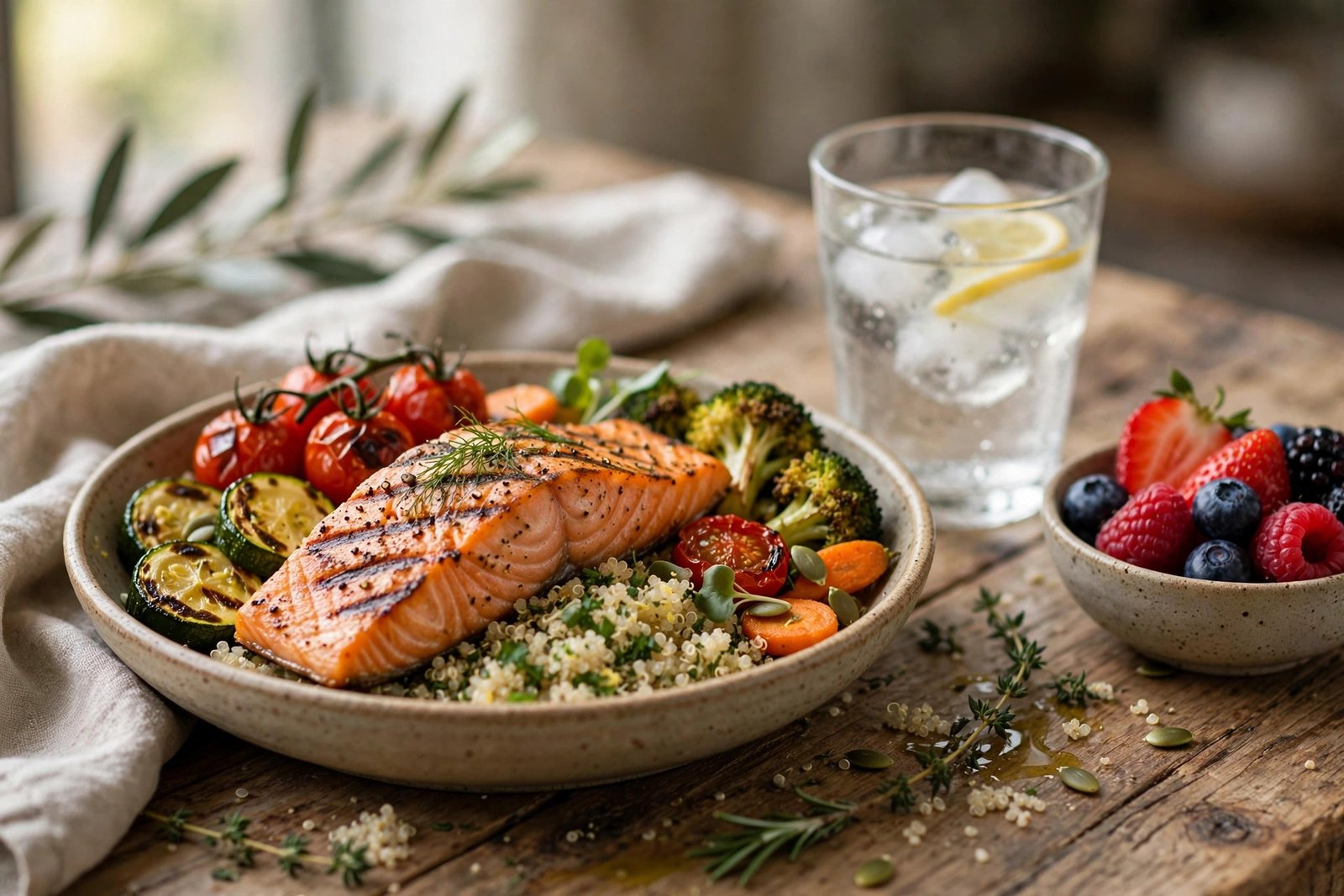
How to lose weight with PCOS is a different question, because the condition changes the starting point. Losing 5 to 10 percent of your body weight is the target the evidence supports, and it is enough to improve periods, ovulation, insulin sensitivity and mood. There is no single best PCOS diet in the trials, so the plan that works is the one you can keep: a modest calorie deficit, lower glycaemic index foods, enough protein, strength training twice a week, and protected sleep.
- Losing 5 to 10 percent of body weight is the guideline target: for a woman at 90 kg that is 4.5 to 9.0 kg.
- About 50 to 70 percent of women with PCOS have insulin resistance, which makes fat storage easier and hunger harder.
- No diet type has beaten the others in trials, but low glycaemic index eating improved insulin sensitivity and cycles.
- In the best fertility trial, losing about 6 percent over 16 weeks raised ovulation to 60 percent, against 46 percent on the pill alone.
- Inositol and metformin are for your clinician to decide: trials show no clear weight effect for inositol.
Why Weight Loss Is Harder With PCOS
Polycystic ovary syndrome (PCOS) affects about 8 to 13 percent of women of reproductive age. It is diagnosed when two of three features are present: irregular or absent ovulation, higher androgens, and many small follicles on the ovaries. Weight gain is common with PCOS, but it is not a personal failure.
The first reason is insulin resistance, which affects about 50 to 70 percent of women with PCOS. The body needs extra insulin to move glucose into cells, and high insulin encourages fat storage around the waist and pushes the ovaries to make more androgen. A clamp study found insulin resistance in 75 percent of lean women with PCOS and 95 percent of overweight women with PCOS.
The second reason is appetite: many women with PCOS report stronger hunger and sharper cravings, especially for sweet and starchy foods. The third is sleep: about 35 percent of women with PCOS have obstructive sleep apnoea, against about 6 percent without it, and broken sleep raises hunger hormones. If you snore loudly or wake unrefreshed, raise it with your clinician.
What 5 to 10 Percent Actually Does
The most useful number is small: 5 to 10 percent of your starting weight. The 2023 international PCOS guideline calls that range a success within six months, because even a modest loss improves reproductive, metabolic and psychological symptoms. For a woman at 90 kg, 5 percent is 4.5 kg and 10 percent is 9.0 kg.
The clearest trial is the Legro trial of 2015: 149 women with PCOS related infertility were assigned to 16 weeks of the pill alone, a lifestyle programme, or both, before fertility treatment. The lifestyle group lost 6.2 percent of body weight, and ovulation was 60 percent against 46 percent in the pill group. The lifestyle programme also included a weight loss drug, so it was not diet alone. Even so, it is the best evidence that losing around 6 percent changes ovulation.
Weight loss does not cure PCOS, but a modest loss turns down the volume on periods, insulin sensitivity, androgens and mood.
There Is No Single Best PCOS Diet
Search for the best PCOS diet and you will find confident answers: keto, low carb, Mediterranean, vegan, gluten free, dairy free. The trials do not support that confidence. A systematic review written to inform the 2023 guideline pooled 11 randomised trials and found no intervention superior to another. Average weight loss ranged from a gain of 0.5 percent to a loss of 10.6 percent, with dropout rates of 12 to 47 percent. The hard part is not picking the perfect diet, it is staying with any reasonable one.
The guideline says there is no, or only limited, evidence that any specific diet type is better than another when calories are matched, so choose the pattern that fits your life, your food culture and your budget. A woman who eats rice and dal every day needs the same deficit, built from the foods she already eats. The guideline suggests a deficit of 500 to 750 kcal a day, which for most women means roughly 1,200 to 1,500 kcal a day. A 500 kcal deficit is the steadier choice: about 0.45 kg a week, and small enough to live with.
Low Glycaemic Index Food and Enough Protein
Within that freedom, two patterns have the best evidence for PCOS. The first is lower glycaemic index eating: oats, lentils, beans and wholegrain bread instead of white bread, white rice, sugary drinks and pastries. A 2020 meta-analysis of 10 trials with 403 women found lower glycaemic index diets improved insulin resistance, fasting insulin, cholesterol, triglycerides, waist and testosterone, with no weight difference.
The best single trial is Marsh and colleagues in 2010. Ninety-six women with PCOS ate a low glycaemic index diet or a conventional healthy diet, matched for calories and fibre, for up to 12 months. Insulin sensitivity and menstrual regularity improved more on the low glycaemic diet, 95 percent against 63 percent for regular cycles. Weight loss did not differ, and nearly half the women in both groups dropped out. Swapping white rice for brown rice or oats needs no new cuisine. Our glycemic index calculator can show you where your usual foods sit.
The second pattern is enough protein: 1.2 to 1.6 g per kg of body weight a day, which for a 90 kg woman is 108 to 144 g a day, or about 36 to 48 g at each of three meals. Protein keeps you full longer and protects muscle while you lose fat. Check your own number with our protein intake calculator.
Strength Training and Walking
A 2025 meta-analysis of 10 trials with 382 women found aerobic exercise reduced BMI, waist size, insulin and cholesterol, while resistance exercise improved lean mass and reduced body fat. Walking improved the blood markers; strength work changed body composition. The guideline adds that supervised vigorous aerobic exercise may give greater benefits, though resistance evidence is thinner.
Do strength training twice a week: squats, lunges, rows, push ups or weights, two or three sets of 8 to 12 repetitions, with a rest day between sessions. Add brisk walking on the other days, towards 150 minutes a week. When you start strength training, your weight may stay flat for a few weeks while muscles hold extra water. Measure your waist weekly too.
Sleep: The Lever Most Plans Forget
Short or broken sleep raises the hunger hormone and lowers the fullness hormone, so the day after a bad night is the day the biscuit tin wins. For women with PCOS the stakes are higher, because about a third have sleep apnoea. If you wake with a headache, or your partner says you stop breathing in your sleep, ask your clinician about a sleep study. What you can control is simple: a regular bedtime and wake time, no caffeine after midday, a dark cool bedroom, screens off an hour before bed, and 7 to 9 hours of sleep.
Inositol and Metformin: What Clinicians Discuss
Two names come up in every PCOS conversation: inositol and metformin. Inositol is a supplement, usually myo-inositol. A review written for the 2023 guideline pooled 30 trials with 2,230 women and found no difference in BMI against placebo, or in BMI, weight or waist against metformin. The guideline says inositol could be considered, noting limited harm and limited benefit. It is not a weight loss treatment, and anyone selling it as one is ahead of the evidence.
Metformin is a prescription diabetes drug that clinicians often discuss for PCOS, because it improves insulin sensitivity. The 2023 guideline says it should be considered for metabolic goals in adults with a BMI of 25 or more. A 2026 network meta-analysis of 16 trials found GLP-1 drugs plus metformin gave the largest weight fall, about 5.6 kg more. None of this is a recommendation: these are prescription medicines with real side effects, and the right choice depends on your blood sugar, weight, fertility plans and other medicines. Do not start, stop or change any drug or supplement because of an article.
The Worked Example
Meet Sara, 32, 165 cm, 90 kg, lightly active, with PCOS. Her numbers, from the Harris-Benedict Revised equation our calculators use: basal metabolic rate 1,652 kcal a day, maintenance 2,272 kcal a day, target 1,772 kcal a day on a 500 kcal deficit. Her protein target is 108 to 144 g a day, 36 to 48 g per meal, and her BMI is 33.1. Check your own numbers with our basal metabolic rate and calories calculators.
Her 5 to 10 percent target is 4.5 to 9.0 kg, taking her from 90 kg to 85.5 kg at 5 percent and to 81.0 kg at 10 percent. At a 500 kcal daily deficit she loses about 0.45 kg a week, or about 5.4 kg in 12 weeks. That puts 5 percent about 10 weeks away and 10 percent about 20 weeks away if the deficit holds. Real life is not steady, so plan for 12 weeks to 5 percent and six months to 10 percent, and treat that as success.
A 12 Week Plan You Can Actually Keep
Weeks 1 and 2 are about the baseline, not perfection: eat at your target three days a week, walk 20 minutes a day, and add protein to breakfast, such as eggs or Greek yoghurt. Weigh yourself three times a week and take the weekly average rather than reacting to a single reading.
Weeks 3 to 6 are where the habits form: eat at your target five days a week, with two days at maintenance for social meals. Start strength training twice a week, and swap two high glycaemic foods for lower ones, such as oats for sugary cereal. Set a regular bedtime and keep it for a month.
Weeks 7 to 12 are about holding the course. If weight loss stalls for four weeks despite honest tracking, check cooking oil and sauces, drinks with calories, weekend meals, and portions that have quietly grown. Do not cut calories in a panic: a stall is normal, especially around periods, when water retention can hide a kilogram or two of fat loss. Our guide to weight loss after 40 and menopause is worth reading if your hormones are changing with age.
When the Scale Stalls
It is tempting to blame every stall on PCOS, and sometimes it is genuinely part of it. But the most common reasons are ordinary: a smaller body burns fewer calories, tracking has drifted, sleep has slipped, or strength training has added water weight. Before changing anything, track honestly for two weeks, including weekends. If the stall lasts more than six weeks despite honest tracking, talk to your clinician about thyroid, blood sugar, medicines and sleep apnoea. Do not slash calories to 1,000 a day or start a supplement or drug on the basis of an advert.
Frequently Asked Questions
How much weight do you need to lose with PCOS to see a difference?
Losing 5 to 10 percent of your starting weight is the target the 2023 international PCOS guideline calls a success within six months. For a woman at 90 kg that is 4.5 to 9.0 kg, and even that modest loss can improve periods, ovulation and mood.
What is the best diet for PCOS weight loss?
No single diet has beaten the others in trials of women with PCOS. A review of 11 trials found no diet type superior when calories were matched. Lower glycaemic index eating has the best supporting evidence, so build your deficit from foods you enjoy and can keep eating.
Does inositol help with PCOS weight loss?
The trials show no clear weight effect. A review written for the 2023 guideline pooled 30 trials with 2,230 women and found no difference in BMI against placebo and no difference in weight against metformin. The guideline says it could be considered, but it is not a weight loss treatment.
Can you lose weight with PCOS without medication?
Yes. Lifestyle change is the first line treatment in the 2023 guideline, and in the Legro trial women who lost about 6 percent of body weight through a lifestyle programme ovulated more often than women on the pill alone. Medication is for your clinician to discuss if lifestyle alone is not enough.
Why am I not losing weight with PCOS on 1,200 calories?
First, check the tracking: cooking oil, sauces, drinks and weekend meals are the usual hidden calories. Second, check sleep and stress. Third, remember that strength training and your menstrual cycle can add water weight that hides fat loss for weeks. If the stall lasts more than six weeks, talk to your clinician about thyroid, blood sugar and your medicines.
Sources
- 2023 international PCOS guideline recommendations: 5 to 10 percent in six months is a success; deficit 500 to 750 kcal a day.
- Weight loss in PCOS, systematic review: 11 trials; weight loss plus 0.5 to minus 10.6 percent; no intervention superior.
- Detecting insulin resistance in PCOS: 50 to 70 percent of women with PCOS have some degree of insulin resistance.
- Intrinsic insulin resistance in PCOS, clamp study: 75 percent of lean women with PCOS; 95 percent of overweight women with PCOS.
- Legro et al. 2015, preconception trial in PCOS: 149 women; lifestyle lost 6.2 percent; ovulation 60 percent against 46 percent.
- Weight loss, exercise improve fertility in women with PCOS, MedicalXpress: Legro trial summary; 13 of 50 in the lifestyle group gave birth, against 5 of 49.
- Glycemic index in PCOS, meta-analysis 2020: 10 trials, 403 women; low GI lowered HOMA-IR, insulin and waist, with no weight change.
- Marsh et al. 2010, low glycemic index in PCOS: 96 women; insulin sensitivity and menstrual regularity improved more on low GI.
- Physical activity in PCOS, meta-analysis 2025: 10 trials, 382 women; aerobic reduced BMI, waist and insulin; resistance improved lean mass and body fat.
- Sleep apnoea in PCOS, Kahal et al. 2019: pooled prevalence 35.0 percent of women with PCOS.
- Does inositol help with weight loss? The trials, Wellgard: 2024 review summary; 30 trials, 2,230 women; no BMI difference against placebo.
- GLP-1, metformin and inositol in PCOS, 2026: 16 trials; GLP-1 plus metformin gave the largest weight fall, about 5.6 kg more.
- Weight Insider: Glycemic Index Calculator, Protein Intake Calculator, Basal Metabolic Rate Calculator, Calories Calculator, Weight Loss After 40 and Menopause.
Medical Disclaimer
This article is for general information only and is not medical advice. Do not start, stop or change any medicine or supplement, or start a new diet or exercise programme, without talking to your clinician first, especially with diabetes, a thyroid condition, sleep apnoea, an eating disorder history, or pregnancy.
Last updated: 25 November 2026