How to lose weight on a budget costs nothing at its core: a 500 calorie daily deficit, enough protein to stay full, and walking you already do. The cheapest protein is lentils, beans and eggs, and frozen vegetables match fresh ones.
- Weigle 2005: raising protein from 15 percent to 30 percent of energy cut spontaneous eating by 441 kcal a day, and 19 people lost 4.9 kg in 12 weeks.
- Rao 2013: the healthiest diets cost about $1.50 more a day than the least healthy ones, across 27 studies in 10 countries.
- CDC: losing 1 to 2 lb, or 0.5 to 1 kg, a week is the gradual pace most likely to stay off.
- Diabetes Prevention Program 2002: diet plus 150 minutes of activity a week cut new type 2 diabetes by 58 percent in 3,234 adults with prediabetes.
- Ducrot 2017: in 40,554 French adults, people who planned meals had lower odds of obesity, 0.79 in women and 0.81 in men.
The Short Answer
Weight loss is energy in against energy out, and none of the three things that create a deficit costs money. Eating less than you burn is free. Walking is free. What costs money is the food itself, and you have to buy food whether you are losing weight or not. The budget version of weight loss is not a cheaper diet product. It is the same deficit, built from the cheapest foods that keep you full.
The honest catch is that the healthiest diets do cost a little more. A 2013 Harvard meta-analysis of 27 studies in 10 countries found the healthiest diets cost about $1.50 more a day than the least healthy ones, roughly $550 a year. But the biggest price gap was in meat and protein, which is where the cheap swaps live: lentils instead of steak, thighs instead of breast, eggs instead of a protein bar.
The Maths First: A Worked Example
Before the shopping list, the numbers, because a budget plan that does not add up is just a wish. Meet James, 38, 178 cm, 95 kg, moderately active. His basal metabolic rate, the calories he burns at rest, comes from the Harris-Benedict Revised equation, and it is 2,000 kcal a day. Multiply by 1.55 for moderate activity and his maintenance is 3,099 kcal a day. Take off 500 kcal and his weight loss target is 2,599 kcal a day. His BMI is 30.0, and his protein target is 114 to 152 g a day, which is 1.2 to 1.6 g per kg of body weight. Check your own numbers with our TDEE calculator and our calories calculator.
A 500 kcal daily deficit is 3,500 kcal a week, which is about 0.45 kg of fat a week at 7,700 kcal per kg, or about 5.45 kg in 12 weeks. James’s first target, 5 percent of his weight, is 4.75 kg, taking him to 90.25 kg, which arrives in about 10 and a half weeks. The CDC calls 1 to 2 lb, or 0.5 to 1 kg, a week a gradual, steady pace, and says people who lose weight that way are more likely to keep it off. Notice what the maths leaves out: nothing in it costs money.
The Cheapest Protein on the Shelf
Protein is the most expensive part of a weight loss diet and also the most useful, because it is the nutrient that keeps you full. In Weigle 2005, 19 people ate a diet with protein raised from 15 percent to 30 percent of energy, and when they were allowed to eat freely they spontaneously ate 441 kcal a day less and lost 4.9 kg in 12 weeks. The catch is that protein is also where grocery bills grow, so the choice of protein is the choice that decides the budget.
Compare foods by protein per 100 kcal, using USDA FoodData Central figures. Canned light tuna in water gives 22.0 g of protein per 100 kcal. Roasted chicken breast gives 18.8 g, roasted chicken thigh 13.9 g, a hard boiled egg 8.1 g, cooked lentils 7.8 g, dry oats 3.5 g, and cooked white rice 2.1 g. But protein per calorie is not price per gram of protein. No specific prices are quoted here, because published figures for the same food disagree by 3 to 6 times, depending on country, date and method. What every ranking agrees on is the order: dried beans and lentils are the cheapest protein you can buy, eggs are the cheapest animal protein, and chicken thighs and drumsticks are the cheapest meat cut.
So the budget protein list is short: dried lentils and beans, eggs, canned light tuna in water, and chicken thighs with the skin removed. One thigh without skin, 116 g, gives 28.7 g of protein for 208 kcal. Work out your own protein target with our protein intake calculator, then buy from the top of this list first. One warning about tuna: it carries mercury, so eat it a few times a week, and light tuna carries less mercury than albacore.
A Day of Eating for About 2,600 Calories
Here is a full day at James’s target of 2,599 kcal, built only from the cheap list. It adds up to about 2,600 kcal and 148 g of protein, inside his 114 to 152 g range. Check the balance of your own day with our macro calculator.
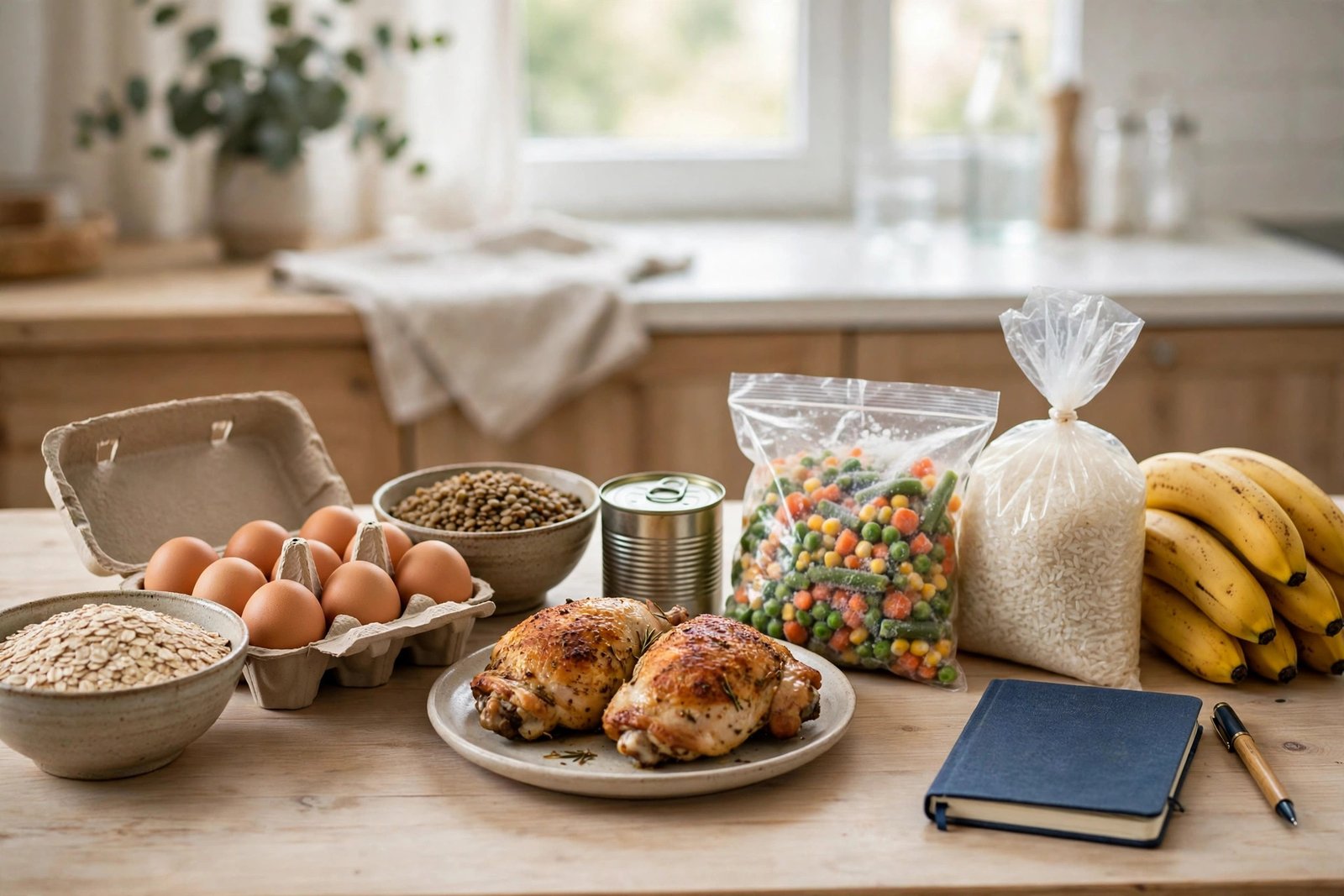
Breakfast, porridge: 80 g of oats cooked with 200 ml of milk and one banana, 508 kcal and 18 g of protein. Lunch, lentil and rice bowl: 200 g of cooked lentils, 250 g of cooked rice and 150 g of frozen mixed vegetables, 654 kcal and 29 g of protein. Snack: two boiled eggs, 155 kcal and 13 g of protein. Dinner: two roasted chicken thighs without skin, 350 g of cooked rice and 150 g of frozen mixed vegetables, 968 kcal and 71 g of protein. Evening: 150 g of plain nonfat Greek yogurt and one banana, 194 kcal and 17 g of protein. Add one tablespoon of olive oil used in cooking, 119 kcal. The day totals about 2,600 kcal and 148 g of protein.
If chicken is dear one week, swap in a can of tuna and a second bowl of lentils. If your target is lower than James’s, shrink the rice first and keep the protein.
The Weekly Shop and Two Batch Cooking Sessions
A budget diet fails in the supermarket, not in the kitchen, so the shop is planned before the week starts. For one person eating the day above, the weekly shop is roughly: 1 kg of oats, 2 kg of rice, 1 kg of dried lentils, about 2 kg of chicken thighs, 18 eggs, 2 kg of frozen mixed vegetables, 1.4 litres of milk, 14 bananas, a 1 kg tub of plain yogurt, and 4 cans of light tuna.
Cook twice a week, not seven times. On Sunday and again on Wednesday, cook a big pot of lentils and a big pot of rice, roast a tray of chicken thighs, and boil a dozen eggs. Portion everything into containers, keep three days in the fridge and freeze the rest. Shop with a list, shop after a meal, never hungry, and buy the store brand of oats, rice, lentils and canned tuna.
Frozen Vegetables and the Pantry
Frozen vegetables are the budget dieter’s best friend, and the science backs them. A University of California, Davis study compared 8 frozen and fresh fruits and vegetables across 11 nutrients, and found frozen produce was generally equal to fresh, and in some cases better: no item lost vitamin C when frozen, and 3 had significantly more, corn, green beans and blueberries. One nutrient did fall with long storage, beta-carotene dropped by about half to two thirds after 3 months in the freezer, so use frozen vegetables within a few weeks. The study was run with the Frozen Food Foundation, an industry body.
The pantry does the same job as the freezer. Dried lentils triple in weight when cooked, so a 1 kg bag gives about 2.5 kg of cooked lentils, enough for a week of lunches. Rice and oats keep for months and cost little per calorie. Canned tuna keeps for years. A pantry built from these foods means you can always make a weight loss meal from what is already in the cupboard.
Free Exercise That Counts
Exercise does not need to cost anything either. The CDC says adults need at least 150 minutes a week of moderate intensity aerobic activity, which it describes as brisk walking for 30 minutes a day, 5 days a week, plus muscle strengthening on 2 or more days a week. That is the whole prescription, and it is free.
Walking is the most underrated weight loss tool there is, because it burns calories without making you hungry the way hard training can. Walk to the shop instead of driving, and add a 30 minute walk after dinner. The Diabetes Prevention Program, the trial that cut new type 2 diabetes by 58 percent, asked its participants for 150 minutes of activity a week, mostly walking, and a 7 percent weight loss goal. No gym was involved. For the strength days, use your bodyweight: squats, push ups, lunges, and rows using a bag filled with books, twice a week for 20 minutes.
Tracking Without Paying
You do not need a paid app to track a deficit. A notebook and a kitchen scale, if you already own one, will do it: write down what you eat and weigh the rice and chicken for one week, and you will learn your portions by eye after that.
Some people do better not counting at all, and that can work on a budget too, because the meals here are built the same way every day. If you would rather skip the numbers entirely, our post on how to lose weight without counting calories covers that approach in full. Weigh yourself once a week and judge the trend over a month.
What Not to Buy
The fastest way to make weight loss expensive is to buy the products sold to people who are trying to lose weight. Meal kits charge you for chopping and packaging food you could cook yourself in ten minutes. Diet shakes replace a meal that costs less and fills you more.
Fat burners and weight loss supplements deserve a special warning. In the United States, the FDA does not approve dietary supplements before they are sold, and it does not check whether they work before they reach the shelves. Under the Dietary Supplement Health and Education Act of 1994, the company is responsible for safety, and the FDA steps in afterwards if there is a problem. No pill has shown weight loss in trials that comes close to a 500 calorie deficit, and the money is far better spent on groceries. The same goes for gadgets: a smart scale, a fitness watch, a blender. None of them creates a deficit.
Why Planning Saves Money
Planning is the cheapest weight loss tool of all, and it is also the one with the best evidence behind it. Ducrot and colleagues studied 40,554 French adults and found that the 57 percent who planned their meals at least sometimes had better diet quality and ate a wider variety of foods. In women, meal planners had lower odds of being overweight, 0.92, and obese, 0.79. In men, the link held for obesity, 0.81. The study was cross sectional, so it cannot prove that planning causes the lower weight, but the mechanism is plain: a plan means a list, and a list means no impulse buys and no takeaway on tired evenings.
Frequently Asked Questions
Can you lose weight without spending any money?
Yes. The deficit itself is free, walking is free, and water is free. The only cost is food, and you buy food anyway. Swap expensive protein for lentils, beans, eggs and chicken thighs, and spend nothing on kits, shakes, supplements or a gym membership.
What is the cheapest high protein food?
Dried lentils and beans are the cheapest protein per gram in every ranking, and eggs are the cheapest animal protein. Chicken thighs and drumsticks are the cheapest meat cut. Exact prices vary by store, country and date, so compare the price per gram of protein on the shelf in your own shop.
How many calories should I eat to lose weight on a budget?
Take your maintenance calories and subtract 500. For James, 38, 178 cm, 95 kg and moderately active, maintenance is 3,099 kcal a day, so his target is 2,599 kcal a day. Work out your own numbers with a TDEE calculator.
Are frozen vegetables as healthy as fresh?
Generally yes. A UC Davis study of 8 fruits and vegetables found frozen produce was equal to fresh for most nutrients, and no item lost vitamin C when frozen. One nutrient, beta-carotene, fell by about half after 3 months in the freezer, so use frozen vegetables within a few weeks.
Do I need a gym membership to lose weight?
No. The CDC recommends 150 minutes of moderate activity a week, such as brisk walking 30 minutes a day, 5 days a week, plus muscle strengthening on 2 or more days a week, which you can do at home. The Diabetes Prevention Program used walking and cut new type 2 diabetes by 58 percent.
Sources
- Weigle et al. 2005, PubMed: 19 people; intake down 441 kcal a day; weight down 4.9 kg in 12 weeks.
- Rao et al. 2013, BMJ Open: 27 studies, 10 countries; healthiest diets cost $1.48 more a day.
- CDC, Steps for Losing Weight: 1 to 2 lb a week most likely to stay off.
- CDC, Adult Activity Guidelines: 150 minutes a week plus strength on 2 or more days.
- Diabetes Prevention Program 2002, PubMed: 3,234 adults; diabetes cut by 58 percent.
- Ducrot et al. 2017, PMC: 40,554 French adults; meal planning linked to lower obesity odds.
- UC Davis frozen produce study, AFFI summary: 8 items; frozen equal to fresh; vitamin C not lost.
- NIH Office of Dietary Supplements: FDA does not check whether supplements work before they are sold.
- USDA FoodData Central, SR Legacy: oats 173904; egg 173424; lentils 172421; vegetables 170472; thigh 172388; breast 171477; tuna 171986.
- Weight Insider: TDEE Calculator, Calories Calculator, Protein Intake Calculator, Macro Calculator, How to Lose Weight Without Counting Calories.
Medical Disclaimer
This article is for general information only, not medical advice. A 500 calorie deficit and a pace of 0.5 to 1 kg a week suit most healthy adults, but they are not right for everyone. Talk to your clinician first if you have a health condition, take regular medication, are pregnant or breastfeeding, are under 18, or have a history of disordered eating.
Last updated: 28 November 2026