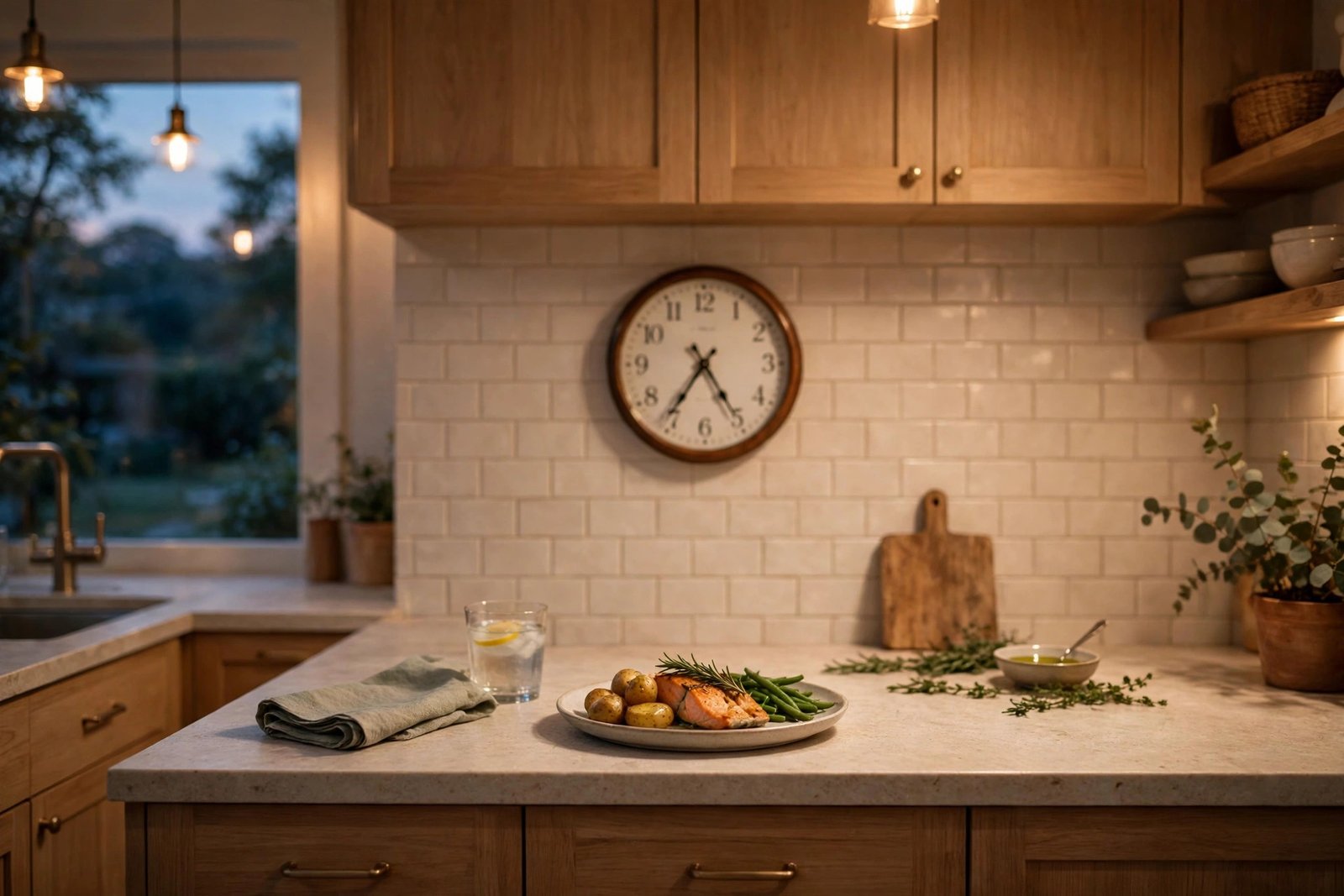
Does eating late at night cause weight gain? Mostly no, and partly yes. The calories matter most: if you eat the same number of calories, eating them late does not add weight on its own. But late eating makes weight gain more likely in real life, because it adds extra calories, raises blood sugar after the meal, and burns less fat overnight.
- In a 12-month trial of 139 adults, eating only from 8am to 4pm lost 8.0 kg against 6.3 kg for calorie restriction alone, a difference of 1.8 kg that was not significant (Liu et al., 2022).
- Eating dinner at 10pm instead of 6pm raised peak blood sugar by about 18% and cut overnight fat burning by about 10% (Gu et al., 2020).
- People who ate lunch after 3pm lost less weight and lost it more slowly than early lunch eaters, even with similar calories (Garaulet et al., 2013).
- Short sleep adds calories: sleeping about 1.2 hours more a night cut intake by about 270 calories a day (Tasali et al., 2022).
- Practical rule: finish dinner 2 to 3 hours before bed, and close the kitchen about 2 hours before bed.
Introduction
Most people who ask this question are really asking about one habit: eating after dinner, often in front of the television, often something sweet or salty, often when they are not really hungry. The question has two answers. The first is about physics: weight changes with calories. The second is about behaviour and hormones: the later you eat, the easier it is to eat too much, and the worse your body handles the food.
This post gives both answers, with the trial evidence for each, and then a practical cutoff that fits real life. If you want help with the habit itself, our guide on how to stop midnight snacking covers triggers, the kitchen routine, and what to do at 11pm when the craving hits.
The Calories Answer Comes First
Weight gain is driven by total calories over weeks and months. A calorie eaten at 10pm carries the same energy as a calorie eaten at 10am. Your body does not reset its energy balance at midnight, and there is no hour after which food turns into fat automatically.
The clearest test is the Liu trial from 2022. It took 139 adults with obesity and put them on calorie restriction for 12 months. One group also restricted eating to an 8-hour window, 8am to 4pm, so they finished eating early. The other group ate the same restricted calories across a normal day. After a year, the early-eating group had lost 8.0 kg and the other group 6.3 kg. The difference was 1.8 kg, and it was not statistically significant (P=0.11).
That finding matters, because it sets the size of the timing effect. If the clock alone made a large difference, a year-long trial with an 8-hour window ending at 4pm should have shown it. It did not. So if your calories are already under control, moving dinner an hour earlier will not change much.
What the Timing Studies Actually Show
Three smaller trials looked at what happens inside the body when the same meal is eaten early or late. They ran for days or weeks rather than months, so they cannot prove long-term weight change, but they agree with each other.
The Sutton trial from 2018 is the most striking. Eight men with prediabetes ate in a 6-hour window with dinner before 3pm, and then in a 12-hour control window, for 5 weeks each. The early window improved insulin sensitivity, beta-cell responsiveness, blood pressure, oxidative stress and evening appetite, all without any weight loss (Sutton et al., 2018). The food was the same; only the timing changed.
The Hutchison trial from 2019 tested the same idea in 15 men at risk of type 2 diabetes. They ate in a 9-hour window for 7 days, once early (8am to 5pm) and once delayed (12pm to 9pm). Time-restricted feeding improved glucose tolerance in both windows, but only the early window lowered mean fasting glucose (Hutchison et al., 2019).
The Gu trial from 2020 is the one that feels most like real life. Twenty healthy volunteers ate dinner at 10pm one week and at 6pm another week, with sleep fixed from 11pm to 7am. The late dinner raised peak blood sugar by about 18%, delayed the triglyceride peak, lowered free fatty acids and cut dietary fatty acid oxidation by about 10%, meaning about 10% less fat was burned overnight. Cortisol rose too. The effects were strongest in habitual early sleepers: their glucose was about 30% higher and their fat burning about 20% lower after the late dinner (Gu et al., 2020).
Then there is the Garaulet study from 2013, which followed 420 people through a 20-week weight-loss programme. Those who ate lunch after 3pm lost less weight and lost it more slowly than those who ate lunch earlier (P=0.002), even though the two groups ate similar calories, slept similar hours and had similar appetite hormones (Garaulet et al., 2013). It was observational, not a randomised trial, so it cannot prove that the late lunch caused the slower loss.
Put together, the picture is consistent: timing does not override calories, but it does change how the body handles food. Earlier eating lines up with higher insulin sensitivity, lower blood sugar after meals, and more fat burned overnight. Later eating does the opposite. The effect is modest, not magic, and it is strongest when the meal is large and close to bedtime.
Why Late Eating Adds Calories in Real Life
The trials above held calories equal, which is how science works. Real life does not hold calories equal. Late eating usually adds calories in three ways, and each one is easy to recognise.
First, the food is different. Late-night food is rarely a planned meal. It is biscuits, crisps, ice cream, toast with jam, or a takeaway ordered because the kitchen is closed and you are hungry. These foods are dense in calories and easy to eat quickly, and they are rarely logged. A bowl of ice cream is about 270 calories, a bag of crisps about 150, and two slices of toast with butter and jam about 250. Eat two of them and you have added 400 calories or more to a day that was otherwise on target.
Second, the portion is unmeasured. When you eat at the table, you serve a plate and stop when it is finished. When you eat on the sofa, there is no plate and no stopping point. The packet stays open, the bowl gets refilled, and the eating continues until the programme ends or the food runs out.
Third, alcohol is usually involved. A glass of wine is about 120 calories, a beer about 150, and alcohol lowers the restraint that keeps portions in check. It also makes you hungrier for salty and fatty food.
None of this means the clock is the villain. It means the clock is the setting where extra calories happen. If you eat a planned dinner at 9pm and nothing after it, the timing effect is small. If you eat dinner at 7pm and then snack through the evening, the extra food is the problem.
The Sleep Connection
Late eating and short sleep feed each other. Eating a large meal close to bedtime can make sleep worse, through reflux and a full stomach, and poor sleep makes you eat more the next day. The Tasali trial from 2022 tested this directly: 80 adults with a body mass index of 25.0 to 29.9 who slept under 6.5 hours a night were helped to sleep about 1.2 hours longer, and their calorie intake fell by about 270 calories a day (Tasali et al., 2022).
The mechanism is straightforward. Short sleep raises the hunger hormone ghrelin, lowers the fullness hormone leptin, and makes the brain more responsive to food cues, especially for sweet and fatty food. A tired person at 10pm is not making a rational food choice; they are responding to a brain that is asking for quick energy. Fixing the sleep often fixes the late eating. Our guide on whether lack of sleep causes weight gain covers this in detail, and our sleep cycle calculator works out the best bedtime for your wake-up time.
A Practical Cutoff That Fits Real Life
The evidence points to a simple rule: finish dinner 2 to 3 hours before bed, and close the kitchen about 2 hours before bed. If you sleep at 11pm, that means dinner finished by 8pm or 9pm, and nothing but water or herbal tea after 9pm. The rule is tied to your bedtime, not to a clock on the wall.
Three things make the rule work. First, make dinner filling enough that you do not need a snack: include protein, vegetables and a whole grain, and eat it at the table. Second, brush your teeth after dinner. It is a clear signal to your brain that eating is finished. Third, keep the evening snack food out of the house, or at least out of sight.
If you are genuinely hungry in the evening, eat something small and planned: a piece of fruit, a small yoghurt, or a handful of nuts. The rule is not “never eat after 8pm”. It is “do not eat an unplanned meal after dinner”. If the scale has stalled despite the cutoff, our guide to how to break a weight loss plateau covers the next steps.
A Worked Example: The Same Calories, Moved Earlier
Take the same person our other guides use: a woman aged 40, 165 cm tall, 85 kg, moderately active, burning about 2,436 calories a day, with a weight loss target of about 1,936 calories a day. Here is how her day looks when the calories are moved earlier, using our calories calculator to set the target.
| Meal | Time | Calories |
|---|---|---|
| Breakfast | 8am | 450 kcal |
| Lunch | 1pm | 600 kcal |
| Afternoon snack | 4pm | 336 kcal |
| Dinner | 7pm | 550 kcal |
| Total | 1,936 kcal |
The total is the same 1,936 calories, but the shape of the day is different. Breakfast and lunch carry most of the food, dinner is the smallest main meal, and there is nothing after 7pm. If she sleeps at 11pm, dinner finishes 4 hours before bed. If she moved the same calories later, eating a small breakfast, skipping lunch, and eating a large dinner at 10pm, the Liu trial says the weight loss would be similar. But the Gu trial says her blood sugar would be higher, her overnight fat burning lower, and her sleep worse.
What If You Work Nights?
Night-shift workers cannot follow a bedtime rule, because their bedtime is in the morning. The same principle still applies, just shifted: eat your main meal before the shift, eat a smaller meal in the middle of the shift, and avoid a large meal in the last 3 hours before you sleep. A big meal at 6am before a 7am bedtime is the night-shift version of a 10pm dinner, and it causes the same problems.
If you work nights, plan your meals the way day workers plan theirs: a main meal, a planned snack, and a clear stopping point. The clock on the wall does not matter. The gap between your last meal and your sleep does.
Frequently Asked Questions
Does eating late at night cause weight gain?
Mostly it is the calories, not the clock. In a 12-month trial, eating only from 8am to 4pm lost 8.0 kg against 6.3 kg for calorie restriction alone, a difference that was not significant. But late eating adds extra calories in real life, raises blood sugar, and burns less fat overnight.
What time should I stop eating at night?
Finish dinner 2 to 3 hours before bed, and close the kitchen about 2 hours before bed. If you sleep at 11pm, finish dinner by 8pm or 9pm, and drink only water or herbal tea after 9pm.
Does eating after 8pm make you gain weight?
No, not by itself. A planned meal at 9pm inside your calorie target will not make you gain weight. The problem is the unplanned snacks that usually follow it.
Is it better to eat a big breakfast or a big dinner?
A bigger breakfast and a smaller dinner fits the evidence better. Insulin sensitivity is higher in the morning, and early eating windows improved fasting glucose and insulin sensitivity in the Sutton and Hutchison trials.
Can I lose weight if I eat late every night?
Yes, if your total calories are below your target. The Liu trial found no significant difference between early and late eating windows at the same calories.
—
Sources
- Liu D, Huang Y, Huang C, et al. N Engl J Med. 2022;386:1495-1504. 139 adults with obesity, 12 months, time-restricted eating 8am to 4pm with calorie restriction vs calorie restriction alone; mean weight loss minus 8.0 kg vs minus 6.3 kg, net difference minus 1.8 kg (95% CI minus 4.0 to 0.4; P=0.11). https://pubmed.ncbi.nlm.nih.gov/35443107/
- Sutton EF, Beyl R, Early KS, et al. Cell Metab. 2018;27(6):1212-1221.e3. 8 men with prediabetes, 6-hour early window with dinner before 3pm vs 12-hour control, 5 weeks crossover; improved insulin sensitivity, beta-cell responsiveness, blood pressure, oxidative stress and evening appetite, without weight loss. https://pubmed.ncbi.nlm.nih.gov/29754952/
- Hutchison AT, Regmi P, Manoogian ENC, et al. Obesity. 2019;27(5):724-732. 15 men at risk of type 2 diabetes, 9-hour time-restricted feeding, early (8am to 5pm) vs delayed (12pm to 9pm), 7 days each, crossover; improved glucose tolerance (glucose iAUC P=0.001); only early TRF lowered mean fasting glucose (P=0.02). https://pubmed.ncbi.nlm.nih.gov/31002478/
- Gu C, Brereton N, Schweitzer A, et al. J Clin Endocrinol Metab. 2020;105(8):2789-2802. 20 healthy volunteers, randomised crossover, late dinner 10pm vs routine dinner 6pm, fixed sleep 11pm to 7am; higher glucose (peak about 18% higher), delayed triglyceride peak, lower free fatty acids and dietary fatty acid oxidation (about 10% less fat burned overnight), increased cortisol. https://pubmed.ncbi.nlm.nih.gov/32525525/
- Garaulet M, Gomez-Abellan P, Alburquerque-Bejar JJ, et al. Int J Obes. 2013;37(4):604-611. 420 people, 20-week weight-loss treatment; late lunch eaters (after 3pm) lost less weight and lost it more slowly than early eaters (P=0.002); similar energy intake and expenditure, sleep and appetite hormones. https://pubmed.ncbi.nlm.nih.gov/23357955/
- Tasali E, Wroblewski K, Kahn E, et al. JAMA Intern Med. 2022;182(4):365-374. 80 adults BMI 25.0 to 29.9, sleeping under 6.5 h a night, about 1.2 h more sleep, minus 270 kcal a day (95% CI minus 393 to minus 147). https://pubmed.ncbi.nlm.nih.gov/35129580/
- Weight Insider. How to stop midnight snacking, Does lack of sleep cause weight gain?, Sleep cycle calculator, Calories calculator, and How to break a weight loss plateau.
Last updated: 21 November 2026
Medical Disclaimer
This article is general information only. It is not medical advice, and it is not a substitute for advice from a qualified health professional. Talk to your doctor before changing your diet, especially if you have diabetes or any other health condition, or if you are pregnant or breastfeeding.