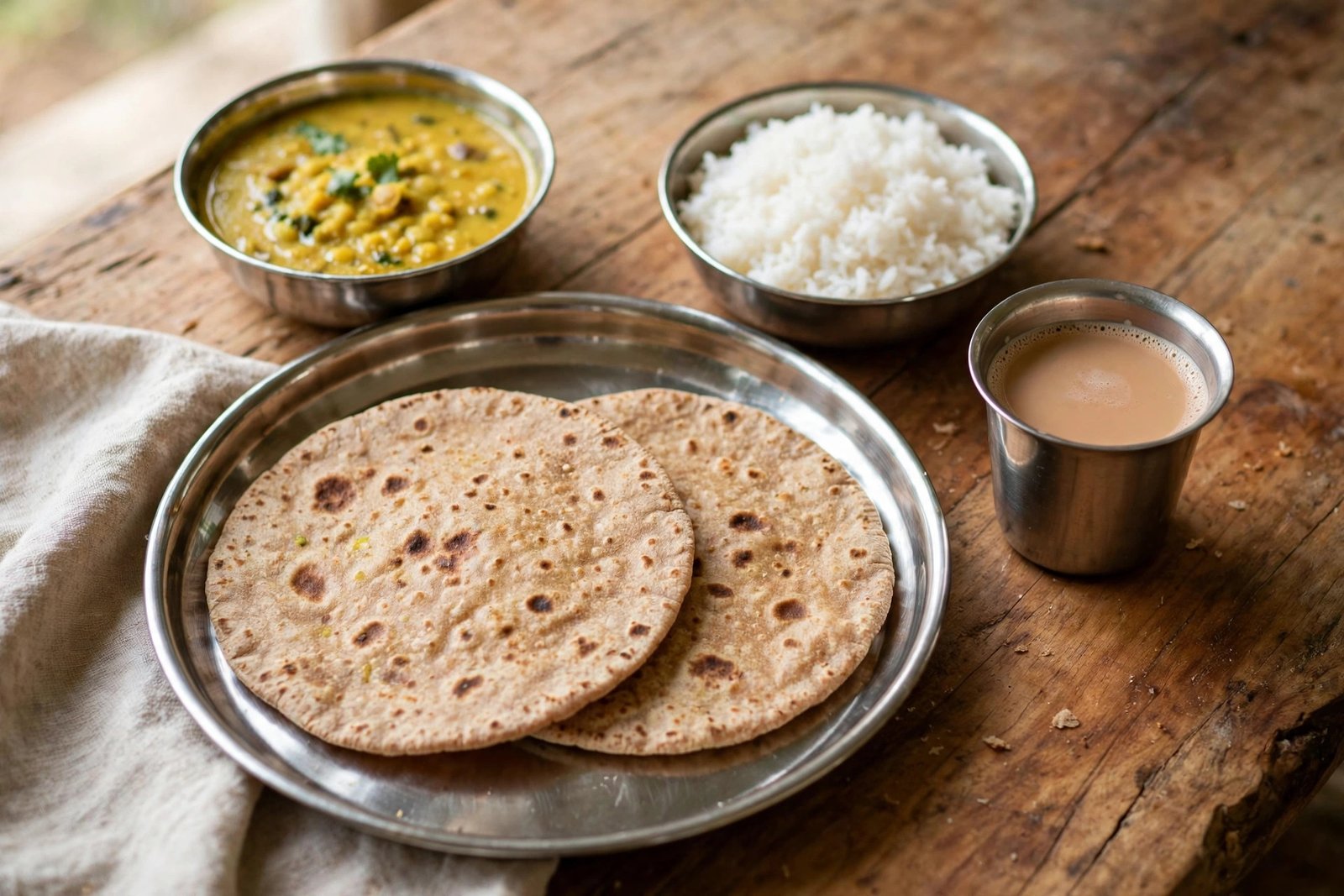
How many calories in roti, rice, dal and chai? One medium roti is about 120 calories, one katori of cooked white rice is about 195 calories, one katori of plain dal is about 100 calories, and one cup of chai with milk and sugar is about 70 to 100 calories. None of these foods is fattening on its own: the calories add up through portions, ghee, second helpings, and the biscuits that come with the chai. This post gives you one table with household portions, the three hidden traps, and a full sample day that fits a weight loss target.
- One medium roti (40 g) is about 120 calories. A smaller roti made from 25 g of atta is about 80 calories, which is why different charts disagree.
- One katori of cooked white rice (150 g) is about 195 calories, and one katori of plain dal is about 100 calories. Add a teaspoon of ghee to the dal tadka and it becomes about 145 calories.
- One cup of chai with milk and 2 teaspoons of sugar is about 70 to 100 calories. Three cups a day is about 210 to 300 calories, before any biscuits.
- Three Marie biscuits are about 66 calories, but three digestive biscuits are about 123 calories, and a whole small pack of Marie biscuits is about 220 calories.
- A full desi day, 2 eggs, 3 rotis, dal, curd, rice, paneer, 2 cups of chai and biscuits, adds up to about 1,475 calories, under a 1,936 calorie target.
The Table: Roti, Rice, Dal and Chai in Household Portions
Every number below is approximate, worked out from USDA FoodData Central and the Indian Food Composition Tables, and every portion is a household measure. A katori, the small steel bowl most homes serve dal, rice, and curd in, holds about 150 g. A medium roti is about 40 g, roughly 7 inches across. Your roti may be bigger or smaller, and your dal may have more or less oil, so treat these as close estimates, not lab measurements.
| Food | Portion | Calories | Protein |
|---|---|---|---|
| Roti / chapati | 1 medium, 40 g | about 120 | about 3 g |
| White rice, cooked | 1 katori, 150 g | about 195 | about 4 g |
| Dal, plain | 1 katori, from 30 g raw | about 100 | about 7 g |
| Dal, with tadka | 1 katori, 1 tsp ghee | about 145 | about 7 g |
| Paneer | 50 g, 4 to 5 cubes | about 133 | about 9 g |
| Egg, boiled | 1 medium | about 72 | about 6 g |
| Curd / dahi | 1 katori, 150 g | about 117 | about 6 g |
| Chai, milk and sugar | 1 cup, 180 ml | about 70 to 100 | about 2 g |
| Sweet lassi | 1 glass, 250 ml | about 199 | about 7 g |
| Samosa, fried | 1 medium, 60 g | about 174 | about 3 g |
Read the table as a planning tool, not a verdict. Dal is the best value on it: about 100 calories for about 7 g of protein, and it keeps you full for hours. Paneer is the most calorie-dense protein: about 133 calories for 50 g, so a small palm-sized portion is plenty, and a restaurant paneer butter masala can double the calories with cream and oil. Rice and roti are close in calories per portion, and the real difference between them is fibre and how easy they are to overeat. Our calories calculator can work out your daily target.
Why Two Charts Disagree on Roti
If you have ever looked up roti calories before, you have seen two answers: about 80 and about 120. Both are right, for different rotis. The 80 calorie figure comes from a roti made with about 25 g of atta, while the 120 calorie figure comes from the USDA tables for a medium 40 g roti. The difference is the size of the roti, not a mistake in either chart. A large roti, or one brushed with ghee, can reach 140 to 160 calories. The lesson is to know your own roti: small and thin, use 80; standard medium, use 120; large, use 140 or more. The same rule applies to rice: a heaped katori holds far more than a level one.
The Hidden Calorie Traps
The staples in the table are not the problem. The problem is the three things that ride along with them, uncounted, every day. Each one is small on its own, and together they can add 300 to 500 calories a day, enough to erase a weight loss deficit.
Trap 1: Ghee on the Roti
A teaspoon of ghee adds about 45 calories, and a tablespoon adds about 123 calories. Two rotis a day, each brushed with a teaspoon of ghee, adds about 90 calories a day, or about 630 calories a week. Over a month, that is about 2,700 calories, roughly a third of a kilogram of fat. Ghee is not a bad food, but it is pure fat, and it is the easiest calorie to add without noticing. If you want the flavour, use half a teaspoon, or save the ghee for the dal tadka, where one teaspoon flavours a whole katori, instead of brushing it on every roti.
Trap 2: The Second Chai, and the Third
One cup of chai is about 70 to 100 calories, depending on milk and sugar. Two cups is about 140 to 200, and three cups is about 210 to 300. A doodh patti, made with more milk and sugar, can reach about 120 calories a cup, so three of those is about 360 calories, all liquid, none of it filling. The sugar is the quiet part: 2 teaspoons is about 30 calories a cup, so cutting to 1 teaspoon saves about 15 calories a cup. The milk matters too: full-cream milk adds more than toned milk, and a cup made mostly with milk instead of water can be half a small meal. None of this means giving up chai. It means counting it: one cup in the morning and one in the afternoon, with 1 teaspoon of sugar, is about 140 to 170 calories, which fits easily.
Trap 3: Biscuits with Chai
Biscuits are the classic chai companion, and they are almost pure refined flour, sugar, and fat, with almost no protein or fibre. A Marie biscuit is about 22 calories, so three with your chai is about 66 calories. A digestive biscuit is about 41 calories, so three is about 123 calories. A cream-filled or chocolate biscuit is about 60 calories each, so three is about 180 calories. And a whole small pack of Marie biscuits, eaten without thinking, is about 220 calories. The fix is portion, not willpower: take 3 biscuits on a small plate instead of the pack, and put the pack away. Our macro calculator shows how quickly these extras add up, because biscuits are almost all carbohydrate and fat.
Three More Traps Worth Knowing
Paratha instead of roti is the first: a plain paratha is about 228 calories, nearly double a roti, and an aloo paratha is about 250 to 350 calories. If you eat paratha every day, count it as two rotis, not one. Sweet lassi instead of chaas is the second: a glass of sweet lassi is about 199 calories, while a glass of chaas is about 82 calories, so swapping saves about 117 calories a glass. Samosa is the third: one medium samosa is about 174 calories, so two at teatime is about 348 calories, more than a katori of dal and a roti together. A large naan is the biggest trap of all: about 550 calories, more than four rotis. None of these foods needs to be banned. They need to be counted.
A Sample Day That Fits a Weight Loss Target
Here is a full desi day built from the table, using the person our other guides use: a woman aged 40, 165 cm tall, 85 kg, moderately active, with a weight loss target of about 1,936 calories a day. Her protein target is about 102 g a day, from 85 kg times 1.2 g per kg. The maths is shown so you can swap foods in and out and keep the total.
Breakfast: 2 boiled eggs, about 144 calories, plus 1 roti, about 120 calories, plus 1 cup of chai, about 85 calories. That is 349 calories, with about 21 g of protein from the eggs and the roti. Lunch: 2 rotis, about 240 calories, plus 1 katori of dal with tadka, about 145 calories, plus 1 katori of curd, about 117 calories. That is 502 calories, with about 19 g of protein. Afternoon: 1 cup of chai, about 85 calories, plus 3 Marie biscuits, about 66 calories. That is 151 calories. Dinner: 1 katori of rice, about 195 calories, plus 1 katori of dal with tadka, about 145 calories, plus 50 g of paneer, about 133 calories. That is 473 calories, with about 23 g of protein. The day adds up to about 1,475 calories, with about 63 g of protein from these foods alone.
That leaves about 461 calories of headroom under her 1,936 target, which is the point. A full desi day does not need to be a small day: she could add a second katori of rice at dinner, about 195 calories, and a samosa as an evening snack, about 174 calories, and still be at about 1,844 calories, under target. Or she could add a glass of milk, a handful of nuts, or a second helping of dal. The foods are not the problem; the portions and the extras are. Check your own target with our protein intake calculator, because protein is the nutrient most desi days fall short on, and our glycemic index calculator can show how rice and roti choices compare.
Roti vs Rice: Which Is Better for Weight Loss?
Neither is better in any absolute sense: both are mostly carbohydrate, both are about the same calories per portion, and both fit into a weight loss plan. The differences are fibre, fullness, and how easy they are to overeat. A whole wheat roti has about 2 g of fibre, while a katori of white rice has less than 1 g, so roti keeps you full a little longer. Rice is easier to overeat, because a katori looks small and a second katori is easy to add without thinking, while a second roti is a visible, deliberate choice. Rice also pairs with more food: a plate of rice usually comes with more dal, more curry, and more oil than a plate of rotis. The practical answer is to eat the one you prefer and control the portion: 2 rotis or 1 katori of rice, not 4 rotis or 2 katoris of rice, and always fill half the plate with vegetables or salad first. Our guide to whether rice is good for weight loss covers the rice question in more detail.
How to Count Desi Food Without a Scale
You do not need a kitchen scale to count desi food, but you do need consistent measures. Use your katori for rice, dal, and curd: one level katori, not heaped, is about 150 g. Use your fist for rice: a fist-sized portion is about 1 cup, or about 200 calories. Use your palm for paneer: a palm-sized portion is about 50 g, or about 133 calories. Count rotis one by one, and know your own roti size: small is about 80, medium is about 120, large is about 140 or more. Count chai by the cup, and sugar by the teaspoon: 1 teaspoon is about 15 calories. And count biscuits by the piece, not by the pack: 3 Marie biscuits is about 66 calories, but a whole pack is about 220. Measure this way for one week, and you will know your usual day by heart. Level the spoon, count the katoris, and the numbers stay honest.
Frequently Asked Questions
How many calories in roti, rice, dal and chai?
One medium roti is about 120 calories, one katori of cooked white rice is about 195 calories, one katori of plain dal is about 100 calories, and one cup of chai with milk and sugar is about 70 to 100 calories. All values are approximate and depend on portion size.
How many calories are in 2 rotis and dal?
Two medium rotis are about 240 calories, and one katori of dal with tadka is about 145 calories, so the meal is about 385 calories. With plain dal instead of tadka, it is about 340 calories.
Is chai fattening?
One cup of chai is about 70 to 100 calories, which is not fattening on its own. Three cups a day is about 210 to 300 calories, and biscuits with chai add more, so the total across the day is what matters.
How many calories are in a samosa?
One medium fried samosa (60 g) is about 174 calories. Two samosas are about 348 calories, which is more than a katori of dal and a roti together.
Can I eat roti and rice while losing weight?
Yes. Both fit into a weight loss plan if the portions are controlled: 2 rotis or 1 katori of rice per meal, with dal, curd, and vegetables. A sample day in this post adds up to about 1,475 calories, under a 1,936 calorie target.
Sources
- Indian food calorie chart, GyanPark: values from USDA FoodData Central (FNDDS); 1 medium roti (40 g) about 120 kcal, 1 katori cooked rice (150 g) about 194 kcal, 1 katori dal about 218 kcal, 1 cup chai about 71 kcal, 1 samosa (100 g) about 310 kcal.
- Calories in roti, rice, dal, idli and poha, Yogyaahar: from IFCT 2017 and USDA; 1 medium roti (25 g atta) about 80 kcal, 1 bowl cooked white rice (150 g) about 195 kcal, 1 katori plain dal about 100 kcal, 1 teaspoon of ghee about 45 kcal.
- Calories in sweet lassi, DietGhar: 1 glass (250 ml) about 199 kcal, calculated from USDA values; chaas 1 glass about 82 kcal.
- Calories in paneer, CaleyeFit: 100 g about 265 kcal, 18 g protein, from USDA FoodData Central (FDC ID 1097995).
- Biscuit calories, ClearCals: 1 Marie Gold biscuit about 22 kcal, 1 McVitie’s Digestive about 41 kcal, a small pack of Marie Gold about 220 kcal.
- Weight Insider: Calories Calculator, Macro Calculator, Protein Intake Calculator, Glycemic Index Calculator, Is Rice Good for Weight Loss.
Medical Disclaimer
This article is for general information only and is not medical advice. It does not replace advice from your doctor or a qualified dietitian. If you have diabetes or another medical condition, talk to a health professional about your diet.
Last updated: 23 November 2026